Staking, and Why There Is None on This Chain
Staking pays you for securing a network. An L2 that settles to Ethereum and charges gas in ETH has nothing for you to secure.
Nothing filed under that yet.
A contract paying one dollar if something happens trades at the market's estimate of it happening. The gap between that and a forecast is where the money is.
Staking pays you for securing a network. An L2 that settles to Ethereum and charges gas in ETH has nothing for you to secure.
Two of three signatures to move anything. It solves theft and loss at once, and introduces a problem of its own.
Not a password. A number, written in a dictionary, from which every key you will ever have is derived.
Not the floor. The honest valuation is the best bid, adjusted for what makes your specific item different.
Minting is a function call that assigns you a token id. Everything expensive about it is decided before anyone clicks.
Written into metadata, honoured by marketplaces, and invisible to the token standard. That gap is the whole story.
It is the cheapest ask, not a valuation. One listing moves it, and nobody has to buy anything.
The loan is easy. Staying in it through a bad week is the part that takes arithmetic, and the arithmetic is not the one most people run.
Someone is paying to borrow, and knowing who tells you what happens when they stop.
Having the tracker and the buy button on one screen removes a delay and a safeguard at the same time.
Most failures are not the bot. They are a transaction that could not execute, and each cause has a different fix.
Four numbers, and the one most people get wrong is the first one the interface asks for.
The interface offers everything at once, which is the problem. Five steps in a fixed order turn it into a filter.
Discovery, holder clustering, a safety scan and a buy button on one screen. The fee is for the screen, not for the price.
An alert on every token you looked at is a notification stream. Three rules make the difference between a tool and wallpaper.
A free endpoint over an indexer built from raw chain logs. The limits are rate limits, and the gap is everything about holders.
The formula subtracts burned supply and nothing else. Which is why market cap and FDV are usually identical here, and occasionally are not.
A boost does not put a token on the trending list. It multiplies a score the token already had, for twelve to twenty-four hours.
Five of the inputs are onchain. Two are not, and those two are the reason trending is not a measure of trading.
The bonding-curve launchpad travelled everywhere. What differs between them is the fee split, the threshold and who the fee pays.
A bot that buys in the first block is not a strategy. It is an arms race with an entry fee, against people who have already paid more.
The deployment is trivial and cheap. Everything that decides whether it works happens before and after, and none of it is on the platform.
The creator walked away and the holders kept trading. A CTO formalises that, and the thing it moves is the revenue.
Most coins never get there. The ones that do change from one market structure into a completely different one, in a single transaction.
A share of trading goes to whoever deployed the coin. That one rule changed what a launch is for.
One trader shows nearly five million in profit on a twelve-dollar median trade. That single row explains what the ranking measures.
Following a feed and mirroring a wallet are different products. One shows you a trade; the other takes it for you while you sleep.
Legit is the wrong word for a trading app. Four narrower questions actually decide whether it is safe for you to use.
A social feed with a buy button, on two chains, on web and phone. The design decides how you will use it more than you do.
A leaderboard number is a claim. Five adjustments separate it from what the wallet actually made, and they usually point the same way.
DCA converts timing risk into time. It does nothing about the asset being worthless, which is the risk that actually applies here.
A strategy that takes small repeated profits needs costs smaller than the profits. Onchain, that arithmetic almost never survives contact.
Supply that arrives on a date is the most predictable selling pressure in crypto, and it is published in advance.
Renouncing removes the owner's powers permanently. It also removes the ability to fix anything, and it does nothing about the largest risk.
A hard rug steals. A soft rug just leaves. Every safety check you run catches the first one and none of them catch the second.
Fee income, divergence loss, time in range and gas. Three of them can be estimated in advance, and the fourth ruins small positions.
You put in half and half. You take out whatever the price left behind, plus fees you have to claim separately.
One design gives you a fungible receipt. The other gives you a unique position. The difference decides what you can do with it afterwards.
Six steps, and the two that decide the outcome happen before you click anything.
A large balance is evidence of a large balance. Whether it means anything about the next trade is a separate question, and usually the answer is no.
Everyone sets up alerts. Almost nobody survives the second week, because the setup was designed to catch everything.
The ratio assumes you know where you get out. On a DEX with no stop loss, half the formula is missing – and it is the half that matters.
There are four ways, they are not equally available, and only one of them is what most people are attempting.
A green score means no known pattern was found. That is a much smaller claim than the colour suggests.
One address explains more about a launch than the chart, the site and the Telegram combined. It is public, and almost nobody opens it.
Deposit one asset into a range the price has not reached yet, and the pool converts it for you – charging the buyer instead of you.
The advertised yield is the last thing to look at. Four numbers above it decide whether the position works.
The words get used interchangeably and they pay you from completely different places. Knowing which one you are doing tells you what can go wrong.
A narrow range earns more per dollar and stops earning sooner. The trade is not complicated, but almost nobody prices both halves of it.
A tokenized treasury is a short government loan with no credit question. Everything else in the bond market has one, and it changes the product.
The highest yields in RWA come from the part with no public market, no daily price and no easy exit. That is not a coincidence.
Gold sits in a vault. Oil does not sit anywhere convenient, which is why almost every oil token is a fund and not a barrel.
An ETF is already a basket you do not hold directly. Tokenizing it adds a second layer, and the second layer is where the differences live.
Two tokens can both say one ounce and mean completely different things. The difference is in the redemption clause nobody reads.
Picking the wallet is the part everyone does. The three settings underneath it are what actually determine your result.
The advertised fee is the smallest of the four. Here is the full stack, and the size at which it stops working.
Most strategies are a list of indicators. This one is four decisions made before you open the chart, because afterwards you will not make them.
The pattern is boring and repeatable. Four things happen in order, and three of them are visible before the last one.
Two hundred holders in the first minute is not two hundred people. Here is how to tell which one you are looking at.
One shows you what people are doing and leaves the decision with you. The other takes the decision away. That difference is the entire product.
A busy Telegram is not demand. Four things separate a community from a room that was paid to look like one.
Every list of real-world-asset tokens mixes three unrelated things. Sorting them takes one question, and most lists never ask it.
The same ticker exists on several chains as several different instruments. What you can do with it depends entirely on which one you bought.
Yes, and the three routes give you very different things – one of which is not a share at all.
Two things share the name. One is a category of products settling real value; the other is a basket of tokens that move on announcements about it.
Tokenizing a building solves settlement. What real estate is short of is buyers, and those are different problems.
Government debt wrapped in a token. The least exciting corner of crypto and the one holding most of the real-world value onchain.
Four parties, one legal wrapper and a contract. The chain is the least complicated part of it, which is why the interesting risks are all off-chain.
Real-world assets is a category with one enormous member, a few working ones and a long tail of announcements. Knowing which is which is the whole subject.
Not a brand on a box. A specific set of choices about who orders transactions, where the data goes, and what you are trusting when you bridge in.
Volume is how much traded, not how many wanted to. Two wallets with a script can produce a week of it in an afternoon.
The swap itself is two clicks. Everything that decides whether it was a good one happens on the screens around it.
A token's name and ticker are text anyone can copy. The address is the only part that cannot be faked, which is why every safety check starts there.
The hard answer first, because the people promising a softer one are running the second scam.
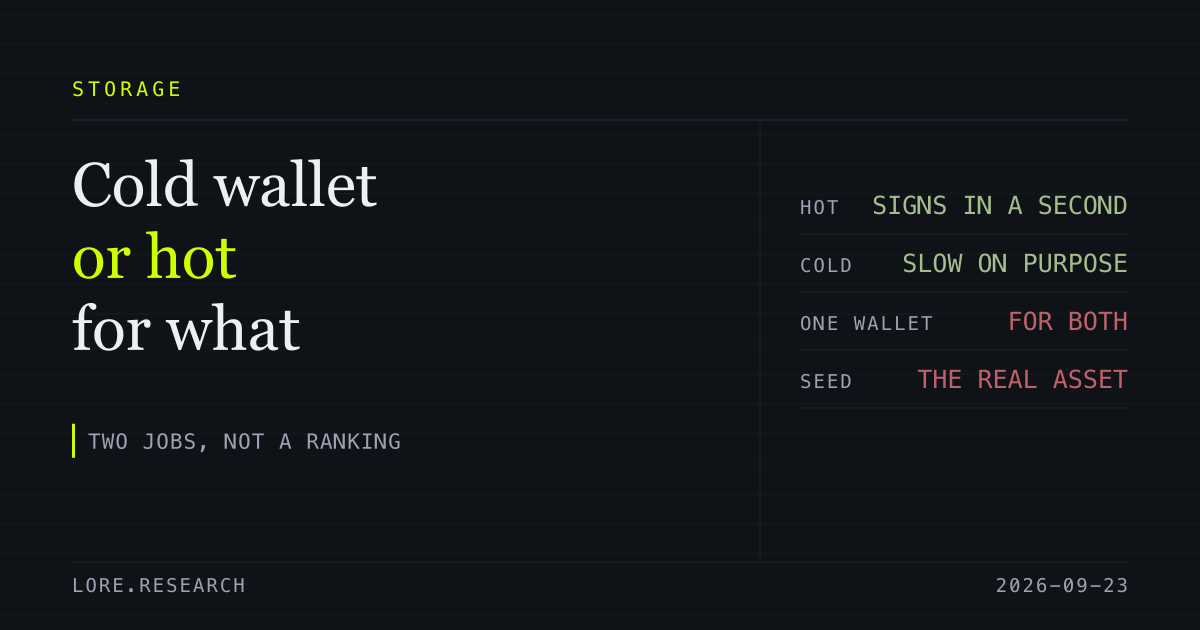
Not a security ranking. Two different jobs, and using one for the other is where most of the pain comes from.
Nobody guesses a seed phrase. They get you to approve something, on a page that looks exactly like the one you meant to open.
Not a penalty and not a margin call you can answer. A contract closing your position automatically, at a price you could have calculated before you opened it.
A stablecoin below a dollar is not automatically broken, and it is not automatically a discount. Telling those apart is a small number of checks.
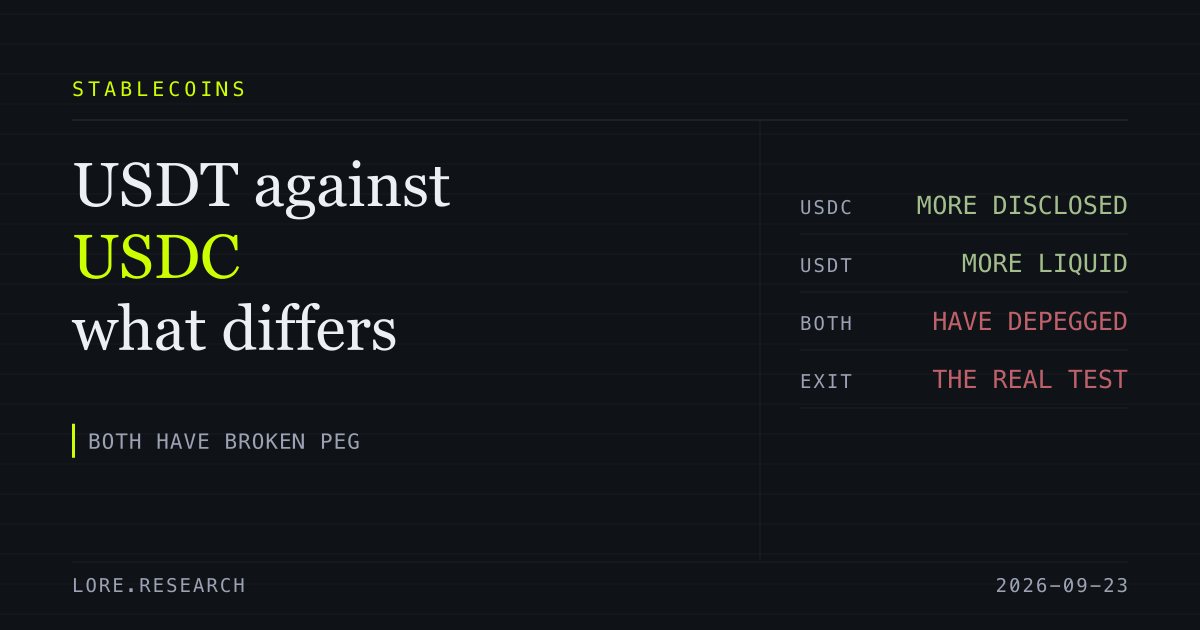
Both are worth a dollar until the day one of them is not. The difference is what stands behind the dollar, and who you can ask about it.
The opportunity is real and it is measured in milliseconds. By the time a price difference is visible on a screen, it has been taken.
It searches every pool for the best route and splits your trade across them. That is worth real money on a large order and worth nothing on a small one.
Every swap asks for permission to move a token, and most of those permissions are unlimited and permanent. They stay live long after the trade is done.
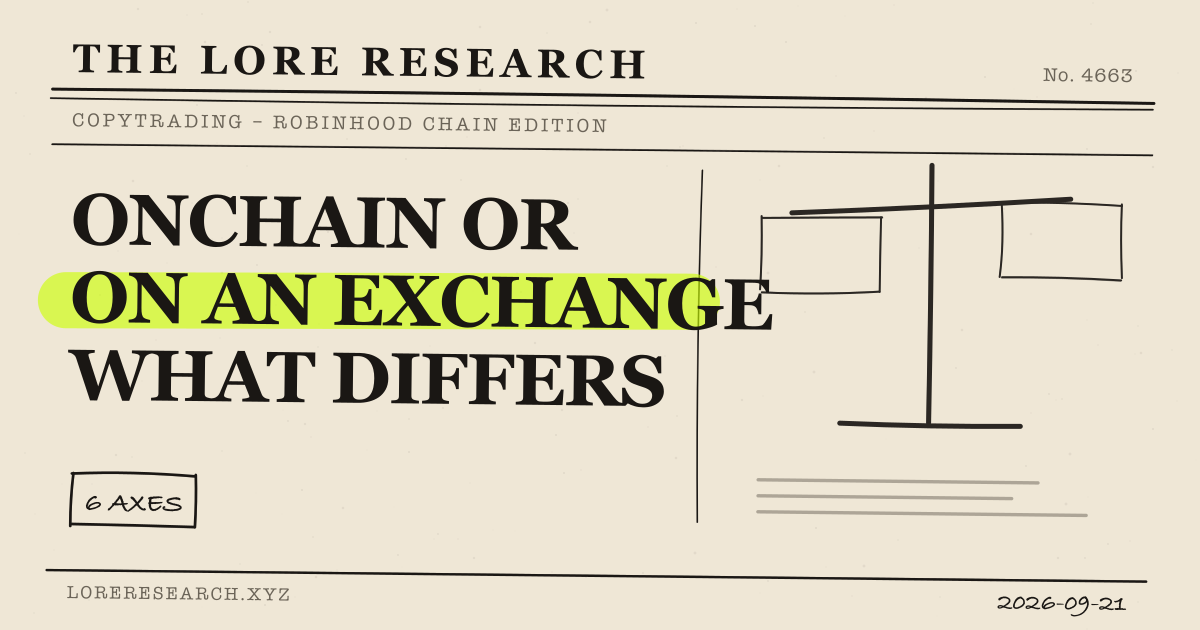
Both connect to the same chains and hold keys the same way. The difference is a single screen, and it is the screen where money is lost.
The trade after a loss is the most dangerous one you will place, because it is not aimed at the market. It is aimed at the last trade.
Fear of missing out is not a character flaw, it is a predictable response to watching a number rise. It is also the single most reliable way to buy the top.
One counts what exists, the other counts what will exist. When they are far apart, the gap is a schedule of future selling with your name on the other side.
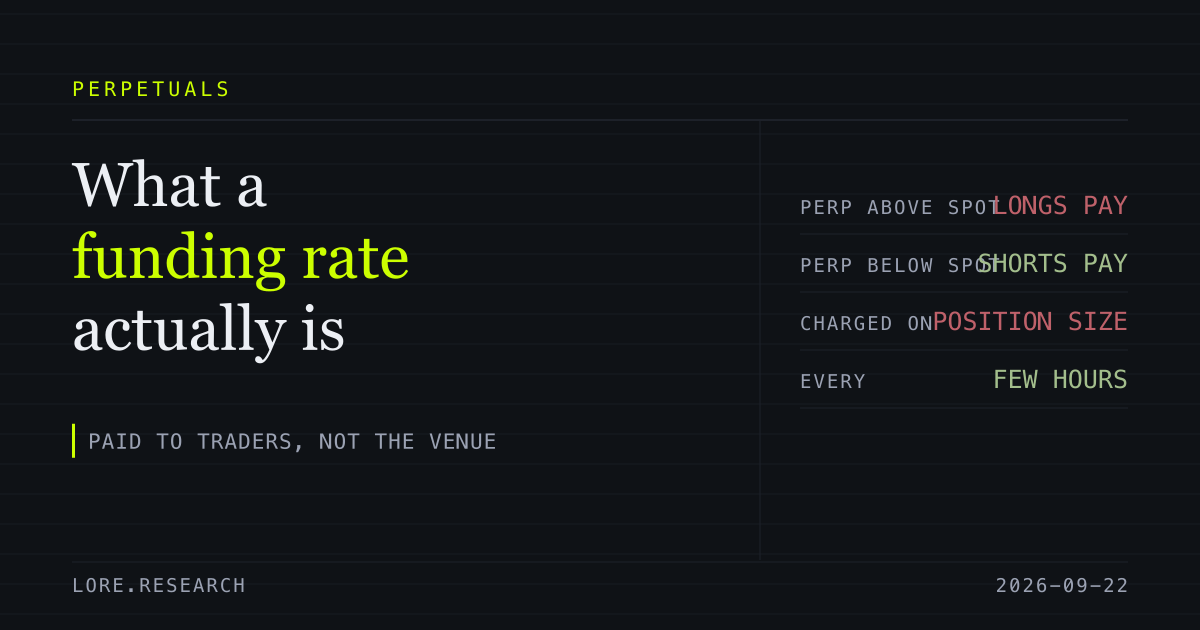
A perpetual has no expiry, so something has to keep it tethered to spot. That something is a payment between traders, every few hours, and you are on one side of it.
There is no order book and nobody matching buyers to sellers. Every trade you make onchain is against a contract holding two piles of tokens, and somebody owns those piles.
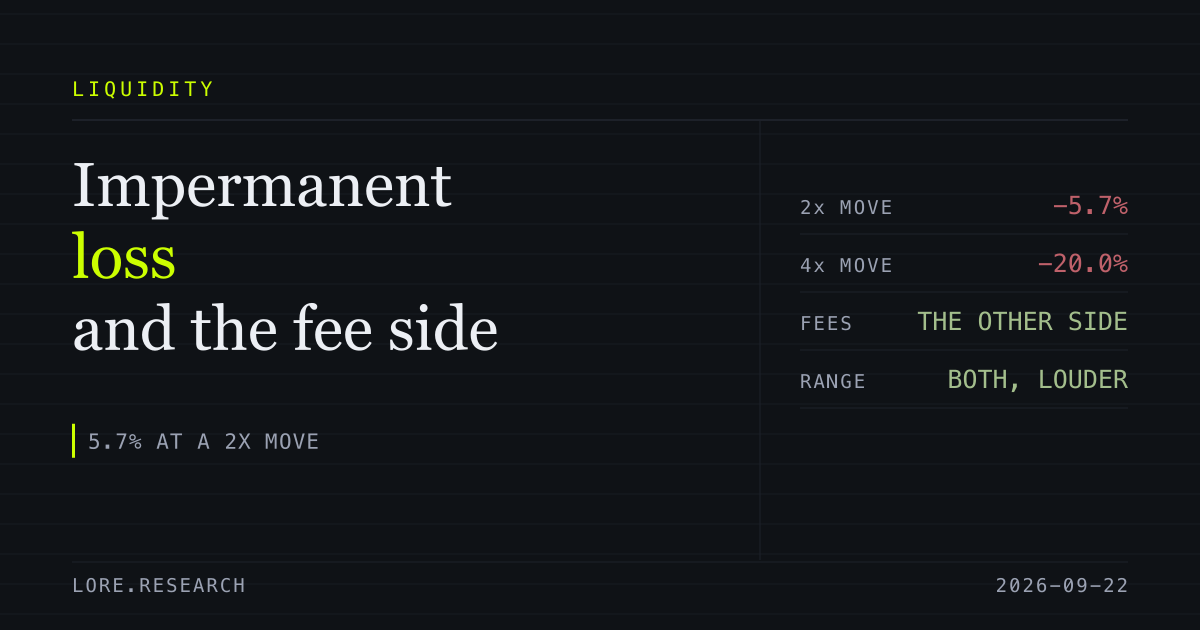
Not a fee and not a hack – arithmetic. Providing liquidity pays you in trading fees and charges you for the price moving, and only one of those is visible while it happens.
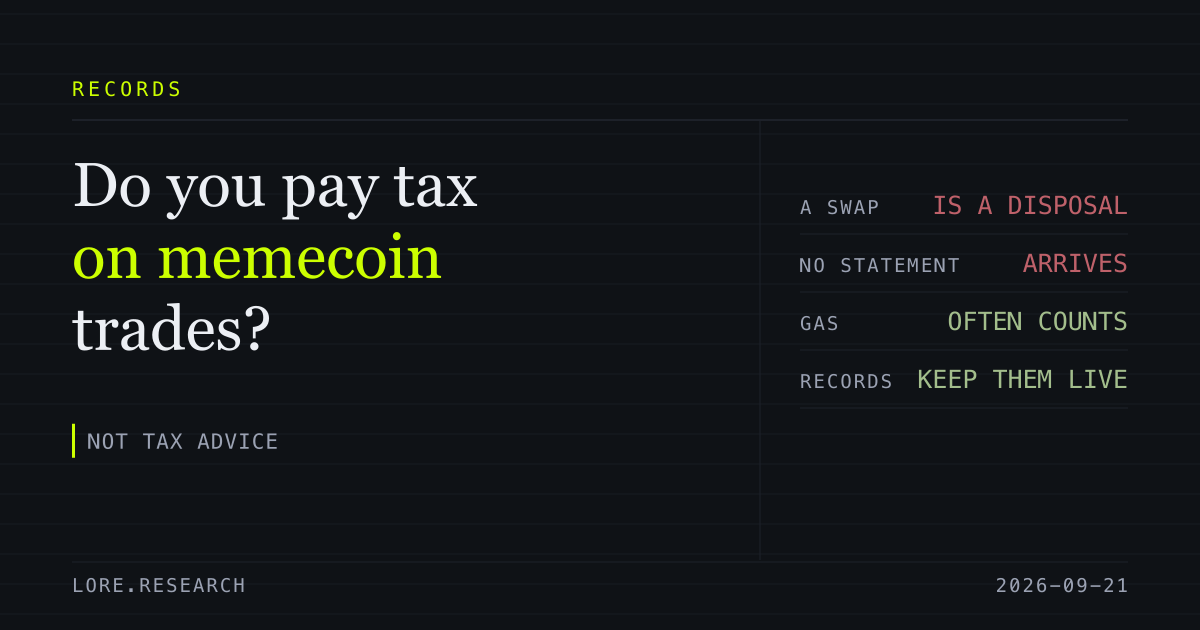
Not advice, and not jurisdiction-specific. A description of which onchain actions tax authorities generally treat as events, and what records you will need if yours does.
The chain already logs every transaction you made. What it cannot log is why you made it, and that is the column the journal exists for.
There is no demo account on a DEX. Here is how to practise anyway – and the one thing simulation can never teach you.
Selling all at once needs you to be right about a moment. Selling in pieces only needs you to be roughly right about a range – which you might be.
A two-minute check that rules out one specific way of losing everything – and leaves several others completely untouched.
Not a hacker and not a bug. A category of profit that exists because somebody chooses the order of transactions – and on this chain, that somebody is not an open auction.
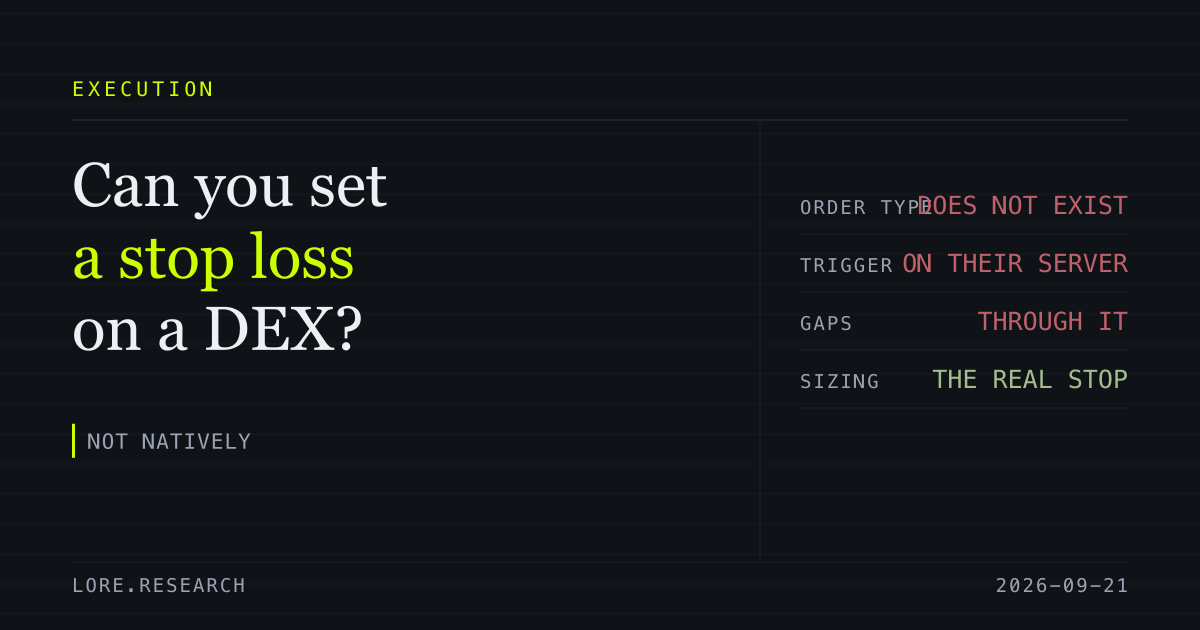
There is no such order type on an automated market maker. What terminals sell you instead is a robot watching a price – which is useful, and is not the same thing.
The columns are easy to read and easy to misread. Here is what each one is measuring, and the three it cannot measure at all.
Two things share a name and almost nothing else. One shows you a verified track record you cannot check; the other shows you everything and vouches for nobody.
Choosing who to follow is the part everyone covers. This is the wiring – the settings that decide whether copying a good wallet makes you money.
Six things to set up before the first buy, in the order that stops the common mistakes.
A wallet that made money is not the same as a wallet that knows something. Telling them apart is the whole skill.
Nothing gets the money back. Several things stop the next hour being worse than the last one.
A token you can buy and cannot sell. The tell is in the contract, and it is readable in about a minute.
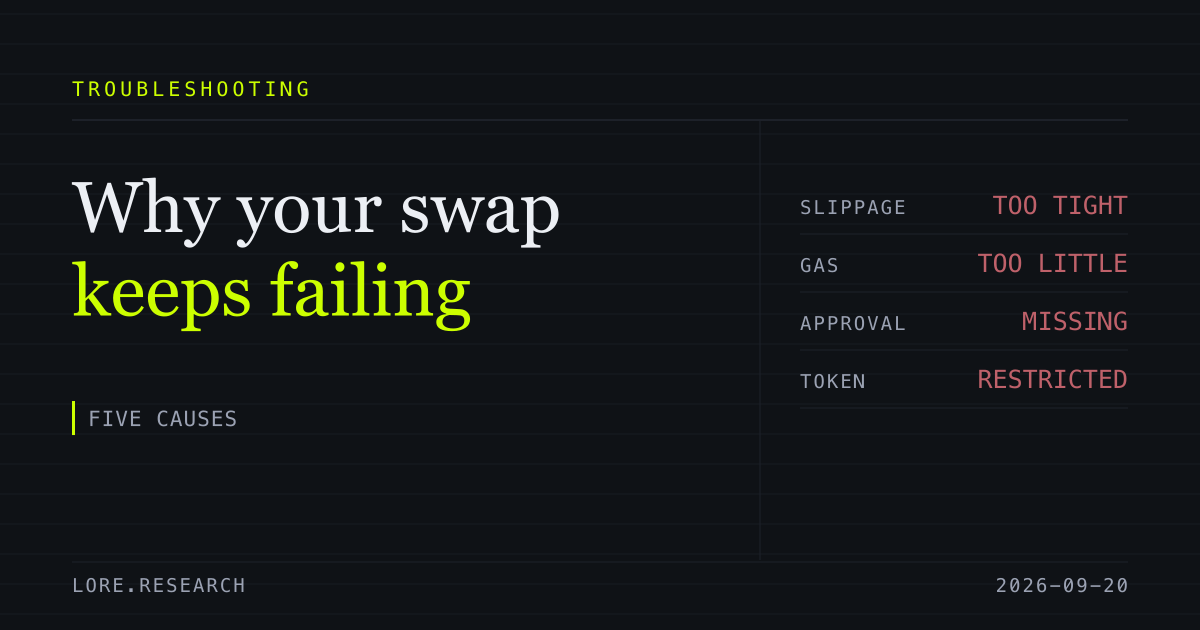
A failed swap is the chain refusing a trade on terms you set. Five reasons cover almost all of them.
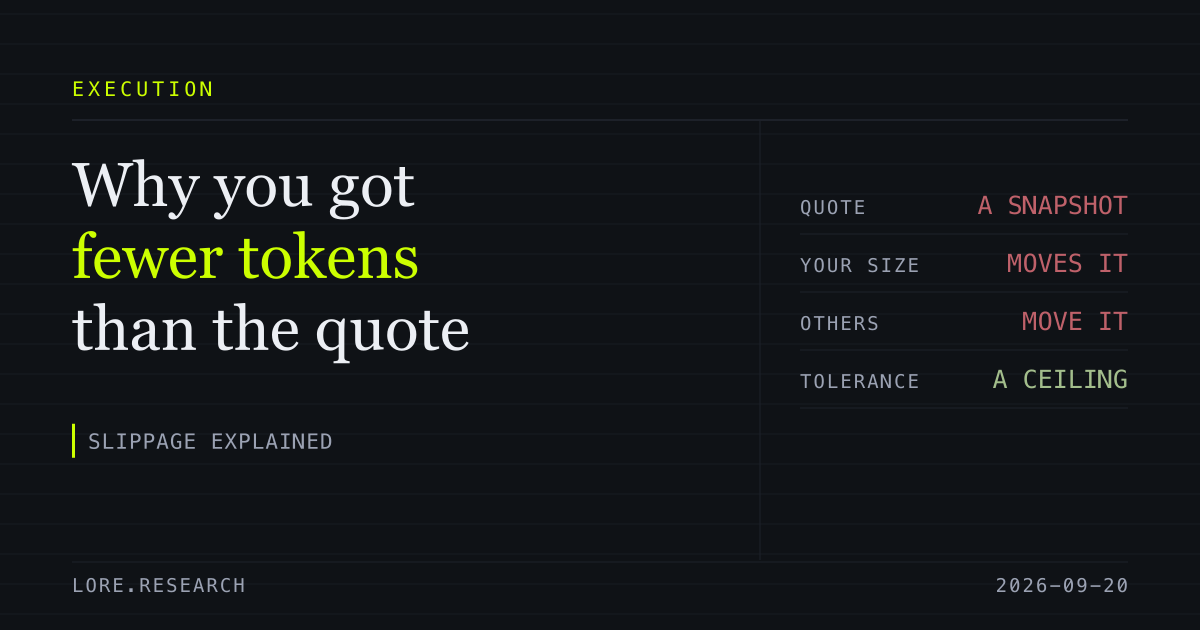
The quote is a prediction about a pool that other people are also trading. Three things move it before your transaction lands.
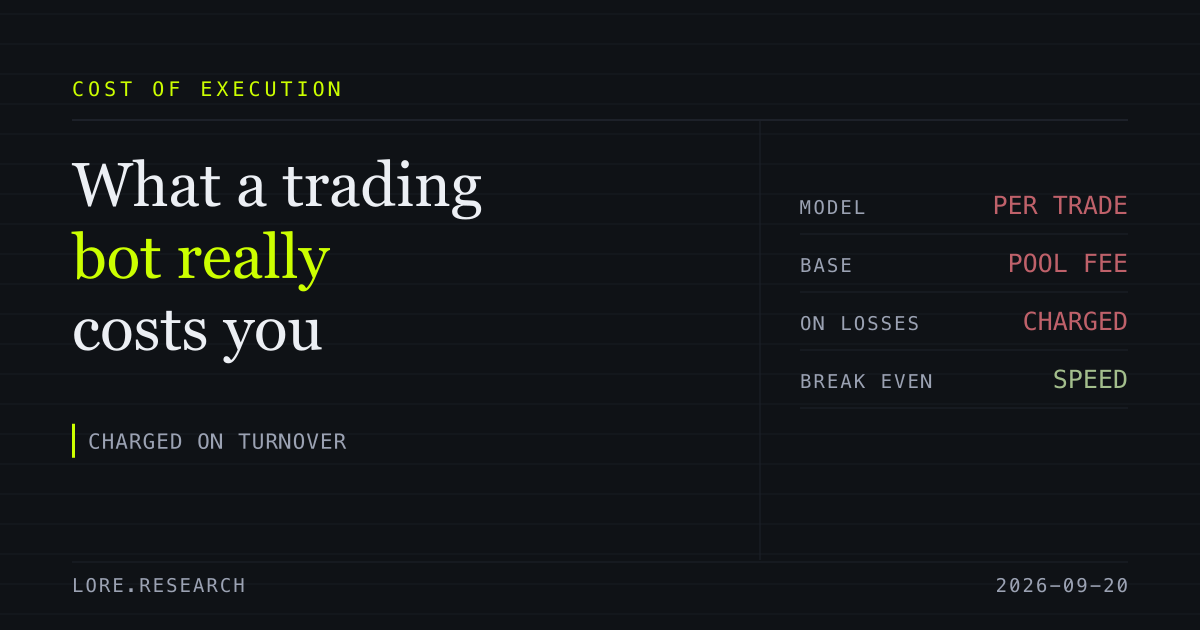
The fee is a percentage of turnover, not of profit. That distinction decides whether a bot is cheap or ruinous for you.
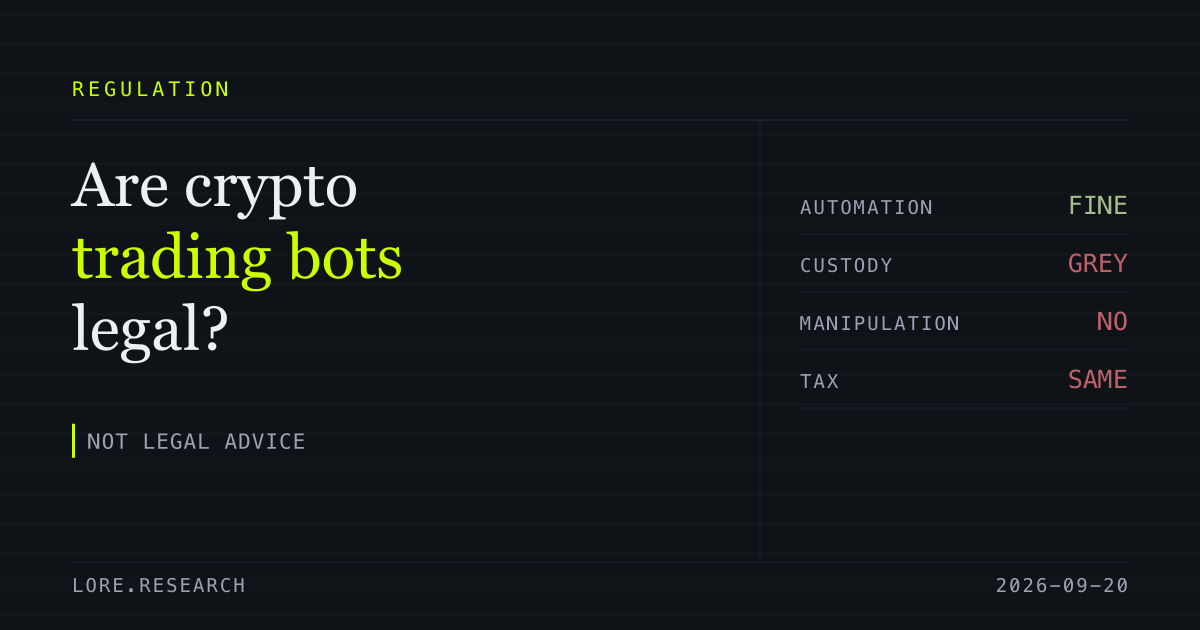
Automating your own trades is not the part regulators care about. Three other things are.
Two completely different products share the name. One works and is boring. The other mostly does not.
Most of them are real products that do what they advertise. That is not the question people are actually asking.
Investing implies a value to estimate and a reason to hold through a drawdown. One of those exists here. The other has to be replaced by something.
Your wallet shows balances, not results. Four things a portfolio view will get wrong, and what to record instead.
Leverage, shorting and the only instrument here that pays when something falls. Also the fastest way to be right and still lose everything.
Two assets with almost nothing in common, in one wallet, on one chain. How to size them so the volatile half cannot decide the outcome.
Continuous access to an asset whose market closes is not the same as a continuous market. Four things behave differently, and one of them is you.
Same chain, same wallet, no bridge. The mechanics work – whether the hedge does depends on a correlation most people assume rather than check.
Three different liquidity mechanisms sit behind the same buy button, and they behave differently on size, on spread and at three in the morning.
The token trades all weekend. The price feed, the supply and the underlying market do not. Three mismatched clocks, and the gap they open.
No cash arrives and your balance never changes. One number moves instead, and it explains why the token's price sits above the share price.
Not a share. A debt security of a Jersey company, backed 1:1 and carrying none of the rights a shareholder has. The structure decides everything downstream.
Entries get all the attention and exits decide the result. Three rules written before the position opens, because none of them can be written during it.
Liquidity decides what your exit costs, and it is the number people check last. Four readings that take a minute and change position size.
Narratives leave traces on-chain before they reach a feed. Four places the trace shows up, and how to tell a real one from a rented spike.
Four passes, in order, with the tool for each. Built so the expensive checks happen before you are emotionally committed to a position.
Six questions that separate a chain with real activity from one with a marketing budget. Answerable in an hour, mostly from public dashboards.
Not randomness. A repeatable machine made of attention, in-group signalling and a supply of tickets priced at almost nothing.
No liquidity provider, no order book, no price to set. The contract is the counterparty, and the maths is public before you buy.
Some launches route the trading fee to the people holding the token rather than to whoever deployed it. What that changes, and what it does not.
A share of every trade, for as long as the token trades. What the splits are, how the money reaches you, and what happens when you walk away.
Four venues, four different deals on fees, liquidity and what you keep. The choice is made before you type a ticker.
Four separate charges hide inside one swap. Add them up and the answer changes which tool you should be using.
Being first is expensive and usually wrong. The cases where speed genuinely earns its cost, and the cheaper entry most traders should take instead.
Fifteen seconds of holder analysis removes more bad trades than any indicator. What concentration, clustering and the deployer's position actually tell you.
The distribution is not normal, so the usual sizing rules give the wrong answer. A method that survives a run of zeros without giving up the outliers.
A memecoin quoted against NVDA or TSLA is not a normal memecoin. Two price drivers, a stranger impermanent-loss profile, and a risk nobody prices correctly.
Not a discipline problem. Four structural features of how these markets work take money from the average participant before any decision is made.
One rents someone else's research at a fixed price. The other charges you in time instead of fees. The honest comparison on cost, control and what you learn.
Copying a named account and copying an anonymous wallet are different trades. One gives you accountability, the other gives you a clean record.
Leaderboards rank by total profit, which is mostly size and luck. Five checks that separate a repeatable edge from one lucky position.
Copytrading pays you the leader's return minus four deductions. Here is what each one costs, and the win rate a wallet needs before following it makes money.
TVL, DEX volume, launch activity and wallet PnL – where each number actually lives.
190+ tokenized equities trading around the clock – and one thing you are not buying.
Day-one partners, the launchpad wave, and the AI-agent layer nobody expected.
A 23,669% APR and a 4.6% APY are both on this chain. Only one of them means what it says.
CASHCAT, stock-paired tokens and 167,000 launches. What actually happened, and how people trade it.
Uniswap took the chain on day one. Arcus, Lighter and Rialto each took a slice it could not.
Blockscout is the default. Arkham, Phalcon and HoodScan each solve a problem Blockscout does not.
The canonical Arbitrum route, the fast third-party bridges, and the mistake that strands most first-time users.
Wallet selection decides your return. Every tool below is downstream of that one choice.
Six terminals, one liquidity layer. What you are actually paying for is the data around the trade.
PONS runs the volume. The interesting ones are the stock-paired launchpads that exist nowhere else.
Three ways to provide liquidity, and the one number that decides whether any of them worked.
Dexscreener for breadth, chain-native screeners for speed, Blockscout for the truth.
Four checks, in order, that take ninety seconds and prevent most avoidable losses.
The five fields you need, where to get them safely, and which RPC provider to use when the public one is not enough.
Native support, manual setup, and the one wallet feature that prevents most drains.
80,000 secondary sales, four collections that defined the run, and where to look for the next one.
What the chain is, what you can actually do on it, and the five things that go wrong first.
One of these has tokenized equities. That is the entire argument, and it is a strong one.
The chain has no token. That does not mean there is nothing to farm – it means you farm the apps.