Graduation: What Happens When a Coin Leaves the Curve
Most coins never get there. The ones that do change from one market structure into a completely different one, in a single transaction.
The short answer
Graduation is the moment a bonding-curve coin reaches a set threshold and its accumulated liquidity moves into a normal pool on a DEX. Before it, price is a formula and every buyer is buying from the curve. After it, price is set by a two-sided market, and the whole character of the trade changes.
A coin on a bonding curve is not trading in a market. It is transacting with a formula: the price rises as supply is bought and falls as it is sold, and there is no counterparty because the curve always quotes. Graduation is the moment that ends.
What the threshold does
The platform sets a level – usually expressed as an amount raised or a market capitalisation – and when the curve reaches it, the accumulated proceeds are deployed as liquidity into a pool on a decentralised exchange. The token then trades there like anything else.
The exact threshold and the fee taken at graduation change over time and differ by platform, so read the current documentation rather than a figure from a thread.
Why the trade is different afterwards
On the curve, you can always sell, at a price the formula guarantees. It might be a low price, but the bid exists by construction. That is a genuinely unusual property and it disappears at graduation.
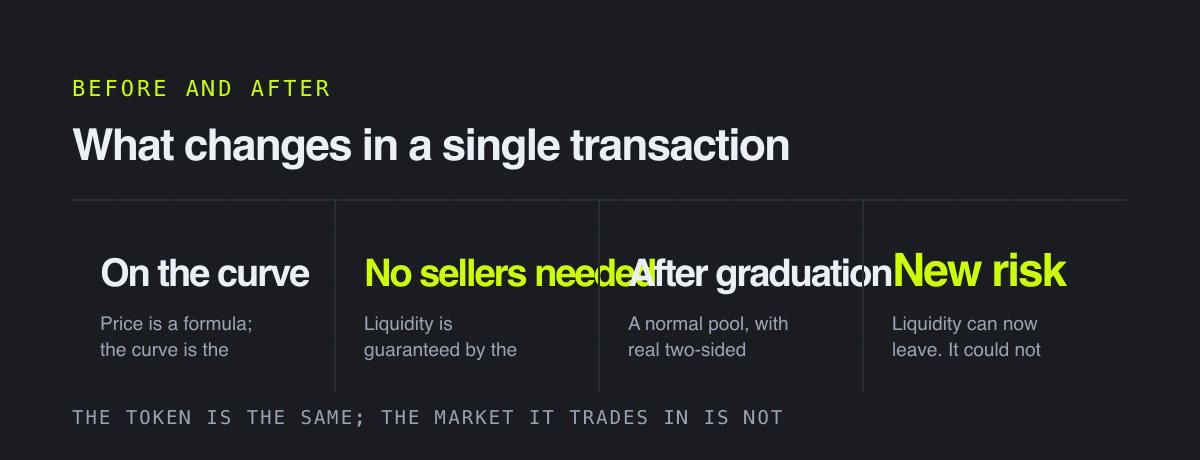
| On the curve | After graduation | |
|---|---|---|
| Price set by | A formula | A two-sided market |
| Can you always sell | Yes, at the formula's price | Only if liquidity remains |
| Liquidity can be removed | No | Yes, by whoever holds it |
| Depth | Defined by the curve | Whatever was deployed, plus anyone else |
| Who you trade against | The curve | Other traders and providers |
Most coins never graduate
This is the part that gets lost in the excitement about the ones that do. The overwhelming majority of coins launched on a curve never reach the threshold, stall partway, and stop trading. The graduation rate is a small number and it is the base rate for everything else on the platform.
Which makes curve progress a useful thing to read before buying: a coin at ten percent of the threshold is a very different proposition from one at ninety, and the distance remaining is the amount of new money required for the thing you are hoping for.
What to do around the event
- Read curve progress before entering. It tells you how much buying is still required.
- Expect volatility at the transition itself – market structure changing is a real event, not just a milestone.
- After graduation, check whether the deployed liquidity is locked, because for the first time that question applies.
- Re-run the holder checks. Concentration that did not matter against a curve matters against a pool someone can drain.
The same structure exists on Robinhood Chain –  PONS runs a curve with a graduation, and
 hood.fun publishes its own mechanics including the supply on the curve and the threshold. The vocabulary transfers; the numbers do not.
FAQ
What does graduation mean on Pump.fun?
That a coin's bonding curve reached its threshold and the accumulated liquidity was deployed into a pool on a decentralised exchange. The token then trades in a normal two-sided market instead of against a formula.
What percentage of coins graduate?
A small one. The overwhelming majority of bonding-curve launches stall before the threshold and stop trading, which makes the graduation rate the base rate to keep in mind for any single launch.
Is a coin safer after it graduates?
Different, not safer. On the curve you can always sell at the formula's price and liquidity cannot be pulled. After graduation liquidity is real, which also means it can be removed – so the liquidity-lock question starts applying at exactly that moment.
What is bonding curve progress?
How far the coin has moved toward its graduation threshold. It is a direct measure of how much further buying is required for the event most holders are waiting for, which makes it more informative than the price alone.
More from the blog
Prediction Markets: A Price That Looks Like a Probability
A contract paying one dollar if something happens trades at the market's estimate of it happening. The gap between that and a forecast is where the money is.
Staking, and Why There Is None on This Chain
Staking pays you for securing a network. An L2 that settles to Ethereum and charges gas in ETH has nothing for you to secure.
Multisig: Removing the Single Point of Failure
Two of three signatures to move anything. It solves theft and loss at once, and introduces a problem of its own.