NFT Royalties: A Payment Almost Nothing Enforces
Written into metadata, honoured by marketplaces, and invisible to the token standard. That gap is the whole story.
The short answer
A royalty is a percentage of each secondary sale paid to the creator. The token standard has no mechanism to enforce it – marketplaces choose whether to honour it, and a transfer that happens outside a marketplace pays nothing. That is why royalty income collapsed when marketplaces started competing on fees.
The pitch for NFTs to creators was recurring income: sell a piece once, earn a percentage every time it changes hands afterwards. The mechanism that was supposed to deliver it does not exist at the level people assumed, and understanding where it does live explains everything that happened next.
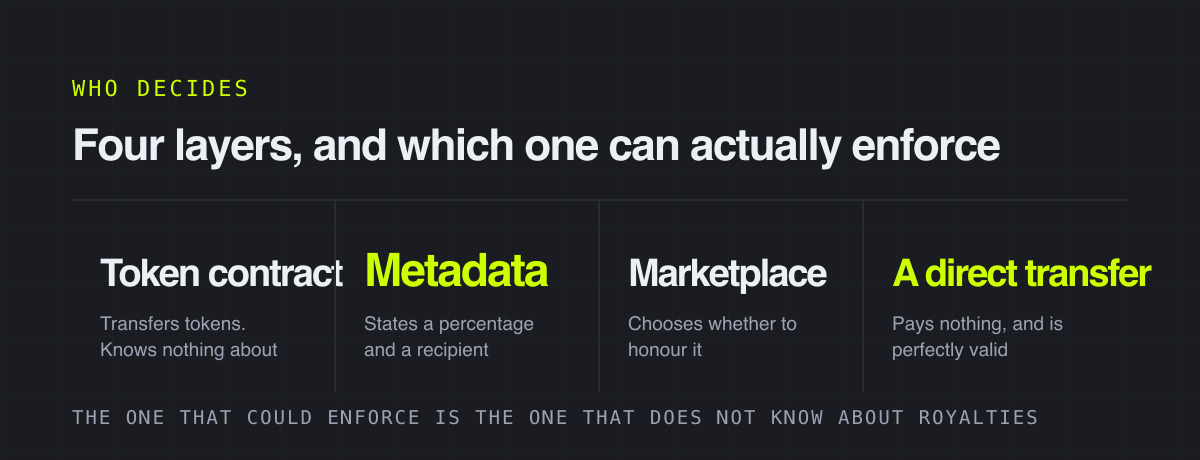
Where a royalty actually lives
Not in the token standard. An NFT contract's job is ownership and transfer, and a transfer function that checked for a royalty payment would break every legitimate movement that is not a sale – a gift, a move between your own wallets, depositing into a contract.
So the royalty is published as information: a percentage and a recipient, which a marketplace can read. Honouring it is the marketplace's decision, made in its own settlement code.
Why marketplaces stopped
Competition. A marketplace that skips the royalty offers sellers a better net price than one that does not, which is a straightforward advantage in a market where sellers choose the venue. Once one does it, the rest follow or lose the flow.
Creators responded with contract-level attempts: blocking transfers to marketplaces that do not pay, and restricting which contracts may hold the token. These work, and they work by making the asset less transferable – which is a genuine cost paid by the holder for the creator's income.
| Approach | Enforces? | Cost |
|---|---|---|
| Metadata royalty | Only if the venue chooses to | None, and no guarantee |
| Transfer blocklist | Mostly | The asset becomes less freely transferable |
| Allowlisted operators | Yes, within the list | Holder loses venue choice |
| Wallet-to-wallet transfer | Never | None – it is a normal transfer |
What this means if you are minting
Price the primary sale as though secondary royalties will be zero, because they might be. Treat any royalty income as upside rather than as the business model, and if the income genuinely matters, understand that enforcing it means restricting where holders can trade – and say so before they buy.
What it means if you are buying
- Check whether the collection enforces royalties at contract level, because that decides where you can sell.
- Read the stated percentage and whether the venue you intend to use honours it. It comes out of your proceeds.
- A collection with enforcement has a smaller set of exits than one without – fewer venues than OpenSea alone. That is a liquidity fact, not a moral one.
- Verify who receives the royalty on
 Blockscout Explorer. It is a published address and it is occasionally not the person you assume.
Royalties are the clearest example of a crypto promise that depended on social convention rather than code. It held for a while because everyone benefited from pretending otherwise, and stopped holding the moment one venue found it profitable to notice.
Tools mentioned
FAQ
How do NFT royalties work?
The collection publishes a percentage and a recipient address in its metadata, and a marketplace reads that and pays it out when it settles a sale. The token contract itself has no role in it.
Are NFT royalties enforceable?
Not by the token standard. Honouring them is each marketplace's choice, and a direct wallet-to-wallet transfer pays nothing at all. Collections that want enforcement have to restrict which contracts can move the token.
Why did NFT royalties stop being paid?
Competition between marketplaces. A venue that skips the royalty gives sellers a better net price, which attracts the flow – so once one did it, the others followed or lost volume.
Should a creator rely on royalty income?
No. Price the primary sale as though secondary royalties will be zero and treat anything received as upside. Enforcing them is possible but costs holders the freedom to trade anywhere, which is a real trade-off to disclose.
More from the blog
Prediction Markets: A Price That Looks Like a Probability
A contract paying one dollar if something happens trades at the market's estimate of it happening. The gap between that and a forecast is where the money is.
Staking, and Why There Is None on This Chain
Staking pays you for securing a network. An L2 that settles to Ethereum and charges gas in ETH has nothing for you to secure.
Multisig: Removing the Single Point of Failure
Two of three signatures to move anything. It solves theft and loss at once, and introduces a problem of its own.