Robinhood Chain Token Screeners: What Each One Actually Surfaces
Dexscreener for breadth, chain-native screeners for speed, Blockscout for the truth.
The short answer
For Robinhood Chain, Dexscreener is the default screener — charts, pairs, liquidity, buy/sell pressure and a filterable new-pairs feed. GeckoTerminal and DEXTools cover the same ground with different data quirks. Chain-native screeners — STONKSCAN, RobinScreener and RobinHood Trending — index the chain directly and surface pairs faster, with stock-token reference prices that multichain tools miss. Blockscout's token list is the rawest signal of all: a contract appears there before any screener indexes it.
A screener answers one question: what is trading right now that was not trading an hour ago. Everything else it shows is secondary. On Robinhood Chain you have three tiers of answer, and they trade off speed against coverage.
The multichain default
Dexscreener is where most people start. Real-time charts, pair explorer, liquidity, buy and sell pressure, and a new-pairs feed you can filter by liquidity, age and volume. The filter is the point — the raw feed on this chain is thousands of tokens a day and unusable without one.
GeckoTerminal, CoinGecko's DEX layer, covers pools with chart, transaction, liquidity and volume fields and adds a rug-checker tool with its own security score. DEXTools offers charts, pair scores and safety indicators with the chain selectable in-app.
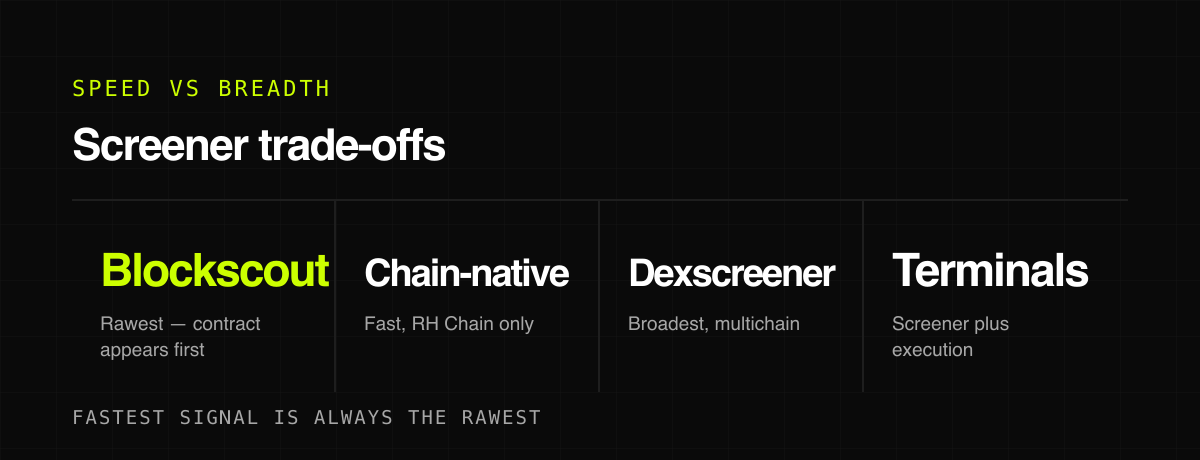
The chain-native tier
A set of screeners built only for Robinhood Chain appeared within weeks of launch. Their advantage is indexing latency and chain-specific fields that multichain tools do not model.
- STONKSCAN — real-time screener with live pairs, charts, trades and swaps.
- RobinScreener — price, transactions, volume, liquidity, pair age, holders and, importantly, stock-token reference prices.
- RobinHood Trending — tracks market cap, volume and trend on chain tokens.
- HoodScan — token rankings by trending activity, holders, volume and price, with a gas tracker attached.
The stock-token reference price field is the one worth caring about. On a chain where tokenized equities trade at weekends, knowing the gap between an on-chain price and its reference is a screener column, not a research project.
The raw tier
Blockscout's token list shows every ERC-20, ERC-721 and ERC-1155 deployed on the chain. A contract appears there the moment it is deployed — before it has a pool, before a screener has indexed it, before anyone has tweeted about it.
Screener plus execution
Terminals — GMGN, Axiom, Nock Terminal, BasedBot — bundle a screener with a buy button. For trading new launches that combination matters, because the tab switch between screener and swap is where the trade goes.
For research rather than execution, a standalone screener is cleaner and usually free.
How to use one without getting farmed
- Filter on liquidity first. Below a floor, the chart is theatre.
- Check the age-versus-volume ratio — implausible volume on a minutes-old pair is usually wash trading.
- Open the contract on Blockscout and confirm it matches what the screener claims.
- Run a safety scan before you act on anything a trending list showed you.
- Remember trending lists are a lagging indicator by construction. If it is trending, the first move already happened.
Building a filter that removes 99% of the noise
An unfiltered new-pairs feed on this chain is unusable — thousands of entries a day, almost all of them worthless. The filter is the product; the feed is just plumbing.
- Minimum liquidity. Set a floor below which you simply never look. This removes the overwhelming majority of entries in one step.
- Minimum age. A few minutes of trading filters out the pure bundle-and-dump launches that never reach a second block of organic flow.
- Buy-to-sell ratio. Heavily skewed one way on a young pair usually means one actor on both sides.
- Holder count against volume. High volume with few holders is wash trading, close to definitionally.
- Exclude the ones you already checked. Most screeners let you hide a pair. Use it, or you will re-evaluate the same rubbish hourly.
What a screener cannot tell you
A screener shows price, liquidity and flow. It does not show intent. Every metric it displays can be manufactured by someone with two wallets and a small budget, and on a chain with near-free gas that budget is very small.
This is why the screener is a discovery layer and never a decision layer. What it produces is a shortlist. What turns a shortlist into a position is contract verification, permission checks and holder clustering — none of which live in a screener.
Alerts beat browsing
Sitting in front of a feed is the least effective way to use these tools, because the moments that matter are short and unpredictable. Alerts on specific conditions — liquidity added above a threshold, a tracked wallet buying, a token crossing a market-cap level — convert the tool from something you watch into something that watches for you.
Set fewer alerts than feels right. An alert stream you ignore is worse than no alerts, because it trains you to dismiss the one that mattered.
 Dexscreener
 GeckoTerminal
 DEXTools
 HoodScan
 Nock Terminal
 BasedBot
 Axiom
Axiom GMGN
GMGNFAQ
What is the best Robinhood Chain token screener?
Dexscreener for breadth and filtering, chain-native tools like STONKSCAN and RobinScreener for indexing speed and stock-token reference prices, and Blockscout's token list for the earliest raw signal.
How do I find new tokens the moment they launch?
Use a launch radar or a filtered new-pairs feed with alerts on liquidity added above a threshold. Blockscout shows the contract even earlier, though without any filtering.
Do screeners show stock-token premiums?
Chain-native ones do. RobinScreener includes stock-token reference prices, and StalkChain runs a dedicated Stock Premium Tracker. Multichain screeners generally do not model this.
Are these screeners free?
Dexscreener, GeckoTerminal, Blockscout and most chain-native screeners are free. Terminals that bundle execution charge a per-trade fee instead.
More from the blog
How to Find a Wallet Worth Copying on Robinhood Chain
Leaderboards rank by total profit, which is mostly size and luck. Five checks that separate a repeatable edge from one lucky position.
Is Copytrading Profitable? The Arithmetic Nobody Runs First
Copytrading pays you the leader's return minus four deductions. Here is what each one costs, and the win rate a wallet needs before following it makes money.
Copytrading vs Trading Yourself: Which Actually Suits You
One rents someone else's research at a fixed price. The other charges you in time instead of fees. The honest comparison on cost, control and what you learn.