Robinhood Chain Airdrop Farming: What's Actually Farmable
The chain has no token. That does not mean there is nothing to farm — it means you farm the apps.
The short answer
Robinhood Chain itself has no announced token, so chain-level airdrop farming is speculative. What is farmable is the application layer: launchpads paying creator rewards, protocols running points and incentive programmes, agent platforms distributing token allocations, and lending markets with temporary subsidies such as Ethena's USDe incentive on Morpho. The honest framing is that you are farming individual apps with real usage, not a guaranteed chain airdrop.
Start with the uncomfortable part: Robinhood Chain has not announced a token, and Robinhood is a publicly listed brokerage with a compliance posture that makes a retroactive user airdrop an unusual thing to expect. Anyone telling you to farm the chain for a guaranteed drop is guessing.
What does exist is a dense application layer that is actively paying users, which is a different and more honest opportunity.
Launchpad creator rewards
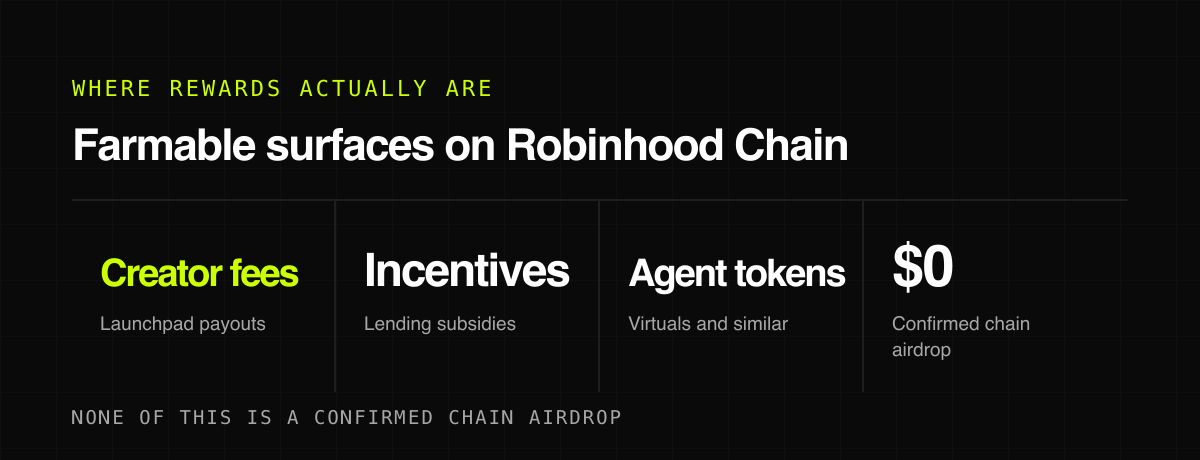
The launchpad layer competes on payouts, and the numbers are public. PONS has paid out over $5 million in creator earnings. BasedOneX opened $50,000 in creator rewards for graduating tokens. Bankr has paid $612,000+ to builders. Launchhood runs a 50% fee share for creators. Flap reports $594,000+ in cumulative dividends.
This is not farming in the airdrop sense — it is revenue share for launching tokens people trade. It rewards being good at distribution, not at wallet cycling.
Protocol incentive programmes
Temporary subsidies appear constantly on a chain this young. The clearest example: Ethena ran a programme paying roughly 4.5% directly to USDe posted as collateral in Robinhood Chain Morpho markets — a bootstrapping subsidy, not USDe's normal yield.
These are farmable in the ordinary sense: supply the asset, collect the subsidy, and watch for the programme ending. They are also the least risky category here, because you are paid in something liquid rather than in a promise.
The agent layer
Virtuals became a leading agent-token launchpad on the chain with 2,400+ agent launches, and ran a trading competition with Binance Wallet carrying a 60,000 USDG prize pool. Quiver Protocol's Season 1 distributed 10 million tokens through AI-managed liquidity vaults. Grid Arena opened referrals for its Season Zero.
This is the most speculative category and the most actively distributing. Treat allocations as lottery tickets with a real cost of participation.
If you are going to do it anyway
- Farm things you would use regardless. Genuine usage survives sybil filters; scripted cycling usually does not.
- Count the cost. Gas is cheap, but a hundred small transactions across a dozen apps is still real money plus real time.
- Track what you did. Retroactive criteria are announced after the fact, and you cannot prove activity you did not record.
- Keep farming wallets separate from holdings. You are signing many unfamiliar contracts by design.
- Do not assume a chain token. Farm the apps that are paying now.
The realistic read
The highest expected value on this chain is not airdrop farming. It is being early to a genuinely new instrument — tokenized equities in DeFi — before the tooling and the strategies around it are commoditised. That window is open now and is not obviously priced.
What a sybil filter actually catches
Teams designing a distribution have the full chain history and no deadline. The patterns they look for are not subtle.
- Funding graphs. Twenty wallets funded from one source, in similar amounts, at similar times, is one wallet wearing twenty hats.
- Behavioural uniformity. Identical transaction sequences across wallets, at identical intervals, is a script.
- Dust activity. Minimum-size interactions across many protocols with no economic purpose reads exactly as what it is.
- Timing clusters. Activity that starts the day a points programme is announced and stops the day it ends.
The consistent finding across previous distributions is that concentrated genuine usage outperformed spread-out farmed usage, and that the filters got better each cycle rather than worse.
Counting the real cost
Farming feels free because gas is cheap. It is not free. Each interaction carries gas, a spread if it involves a swap, and the opportunity cost of capital parked in a protocol paying less than the alternative. Across a dozen protocols over months, that is a real number.
Then there is the risk nobody prices: every protocol you interact with is another contract holding an approval from your wallet. Farming maximises exactly the exposure that causes most losses in this industry.
The alternative use of the same effort
The chain's genuinely novel surface is tokenized equities as composable DeFi collateral, with stock-paired tokens and weekend premium dynamics that exist nowhere else. That is an area where understanding compounds and where almost nobody has built expertise yet.
Farming an unannounced airdrop is a bet that someone else will decide to pay you. Learning an instrument before it is commoditised is a bet on yourself. On a chain this young, the second has better odds and it does not expire.
 PONS
PONS Morpho
FAQ
Is there a Robinhood Chain airdrop?
No token has been announced for the chain itself. Robinhood is a publicly listed brokerage, which makes a retroactive user airdrop an unusual expectation. What is real is the application layer paying creator rewards, incentives and agent-token allocations.
What is worth farming on Robinhood Chain?
Launchpad creator revenue share, temporary protocol incentives such as lending subsidies, and agent-platform token distributions. All are app-level, not chain-level.
Is it too late to farm Robinhood Chain?
For the first-cohort advantage, yes — that closed in July 2026. Application-level incentive programmes are still running and new ones launch regularly.
How do I avoid being sybil-filtered?
Use the applications the way a real user would, keep activity concentrated in a small number of wallets rather than spread across many, and prefer protocols you would use without an incentive.
More from the blog
How to Find a Wallet Worth Copying on Robinhood Chain
Leaderboards rank by total profit, which is mostly size and luck. Five checks that separate a repeatable edge from one lucky position.
Is Copytrading Profitable? The Arithmetic Nobody Runs First
Copytrading pays you the leader's return minus four deductions. Here is what each one costs, and the win rate a wallet needs before following it makes money.
Copytrading vs Trading Yourself: Which Actually Suits You
One rents someone else's research at a fixed price. The other charges you in time instead of fees. The honest comparison on cost, control and what you learn.