Liquidity Mining, Yield Farming and Staking Are Three Things
The words get used interchangeably and they pay you from completely different places. Knowing which one you are doing tells you what can go wrong.
The short answer
Staking pays you from a protocol's own issuance for securing or locking. Liquidity mining pays you in a token the protocol prints, on top of trading fees, to attract deposits. Yield farming is the umbrella term for chasing whichever of those is highest. The differences decide what happens when the incentive stops.
Three terms, used as synonyms in almost every guide, describing three arrangements that fail in different ways. The useful question behind all of them is the same and it is rarely asked out loud: who is paying me, and what makes them stop.
Staking
You lock a token, and the protocol pays you in that token for doing so. On a proof-of-stake network this is payment for securing the chain and the money comes from issuance and transaction fees. Elsewhere it is often payment for reducing circulating supply, which is a different thing wearing the same word.
The risk is usually straightforward: the price of what you locked, and whether you can unlock when you want to.
Liquidity mining
You deposit into a pool and earn two things: a share of trading fees, and a stream of a token the protocol issues specifically to attract deposits like yours. The second part is the mining, and it is marketing spend denominated in a token.
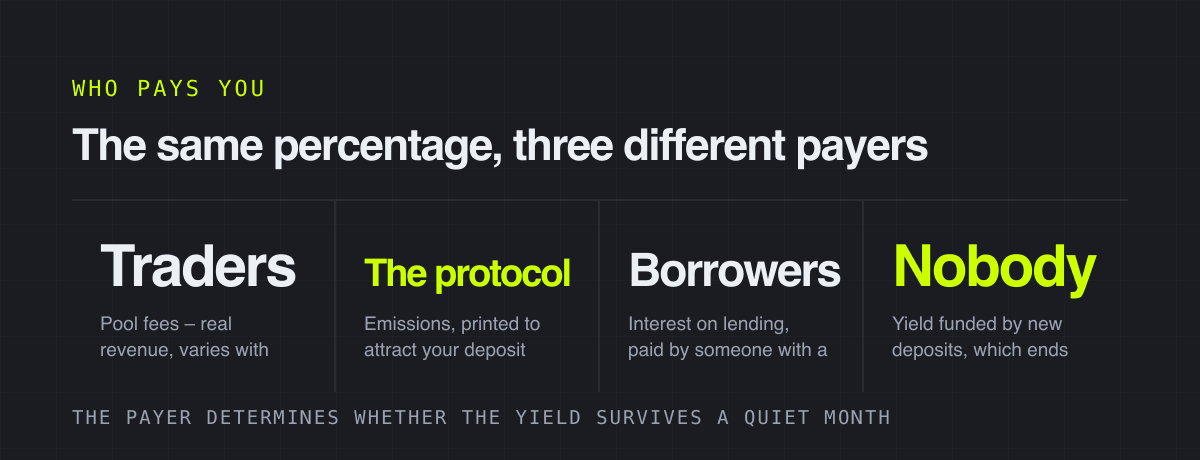
Two things follow. First, a headline rate made mostly of emissions is a forecast about a token price, not a yield. Second, everyone else is also selling that token, which is why a high advertised rate and a falling reward price so often arrive together.
Yield farming
The umbrella: moving capital to whatever currently pays most, across pools, lending markets and incentive programmes. It is an activity rather than a mechanism, and its defining cost is the one nobody puts in the spreadsheet – gas, timing, and the tax events created by every rotation.
| Paid from | Fails when | |
|---|---|---|
| Staking | Issuance and fees | The locked token falls, or unlocking is delayed |
| Pool fees | Traders | Volume dries up |
| Liquidity mining | Emissions | The programme ends or the reward token drops |
| Lending interest | Borrowers | Demand to borrow disappears, or a borrower defaults |
How to read a headline rate
- Split it into fee yield and incentive yield.
 DefiLlama Yields shows the breakdown, and the ratio is the whole story.
 - Check the reward token's own liquidity. A high rate paid in something you cannot sell is not a rate.
- Find the programme's end date. Emissions almost always have one, and it is usually published.
- Look at what volume the pool actually does – DefiLlama DEX Volume for the venue, the pool page for the pair.
- Only then consider the number on the front.
The honest summary
Fee yield is real revenue from people who wanted to trade. Emissions are a subsidy that ends. Lending interest is real but carries a borrower who might not repay. None of them are free, and a rate that does not resolve into one of those three is being paid out of new deposits, which is the arrangement that always ends the same way.
Tools mentioned
FAQ
What is liquidity mining?
Depositing into a liquidity pool and being paid both a share of trading fees and a stream of tokens the protocol issues to attract deposits. The second part is an incentive programme with a budget and usually an end date.
What is the difference between liquidity mining and staking?
Staking locks a single token and is paid from the protocol's issuance. Liquidity mining deposits a pair into a pool and is paid from trading fees plus emissions – so it carries divergence loss, which staking does not.
Is liquidity mining still profitable?
It depends entirely on the split between fee yield and emissions. Fee yield comes from real trading and persists; emissions are a subsidy that ends. A pool where most of the rate is emissions is a bet on a reward token's price.
What is yield farming?
The general practice of moving capital to whichever opportunity currently pays most. It is an activity rather than a mechanism, and its real costs are gas, timing and the tax events created by constant rotation.
More from the blog
Tracking Whale Wallets Without Mistaking Size for Skill
A large balance is evidence of a large balance. Whether it means anything about the next trade is a separate question, and usually the answer is no.
Wallet Tracking You Will Actually Read
Everyone sets up alerts. Almost nobody survives the second week, because the setup was designed to catch everything.
Risk-Reward on a Token With No Floor
The ratio assumes you know where you get out. On a DEX with no stop loss, half the formula is missing – and it is the half that matters.