Robinhood Stock Tokens: What They Are and How to Buy Them
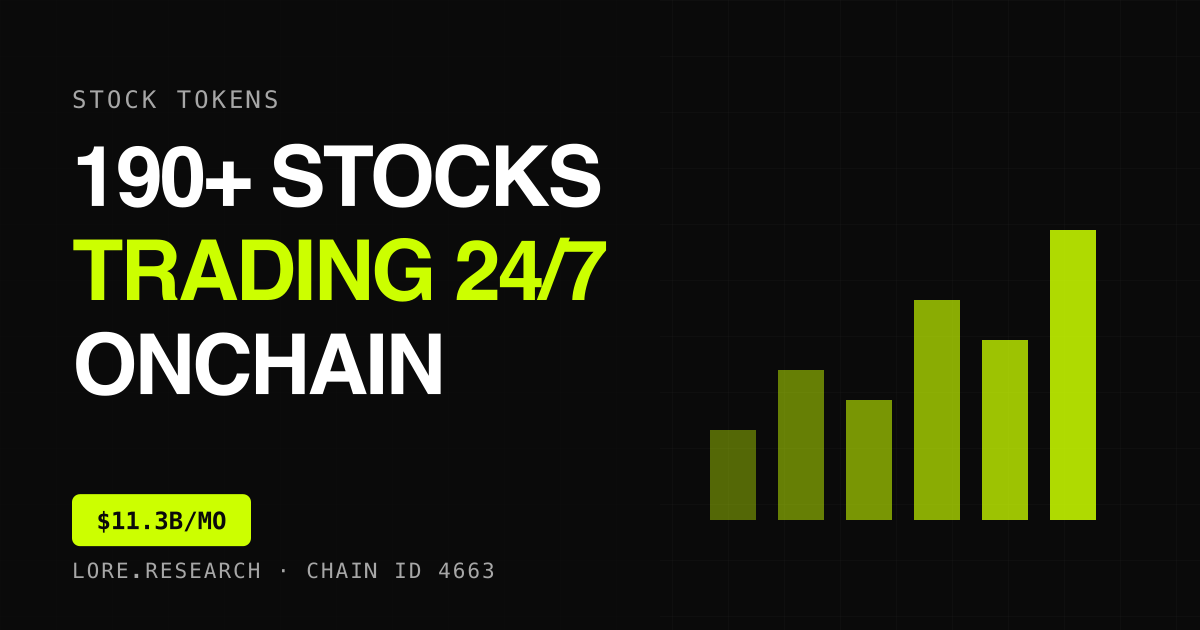
190+ tokenized equities trading around the clock — and one thing you are not buying.
The short answer
Robinhood Stock Tokens are ERC-20 tokens on Robinhood Chain that track the price of real, custodied shares and ETFs — 190+ names including NVIDIA, Apple, Alphabet and QQQ — trading around the clock including weekends. You can buy them inside the Robinhood app after completing the approval steps, or trade them on-chain through Uniswap pools and venues like Arcus and Rialto. Critically, they are structured as tokenized debt securities giving economic exposure, not legal ownership of the underlying share, and they are not available to US persons.
Stock tokens are the reason Robinhood Chain exists. Everything else on the chain — the memecoins, the launchpads, the agents — arrived afterwards. Understanding the instrument matters more than understanding the chain.
What you are actually holding
A Robinhood Stock Token is a standard ERC-20 issued on Robinhood Chain that tracks the price of a real, custodied share or ETF. Each has an on-chain Chainlink price feed so contracts can read current pricing.
The legal structure matters and is easy to skim past. The tokens are structured as tokenized debt securities issued by Robinhood Assets (Jersey) Limited, not as direct ownership of the underlying securities. Holders get economic exposure. They do not hold legal or beneficial ownership of the corresponding shares, and they do not get voting rights.
Buying them in the app
The in-app route is the simple one, and it requires approval first: providing a tax identification number, answering investor-profile questions, and completing a knowledge check confirming you understand the product and its risks.
- Find the token in Explore — search by ticker or company name.
- Open the Stock Token Detail Page.
- Place a buy or limit buy, by quantity or by currency value. Fractionals are supported; entry starts from €1.
- Review the estimated price and FX details. Tokens are displayed in USD and bought in EUR, with a 0.10% FX fee and no added Robinhood spread.
Trading runs 24 hours, Monday to Friday, in the app — the broader on-chain market runs at weekends too.
Buying them on-chain
Because they are plain ERC-20s, stock tokens trade in AMM pools like anything else. Uniswap holds the deepest pools. Rialto supports 25+ stock-token markets with 24/7 trading, and Arcus offers leveraged exposure through pTokens.
This is also where the composability argument becomes concrete: stock tokens can be supplied as liquidity, posted as collateral in lending markets like Morpho and Ripe, or paired against memecoins on launchpads such as Long and Bankr.
The premium and discount question
Because on-chain markets trade when equity markets are closed, stock tokens drift from their reference price at weekends and overnight. That gap is the most-watched number in this market. StalkChain runs a free Stock Premium Tracker and a Stock Flow Radar specifically for it.
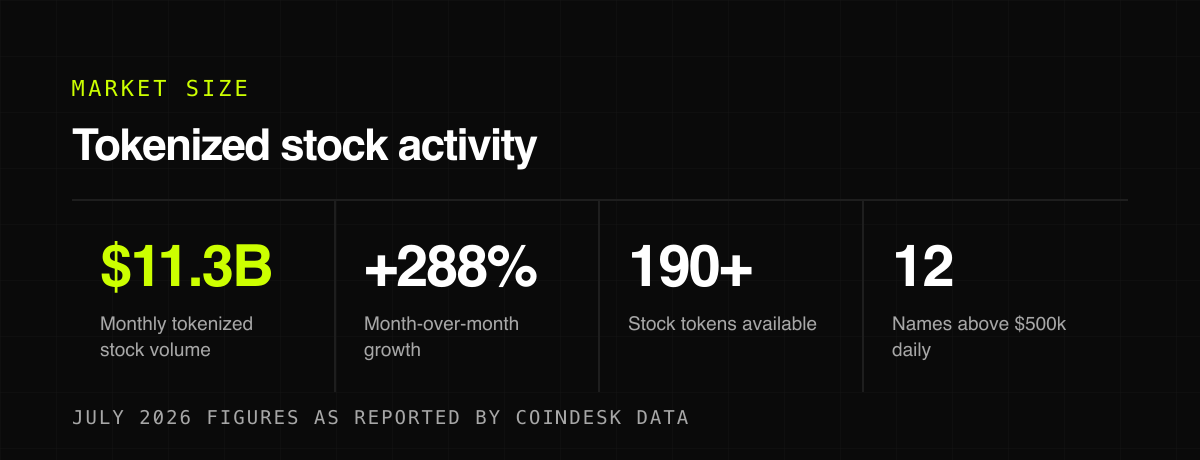
The market is no longer small. CoinDesk Data clocked monthly tokenized stock and ETF volume at $11.3 billion in July 2026 — a 288% jump from June — with a dozen names each clearing at least $500,000 in daily volume.
Before you size a position
- Read the official Stock Tokens documentation, not a summary of it. The issuance structure is the risk.
- Check liquidity on the specific token before trading on-chain. The headline volume is concentrated in a handful of names.
- Corporate actions such as splits and dividends are handled by an on-chain multiplier that changes the shares-per-token ratio without changing your balance. Know that before a split confuses your PnL.
The premium trade, explained properly
Stock tokens trade on-chain continuously. The equities they track do not. Between Friday's close and Monday's open, the token's price is set entirely by on-chain flow with no arbitrage anchor to a live market.
That produces measurable premiums and discounts. If weekend news moves sentiment, the token moves and the stock cannot. When the underlying market reopens, the gap closes — sometimes in the token's favour, sometimes violently against it.
Two implications worth internalising. If you are trading the gap, you are taking a view on weekend news and on the depth of the on-chain market, not on the company. And if you are providing liquidity to a stock-token pool, the Monday open is a scheduled impermanent loss event you should be pricing.
Corporate actions will confuse your PnL
Splits and dividend adjustments are handled through an on-chain multiplier that changes the shares-per-token ratio while leaving your token balance untouched. Your wallet shows the same number of tokens before and after a split; what each token represents has changed.
Applications and price oracles account for this. Naive PnL tracking usually does not. If a position looks like it halved overnight on a stock that did not move, check for a split before panicking.
Liquidity is concentrated and that matters
The headline figure — $11.3 billion in monthly volume — describes the whole market. A dozen names each clear at least $500,000 in daily volume. The rest of the 190+ tokens share whatever is left, which in practice means the long tail is thin.
Before trading anything outside the obvious large caps, check the actual pool depth rather than assuming the market-wide figure applies. A $200 order can move a thin stock-token pool more than the underlying equity moves in a week.
Tools mentioned
 Chainlink
 Uniswap
 Arcus
Arcus Morpho
 StalkChain
FAQ
Do I own the actual share?
No. Stock Tokens are tokenized debt securities issued by Robinhood Assets (Jersey) Limited that give economic exposure to a custodied share. They do not confer legal or beneficial ownership, nor voting rights.
Can US residents buy Robinhood Stock Tokens?
No. They are not available in the US or to US persons, and are restricted in several other jurisdictions including Canada, the UK and Switzerland.
Do stock tokens trade at weekends?
On-chain, yes — the AMM pools never close. In the Robinhood app, trading runs 24 hours Monday to Friday. That difference is why weekend premiums and discounts to the reference price appear.
Can I use stock tokens in DeFi?
Yes. They are standard ERC-20s, so they can be supplied to Uniswap pools, posted as collateral on Morpho or Ripe, and paired against memecoins on stock-paired launchpads.
What fees do I pay?
In-app, tokens are displayed in USD and purchased in EUR with a 0.10% FX fee and no added Robinhood spread. On-chain you pay pool fees plus ETH gas.
More from the blog
How to Find a Wallet Worth Copying on Robinhood Chain
Leaderboards rank by total profit, which is mostly size and luck. Five checks that separate a repeatable edge from one lucky position.
Is Copytrading Profitable? The Arithmetic Nobody Runs First
Copytrading pays you the leader's return minus four deductions. Here is what each one costs, and the win rate a wallet needs before following it makes money.
Copytrading vs Trading Yourself: Which Actually Suits You
One rents someone else's research at a fixed price. The other charges you in time instead of fees. The honest comparison on cost, control and what you learn.