GMGN Copy Trade Settings That Decide the Outcome
Four numbers, and the one most people get wrong is the first one the interface asks for.
The short answer
GMGN Copy Trade mirrors a wallet's swaps with caps on position size, a slippage limit and automatic take-profit. The settings decide the result far more than the wallet does: fixed size rather than proportional, a slippage limit wide enough to fill but tight enough to protect, and a take-profit you chose rather than inherited.
 GMGN Copy Trade is sold as a wallet-selection problem and it is a settings problem. The same leader, mirrored with two different configurations, produces two unrelated results – and the configuration is entirely yours.
Size: fixed, not proportional
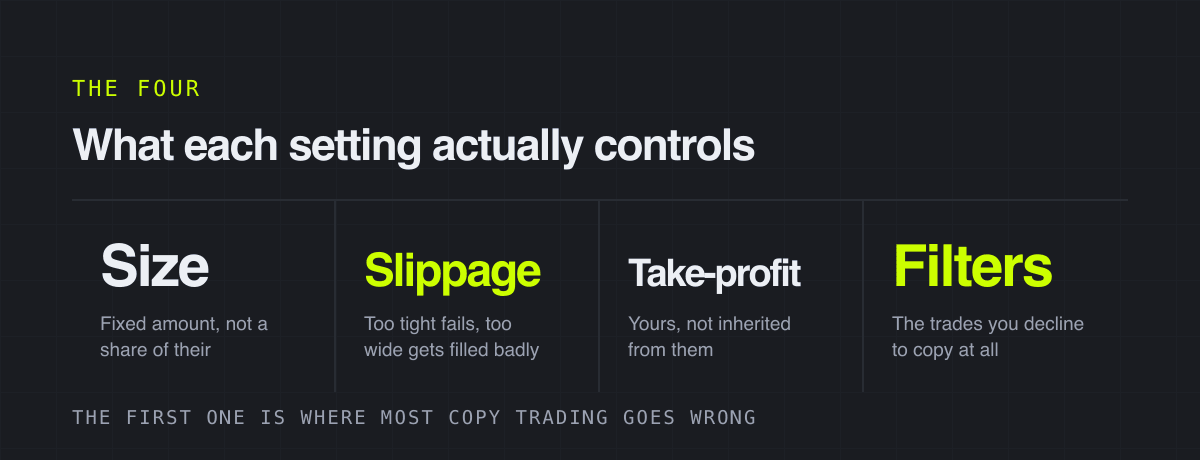
The default in most tools is to copy a share of the leader's position, which sounds sensible and hands your risk management to someone who does not know you exist. When they take an outsized swing, so do you, at a moment you did not choose and in a size you did not pick.
A fixed amount per copied trade is duller and more robust. Every trade is the same size, your worst day is knowable in advance, and one conviction bet from them cannot become one from you.
Slippage: the setting that causes the failures
Slippage tolerance decides whether the mirrored trade executes at all. Too tight and transactions revert on exactly the volatile launches you were trying to catch. Too wide and you fill at a price far from the one you saw, which on a thin pool is most of the trade's margin.
Take-profit: yours or nothing
An automatic take-profit is the most useful setting here, because it solves the problem the whole product has: the leader exits when it suits their book, and their book is not yours. A take-profit you set means you leave on your terms even when mirroring someone else's entry.
Set it to return your stake first rather than to call a top. That converts a copied trade into a decision you made.
| Setting | The version that fails | The version that works |
|---|---|---|
| Size | A percentage of their position | A fixed amount you chose |
| Slippage | One value for every pool | Matched to the liquidity you copy into |
| Take-profit | Whatever they do | A level that returns your stake |
| Scope | Every transaction they make | Only trades passing a liquidity floor |
Filters: the trades you decline
A wallet does not only trade. It rotates, hedges, closes old positions and moves funds between its own addresses, and a mirror reproduces all of it and charges you for each one. A minimum liquidity floor and a maximum position size remove most of that noise.
- Start with one wallet, chosen from a size-adjusted record such as
 Nock Scout's. Several at once is a portfolio nobody designed.
- Know the round-trip cost – service fee, pool fee, gas and slippage, all twice – before judging whether it is working.
- Write the stop rule before you start, because deciding mid-drawdown is deciding while losing.
- Review the settings after twenty copied trades, not after a bad one.
Tools mentioned
FAQ
What are the best GMGN copy trade settings?
A fixed amount per trade rather than a percentage of the leader's position, a slippage limit matched to the liquidity you are copying into, a take-profit that returns your stake, and a minimum liquidity filter to skip the thin pools.
Should I copy a percentage of the trader's position?
Usually not. Proportional sizing transfers their risk appetite onto your account, including conviction bets sized for a portfolio and time horizon you do not share.
What slippage should I set for copy trading?
There is no single right number – it depends on the depth of the pools you copy into. Too tight and trades revert on new launches; too wide and you fill far from the price you saw on thin pairs.
Does automatic take-profit help?
It is the most useful setting available, because it solves the product's core problem: the leader exits when it suits their book. A take-profit you set lets you leave on your own terms.
More from the blog
Prediction Markets: A Price That Looks Like a Probability
A contract paying one dollar if something happens trades at the market's estimate of it happening. The gap between that and a forecast is where the money is.
Staking, and Why There Is None on This Chain
Staking pays you for securing a network. An L2 that settles to Ethereum and charges gas in ETH has nothing for you to secure.
Multisig: Removing the Single Point of Failure
Two of three signatures to move anything. It solves theft and loss at once, and introduces a problem of its own.