Robinhood Chain Copytrading: The Bot Is the Easy Part
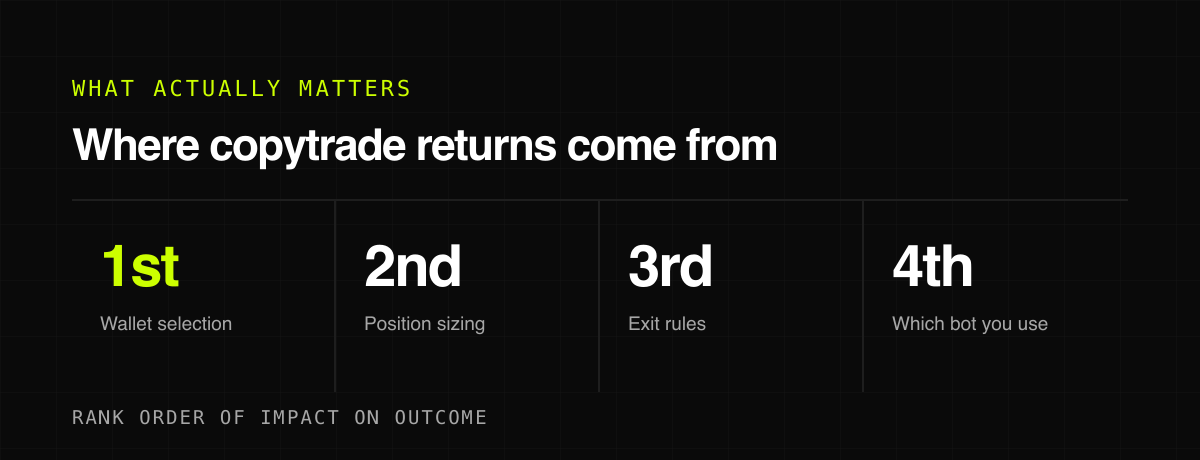
Wallet selection decides your return. Every tool below is downstream of that one choice.
The short answer
Copytrading on Robinhood Chain means pointing a bot at a wallet with a proven record and mirroring its buys with your own sizing and exit rules. GMGN Copy Trade and CopyFomo are the most used front-ends; Maestro and NockBot run the same execution from inside Telegram. The part that decides your outcome is not the bot — it is wallet selection, so score any candidate wallet on Nock Scout or StalkChain first. Copy tools mirror entries far better than exits, which is why most copytraders underperform the wallet they copy.
Copytrading is the most misunderstood tool in on-chain trading. People compare execution speeds between bots and skip the decision that accounts for almost all of the variance: whose trades you are copying.
How it works mechanically
A copy bot watches a source wallet, detects a supported trade, decides whether to mirror it, and executes a separate position from your wallet. You are not sharing their position — you are opening your own, later, at a worse price, with your own size.
That gap is the whole problem. Your fill is behind theirs. Your slippage is worse if your size is larger relative to the pool. And when they exit, you find out afterwards.
The tools on Robinhood Chain
- GMGN Copy Trade — copy any wallet with position-size caps, slippage limits and auto take-profit. The most used front-end on the chain.
- CopyFomo — built on FOMO accounts, so you follow social-graph traders rather than anonymous addresses. Fewer candidates, more context on each.
- Maestro — the veteran Telegram bot, with Robinhood Chain support alongside sniping and limit orders. Charges a subscription on top of per-trade fees.
- NockBot — Robinhood-Chain-native Telegram bot wired into Nock Scout's wallet leaderboard, which puts selection and execution in one place.
- Axiom Pro — watches 40+ launchpads from the first block and offers copy trading alongside sniping.
Choosing a wallet properly
Nock Scout publishes a leaderboard of public wallets with estimated PnL, win rate and trade count — plus a follower simulation that models how a 1–3 ETH copier would actually have done. That last number is the one to read, because it already accounts for the entry lag.
StalkChain's Fresh Wallet Feed and Whale Accumulation tools cover the same ground from a different angle. Cross-check a candidate on both.
Sizing, and the mistake everyone makes
Simulation tools model a 1–3 ETH follower for a reason: that is roughly where copying stops being free. Size above the source wallet's own average entry and your slippage grows while theirs does not — you are now paying for the privilege of being second.
Set a fixed buy size rather than a percentage of their trade. Set a maximum slippage. Set your own take-profit and stop, because the bot will not mirror their exit reliably.
The custody question
To trade from a chat window, most Telegram bots hold your keys. Some, like SUITE, are explicitly non-custodial and never hold funds. Either way the rule is the same: never fund a bot wallet with more than your active trading budget, and treat that balance as at-risk capital independent of the trades themselves.
Why the leaderboard is a trap if you read it naively
Wallet leaderboards rank by realised PnL over a window. That construction has two problems, and both favour wallets you should not copy.
The first is survivorship. A leaderboard shows the wallets that won; it does not show the hundred wallets that ran the identical strategy and did not. A single enormous winner can lift a wallet's ranking while its median trade loses money.
The second is regime. A wallet that made its number during a two-week run in one narrative is ranked on that run for as long as the window holds. You are copying its behaviour in a market that no longer exists.
What to actually look for in a source wallet
- Trade count. Twenty trades is noise. Several hundred starts to describe a process.
- Win rate alongside average size. A 70% win rate with losers twice the size of winners is a losing strategy.
- Consistency across the window, not one dominant trade. Check whether removing the single best trade collapses the record.
- Holding periods. A wallet that exits in minutes is running a strategy your copy latency cannot reproduce.
- Recency. Activity in the last week matters more than the total. Strategies stop working and the wallet stops trading before the leaderboard notices.
The exit problem, and a workable answer
Copy tools mirror entries reliably and exits unreliably. That asymmetry is structural — entries are single events you can react to, exits are often partial, staged, or routed differently.
The practical answer is to stop trying to copy exits at all. Use the source wallet purely as an entry signal and run your own exit rule: a fixed take-profit, a fixed stop, or a time-based exit. That converts copytrading from an attempt to clone someone into what it actually is — a discovery mechanism with your own risk management bolted on.
 GMGN Copy Trade
 CopyFomo
 FOMO
FOMO Maestro
 NockBot
 Axiom
Axiom StalkChain
FAQ
How do I copytrade on Robinhood Chain?
Pick a wallet using a scoring tool like Nock Scout or StalkChain, connect it in a copytrade front-end such as GMGN Copy Trade or CopyFomo, then set a fixed buy size, a maximum slippage and your own exit rules.
Which Telegram bots support Robinhood Chain?
Maestro supports the chain alongside its other networks, and NockBot is Robinhood-Chain-native and wired into Nock Scout's leaderboard. Axiom Pro also offers copytrading with launchpad monitoring.
Why do copytraders underperform the wallets they copy?
Entry lag and exit mismatch. Your fill comes after theirs at a worse price, and copy tools mirror entries far more reliably than exits, so you are often still holding when the source has already sold.
What is a realistic copytrade position size?
Simulation tools model a 1–3 ETH follower. Sizing much above the source wallet's own average entry increases your slippage without increasing theirs, which erodes the edge you were copying.
More from the blog

How to Find a Wallet Worth Copying on Robinhood Chain
Leaderboards rank by total profit, which is mostly size and luck. Five checks that separate a repeatable edge from one lucky position.
Is Copytrading Profitable? The Arithmetic Nobody Runs First
Copytrading pays you the leader's return minus four deductions. Here is what each one costs, and the win rate a wallet needs before following it makes money.

Copytrading vs Trading Yourself: Which Actually Suits You
One rents someone else's research at a fixed price. The other charges you in time instead of fees. The honest comparison on cost, control and what you learn.