Tracking Wallets Inside the Terminal You Trade From
Having the tracker and the buy button on one screen removes a delay and a safeguard at the same time.
The short answer
GMGN's wallet tracking surfaces chosen addresses' activity inside the same interface used to trade, which removes the gap between seeing a trade and taking one. That is its advantage over a separate alert service and also its only real risk, since the gap was doing useful work.
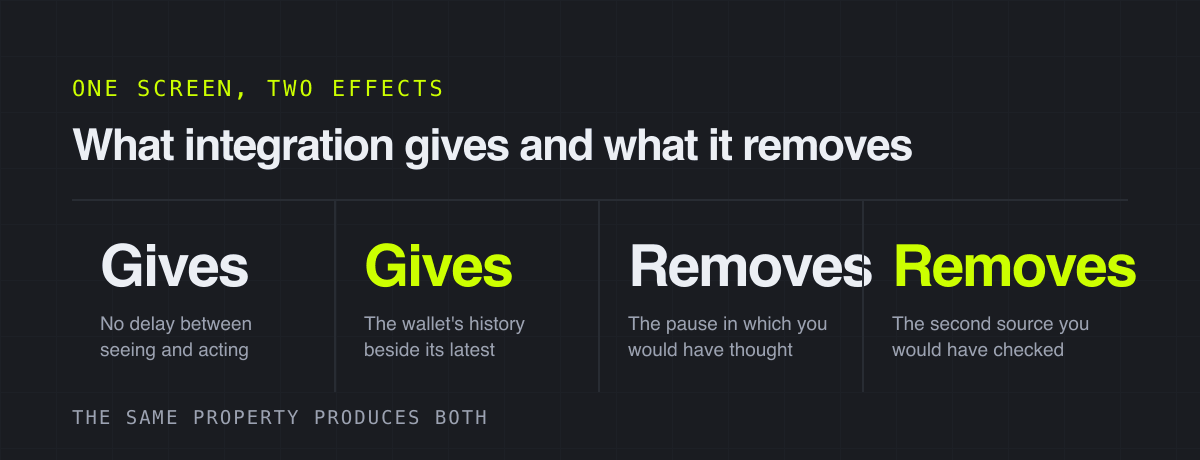
A standalone tracker sends you a message. You read it, you open something else, you look, you decide, you execute. An integrated tracker puts the trade on the same screen as the button, and the entire sequence collapses into one action.
The genuine advantage
Context. When an address does something, its history is right there – what it has traded, how it has done, whether this is typical for it. A separate alert gives you a notification and a hex string; an integrated one gives you the notification and the reason to care or not.
That is a real improvement and it is why people use it. Judging a single trade requires knowing what the wallet usually does, and that is exactly what a Telegram alert cannot carry.
What the gap was for
The delay between alert and execution in a separate tool is friction, and friction is usually framed as a flaw. On trades made in seconds, that friction is the only place a second thought ever happens.
How many to track
Three to five, as with every tracker. The constraint is not the tool's limit, it is that the value of an alert comes from reading and thinking about it, and attention is fixed. Thirty tracked wallets produces a stream that gets ignored, which is worth the same as tracking none.
| Setup | What happens by week two |
|---|---|
| Three wallets, size filter on | You recognise each name and read every alert |
| Ten wallets, no filter | Skimming. The important one gets missed |
| Thirty wallets | Muted |
| Three wallets, no response rule | Read, and acted on inconsistently |
Choosing who to track
On a record adjusted for size, not on a headline number. A wallet trading far larger than you gets fills you cannot, and a wallet trading far smaller has a record that will not scale.  Nock Scout ranks by what a small copier would actually have made, which is the correct adjustment and produces a different list from any raw leaderboard.
The rule to write down first
- Decide what an alert means before you have any: look, research, or act. For most people the honest answer is look.
- If it means act, the size is decided in advance rather than by how strong the alert felt.
- Use the tracker to learn how a good trader behaves – what they skip, how long they hold – which is the slower and larger return.
- If you want the mirroring rather than the learning, that is copy trading, and the settings decide it rather than the wallet.
The integration is a good feature. It is worth knowing that it optimises for speed on a question where speed was never your advantage.
Tools mentioned
FAQ
What does GMGN's wallet tracker do?
Surfaces the activity of addresses you choose inside the same interface you trade from, with the wallet's history alongside its latest trade – so the context for judging an alert is on the same screen.
How many wallets should I track?
Three to five. The value of an alert comes from reading and thinking about it, and attention is fixed, so a long list becomes a stream that gets ignored.
Is an integrated tracker better than Telegram alerts?
Better for context, because the wallet's history is right there. Worse for discipline, because the delay a separate tool creates is where second thoughts happen.
How do I choose wallets to track?
On a record adjusted to a size you could actually trade, rather than on headline profit. A wallet trading far larger gets fills you will not, and one trading far smaller has a record that does not scale.
More from the blog
Prediction Markets: A Price That Looks Like a Probability
A contract paying one dollar if something happens trades at the market's estimate of it happening. The gap between that and a forecast is where the money is.
Staking, and Why There Is None on This Chain
Staking pays you for securing a network. An L2 that settles to Ethereum and charges gas in ETH has nothing for you to secure.
Multisig: Removing the Single Point of Failure
Two of three signatures to move anything. It solves theft and loss at once, and introduces a problem of its own.