What a Pump and Dump Looks Like From the Inside of the Data
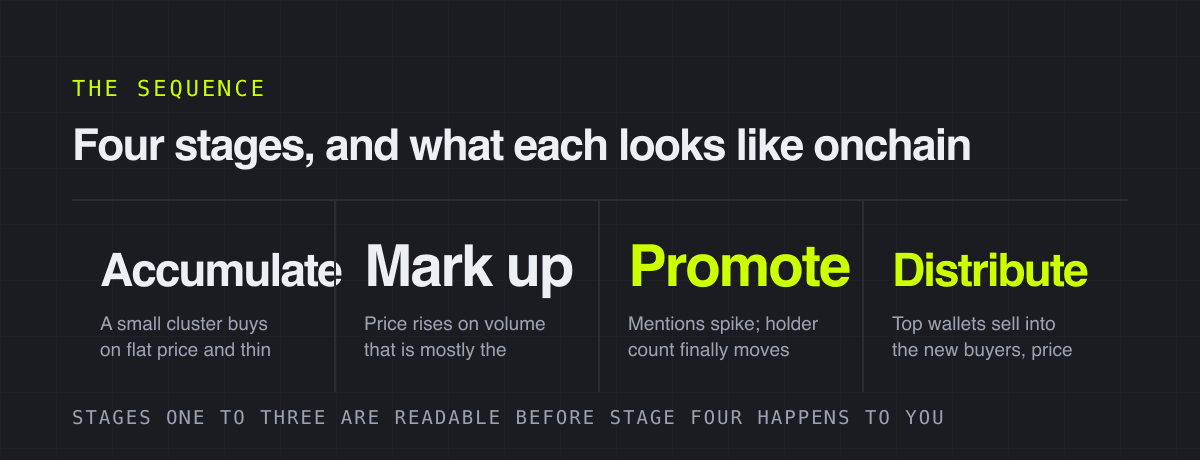
The pattern is boring and repeatable. Four things happen in order, and three of them are visible before the last one.
The short answer
A pump and dump is a coordinated buy that creates a rising chart, promotion that brings in outside buyers, and distribution into their orders. Onchain it has a signature: accumulation by a small cluster at flat prices, a volume spike with few new holders, and the largest wallets selling while the price is still rising.
The phrase gets used for any token that went up and then down, which makes it almost useless. A pump and dump is a specific thing: somebody accumulates quietly, manufactures a chart, buys attention, and sells into the people the attention brought. It has a shape, the shape repeats, and most of it is visible while it is happening.
Stage one: accumulation nobody notices
The buying happens when nothing is happening. Price is flat, volume is low, and a handful of wallets are adding in sizes small enough not to move the chart. This is the stage that is easiest to see afterwards and hardest to act on at the time, because there is nothing to react to – that is the design.
What makes it legible is concentration. If the wallets doing the accumulating share a funding source,  Bubblemaps will draw them as one cluster rather than a dozen independent buyers.
Stage two: a chart built on its own volume
Then the price starts rising, and the volume looks real. The tell is that the holder count does not move with it. Volume without new holders means the same addresses are trading with each other, which produces a chart at a fraction of the cost of producing demand.
Stage three: the part you were meant to see
Promotion arrives once the chart is presentable. Posts, calls in groups, a coordinated wave of mentions from accounts that never discussed the token before.  Moni scores accounts on whether their followers are real, which is the fastest way to tell a genuine wave from a purchased one.
This is the first stage that costs the organisers real money, and it is the reason the chart had to exist first. Nobody promotes a flat line.
Stage four: distribution while the candle is still green
The selling does not start at the top. It starts when there is enough incoming volume to absorb it, which is well before the top, and it is why the last leg up often looks strongest.  Cielo Finance will tell you that the largest wallets are reducing while the price is still rising, which is the single most useful alert in this whole sequence.
| What you see | What it usually means |
|---|---|
| Price up, holders flat | The volume is the same wallets |
| Mentions spike after a 3x, not before | The chart was built to be promoted |
| Top wallets down 20% in size on a green day | Distribution has started |
| Liquidity falling while price rises | Someone is removing the exit as they use it |
What this does not mean
Not every token that runs and retraces was coordinated. Most memecoins go up and then down because that is what happens when a thing with no cash flows loses attention. The sequence above is a specific set of behaviours, not a verdict on every red chart, and reading it backwards after a loss is a good way to learn nothing.
The practical version
- Check holder growth against volume before you check the chart.
 Dexscreener gives you both on one screen.
 - Look at when the mentions started relative to the move. Promotion that follows a 3x is promotion that was paid for by the 3x.
- Set an alert on the top wallets rather than on the price. The price tells you last.
- If you are in and the sequence is running, the honest question is whether you are early to stage four, not whether it goes higher.
Tools mentioned
FAQ
How do you spot a pump and dump in crypto?
Look for rising volume without rising holder count, promotion that starts after the price already moved, and the largest wallets reducing their position while the chart is still green. Those three together are the signature.
Is a pump and dump illegal?
In regulated securities markets, coordinated pump and dump schemes are market manipulation and prosecuted as such. For memecoins the legal position is far less settled and enforcement is rare, which is precisely why the behaviour is common.
Can you profit from a pump and dump?
Some people do, by being early and selling into the promotion rather than after it. The arithmetic is brutal: you need to exit during stage four alongside the organisers, and they know the schedule and you do not.
What is the difference between a pump and dump and a rug pull?
A rug pull removes liquidity or disables selling, so the exit stops existing. A pump and dump leaves the market open and simply sells into it. The second one lets you out, at a price you will not enjoy.
More from the blog
Tokenized Bonds Beyond Treasuries: Credit, Coupons and Who May Hold Them
A tokenized treasury is a short government loan with no credit question. Everything else in the bond market has one, and it changes the product.
Tokenized Private Credit: The Yield Is Someone Else's Loan
The highest yields in RWA come from the part with no public market, no daily price and no easy exit. That is not a coincidence.
Tokenized Commodities: What Is Behind the Barrel
Gold sits in a vault. Oil does not sit anywhere convenient, which is why almost every oil token is a fund and not a barrel.