Is the FOMO App Legit? The Questions Worth Asking Instead
Legit is the wrong word for a trading app. Four narrower questions actually decide whether it is safe for you to use.
The short answer
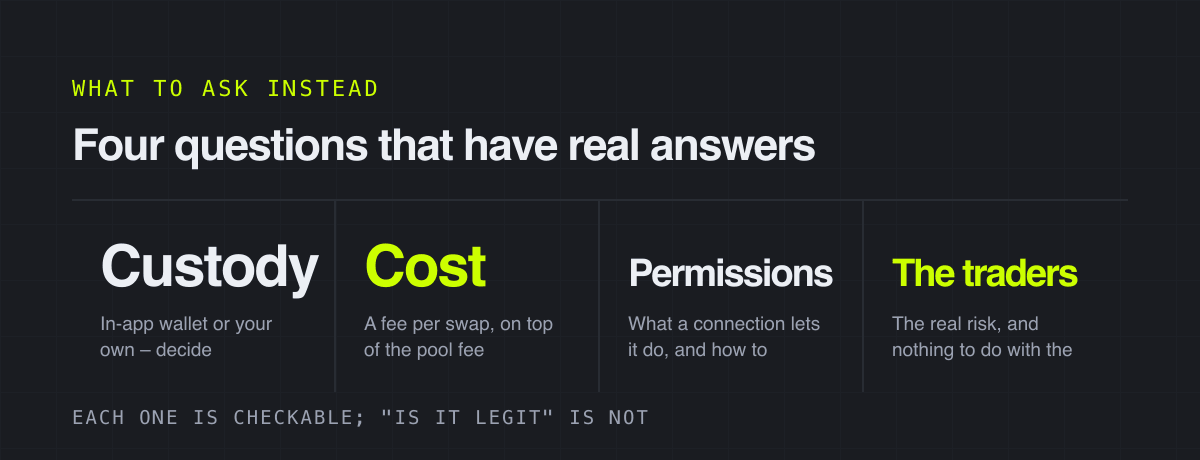
FOMO is a real product with a real company behind it, so the honest answer to "legit" is yes in the sense people usually mean. The useful questions are narrower: who holds the keys, what it charges, what it does with a wallet connection, and whether the traders it shows you are worth following.
The question gets asked about every trading app and almost never gets a useful answer, because "legit" compresses four different concerns into one word. Two of them are about the company, and two are about what you do with it.
Is it a real product
Yes.  FOMO is a working social trading app on web and mobile, covering Robinhood Chain and Solana, with a public trader leaderboard and a real user base. It is not a fake site collecting deposits, which is the thing people are usually afraid of when they ask.
That settles the smallest version of the question and none of the rest.
Who holds the keys
This is the one that actually matters and it is a choice you make rather than a property of the app. An in-app wallet is convenient and means the balance sits somewhere you do not control. Connecting your own wallet keeps custody and adds the approval question instead.
What it costs
A fee per swap, charged on top of the pool fee you would pay anyway. That is the standard model for terminals and bots, and the number is worth reading because it applies to every trade in both directions – a fee schedule matters more to someone trading ten times a day than the headline suggests.
The larger cost is behavioural. A feed that surfaces a new buy every minute makes overtrading the default, and overtrading is more expensive than any fee schedule.
The risk that is not the app
Most money lost through a social trading app is not lost to the app. It is lost to following someone whose record does not survive examination, or to buying a token from a feed without checking who holds the supply.
| Concern | Real? | Where it actually sits |
|---|---|---|
| The app takes your deposit | No | It is a working product |
| Custody of an in-app balance | Yes | Your choice of wallet |
| Fees compound on frequent trading | Yes | Your trading frequency |
| A followed trader is distributing into you | Yes | The trader, not the app |
| A token from the feed is a honeypot | Yes | The contract – check it elsewhere |
The practical checklist
- Decide custody first: your own wallet, or an in-app balance you are willing to lose entirely.
- Read the fee per swap and multiply it by how often you actually trade.
- If you connect an external wallet, know where to revoke –
 Revoke.cash, afterwards, not eventually.
- Verify tokens from the feed on a scanner and a holder map before buying, because the feed does neither.
- Judge the traders on their record adjusted for size, not on their follower count.
Answered that way, the question resolves. It is a legitimate product whose main risks are the ones you bring to it, which is true of every good trading tool and worth knowing before you conclude otherwise.
Tools mentioned
FAQ
Is the FOMO app legit?
It is a real, working social trading product on web and mobile across Robinhood Chain and Solana, not a fake site collecting deposits. The risks that matter are custody of an in-app balance, fees on frequent trading, and the traders you choose to follow.
Is FOMO safe to use?
As safe as the custody choice you make. An in-app wallet should hold only a trading-sized balance; an external wallet keeps custody but creates approvals you should know how to revoke.
Does FOMO charge fees?
Yes – a fee per swap on top of the pool fee. Since it applies in both directions, the cost scales with how often you trade, which makes it matter far more to an active user than the headline rate suggests.
What is the biggest risk with a social trading app?
Not the app. It is following a trader whose record does not survive adjustment for size and realised gains, and buying tokens straight from a feed without checking the contract or who holds the supply.
More from the blog
Prediction Markets: A Price That Looks Like a Probability
A contract paying one dollar if something happens trades at the market's estimate of it happening. The gap between that and a forecast is where the money is.
Staking, and Why There Is None on This Chain
Staking pays you for securing a network. An L2 that settles to Ethereum and charges gas in ETH has nothing for you to secure.
Multisig: Removing the Single Point of Failure
Two of three signatures to move anything. It solves theft and loss at once, and introduces a problem of its own.