Reading a Memecoin Community Before You Buy Into It
A busy Telegram is not demand. Four things separate a community from a room that was paid to look like one.
The short answer
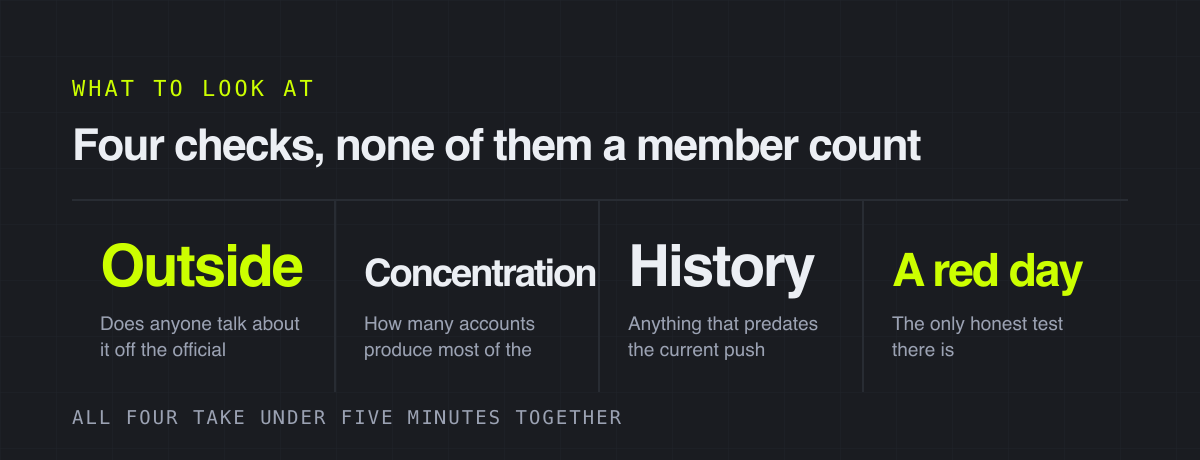
A memecoin's community is the only fundamental it has, which makes faking one the highest-return thing a project can do. Four checks separate the real from the manufactured: whether conversation exists outside the official channels, whether the same accounts do all the talking, whether anything predates the current push, and how the room behaves on a red day. Member counts, message volume and follower numbers are the metrics easiest to buy and therefore the least informative, which is exactly why they are the ones on the landing page.
A token with no cash flows and no product has one thing underneath it: whether people care. That makes community the entire fundamental, and it makes a convincing imitation of one the single highest-return investment a project can make before launch.
Why the visible numbers are the wrong ones
Members, followers and messages per hour are the metrics on every landing page, and all three are purchasable at prices that are trivial next to what a launch raises. A room of forty thousand with three hundred real participants looks identical to a room of forty thousand until you read it, which almost nobody does.
Check one: does it exist outside the official channels
The official Telegram and the official account are controlled surfaces. What is not controlled is whether the ticker appears in conversations that have nothing to do with the project – in other communities, in replies under unrelated posts, in someone's thread about their own portfolio.
Search the ticker and read what comes back excluding the project's own output. If everything is either official or a reply to something official, the community is an audience rather than a community.
Check two: who is doing the talking
Scroll a few hundred messages and count distinct names. A genuine room has a long tail: many people saying one thing each. A manufactured one has a handful of accounts producing most of the volume, usually in a register that does not vary and at a cadence that does not sleep.
Check three: what predates the push
Scroll to the beginning. A community that formed around something has a before – older messages, in-jokes that were not marketing, arguments about things that no longer matter. A room created for a launch begins at the launch, and everything above the first announcement is either empty or three people testing the bot.
The same applies to the accounts promoting it.  Moni scores accounts on exactly this: an account created six weeks ago with forty thousand followers has bought something, and it was not an audience.
Check four: a red day
This is the only test that cannot be bought, and it requires patience rather than skill. On a day the chart is down thirty percent, a real community argues, complains, blames each other and stays. A manufactured one goes quiet, or produces exactly the same upbeat volume as on a green day, which is the more obvious tell of the two.
If you can watch a token through one bad session before buying, you learn more than every other check combined.
What a real community does and does not mean
- It means there is a reason for someone to buy other than the chart, which is the only thing that survives a drawdown.
- It does not mean the supply is distributed. A genuine crowd can be sitting on top of a contract where four wallets hold most of the tokens, which
 Bubblemaps shows in seconds.
 - It does not mean the price goes up. Plenty of beloved tokens have gone to nothing with the room still talking.
- It is not the same as a large community. Small and real beats large and rented every time.
- It can be bought later. A project with money can acquire a crowd after launch, and some do.
Which is why this check belongs next to the others rather than instead of them. A real community and a concentrated supply is a common and expensive combination, and only one of the two is visible in a chat window.
Tools mentioned
FAQ
How do you tell if a memecoin community is real?
Look for conversation outside the official channels, count how many distinct accounts produce the messages, check whether anything predates the current push, and watch how the room behaves on a heavily red day. Member counts and follower numbers are the easiest metrics to buy and the least informative.
Does a big community mean a memecoin will do well?
No. Size is purchasable and small-and-real beats large-and-rented. A genuine community means there is a reason to hold other than the chart, which is what survives a drawdown – it says nothing about whether the supply is concentrated or whether the price rises.
What is the best single test of a memecoin community?
A red day. Everything else can be manufactured cheaply; behaviour during a thirty-percent drawdown cannot. A real room argues and stays, a rented one goes quiet or posts exactly the same cheerful volume it did the day before.
More from the blog
Social Trading vs Copy Trading: Not the Same Thing
One shows you what people are doing and leaves the decision with you. The other takes the decision away. That difference is the entire product.
RWA Tokens: What Is in the Basket, and What It Owns
Every list of real-world-asset tokens mixes three unrelated things. Sorting them takes one question, and most lists never ask it.
Where Tokenized Stocks Trade, and Why the Venue Decides
The same ticker exists on several chains as several different instruments. What you can do with it depends entirely on which one you bought.