Soft Rug Pulls: The Exit That Breaks No Rules
A hard rug steals. A soft rug just leaves. Every safety check you run catches the first one and none of them catch the second.
The short answer
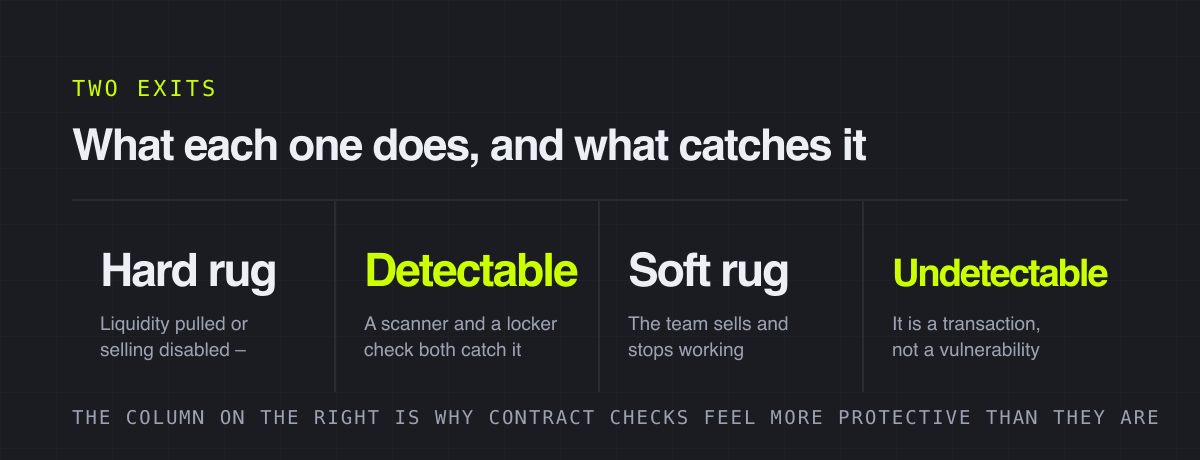
A hard rug pull removes liquidity or disables selling – a mechanical theft, detectable in the contract. A soft rug is the team selling their allocation and abandoning the project while the market stays open. Nothing is broken, every scanner passes it, and the result for a holder is usually the same.
Rug pull is used for any token that collapsed, which flattens two very different events into one word. The distinction is worth keeping, because one of them is preventable by checks you can run in a minute and the other is not preventable by anything.
The hard version
A hard rug removes the exit. Liquidity is withdrawn so there is nothing to sell into, or the contract is written so selling fails for everyone but a whitelist, or the owner mints an enormous supply and dumps it. All of these are mechanical, and all of them leave traces in the contract before they happen.
This is the failure the whole safety-check industry exists for.  HoodScan and similar scanners simulate a sell, read the owner functions and check whether the liquidity is locked. Against a hard rug they work.
The soft version
A soft rug is a team selling their tokens and going quiet. The contract keeps working. Liquidity stays where it was. Every holder can still sell, at whatever price is left after a large holder sold into the book first.
There is usually no announcement. Updates get slower, the roadmap stops being mentioned, the team's address distributes over days rather than in one transaction, and at some point people notice nobody has posted in a month.
Why the distinction matters to you
Because it tells you which defences are worth building. Against a hard rug, tooling works: run the scanner, check the lock, verify the sell simulation. Against a soft rug, only two things help, and neither is a tool.
| Hard rug | Soft rug | |
|---|---|---|
| What happens | The exit is removed | The team uses the exit first |
| Contract state | Modified or malicious | Perfectly normal |
| Scanner catches it | Usually | Never |
| Legal position | Fraud in most jurisdictions | Ambiguous at best |
| Defence | Checks before buying | Position size and watching the team's wallet |
The two defences that exist
The first is watching the wallets that hold enough to matter. A team address distributing while the chart is still fine is the earliest signal available, and it is public.  Cielo Finance alerts on it;
 Bubblemaps shows whether several innocent-looking addresses are one holder.
The second is sizing. If the position is small enough that its total loss changes nothing, a soft rug is an annoyance rather than an event. That is a duller answer than a detection tool, and it is the only one that works reliably.
On legality
A hard rug is theft and is prosecuted as such when anyone can be found. A soft rug is a team selling assets they held and ceasing to work on something they never contractually promised to work on. Whether that is actionable depends on what was promised, in what jurisdiction, to whom – and in practice, almost never.
- Run the mechanical checks anyway. They are cheap and they eliminate the version that is preventable.
- Then read the deployer and the largest holders, because that is where the other version announces itself.
- Treat slowing communication as data. It usually precedes the selling rather than following it.
- Size for the assumption that the team will eventually sell, because most of them eventually do.
Tools mentioned
FAQ
What is a soft rug pull?
When a project's team sells their token allocation and abandons the project, without removing liquidity or disabling trading. The market keeps working and holders can still sell – into a price that a large seller has already pushed down.
What is the difference between a hard and a soft rug pull?
A hard rug removes the exit, by pulling liquidity or blocking sells, and is detectable in the contract. A soft rug uses the exit first, which is an ordinary transaction and invisible to every safety check.
Are soft rug pulls illegal?
Usually ambiguous. Selling tokens you hold and ceasing work on a project are not inherently unlawful, so any case depends on what was specifically promised and in which jurisdiction. Enforcement is rare.
How do you protect against a soft rug?
Two things only: watch the team and large holder addresses for distribution, which is public and happens before the price reflects it, and size the position so that its complete loss does not matter.
More from the blog
Prediction Markets: A Price That Looks Like a Probability
A contract paying one dollar if something happens trades at the market's estimate of it happening. The gap between that and a forecast is where the money is.
Staking, and Why There Is None on This Chain
Staking pays you for securing a network. An L2 that settles to Ethereum and charges gas in ETH has nothing for you to secure.
Multisig: Removing the Single Point of Failure
Two of three signatures to move anything. It solves theft and loss at once, and introduces a problem of its own.