Reading the FOMO Leaderboard: Followers, PnL and Median Swap
One trader shows nearly five million in profit on a twelve-dollar median trade. That single row explains what the ranking measures.
The short answer
The FOMO leaderboard ranks traders by followers, and shows a 30-day PnL beside it. Neither number tells you whether copying would work – for that you need the median swap size, because a huge PnL on a tiny median trade means the profit came from a few outsized positions rather than from the typical one.
The leaderboard is the obvious place to start looking for someone to follow, and the ranking is by followers – which measures attention rather than trading. The PnL figure beside it looks like the corrective, and it is not, for a reason that becomes obvious once you add a third column.
What the third column reveals
 CopyFomo publishes the median swap size alongside the leaderboard figures, computed from the trader profiles. Setting the two next to each other produces rows that cannot be read any other way.
On its September 2026 snapshot, one account showed roughly 4.8 million dollars of 30-day PnL against a median swap of twelve dollars. Another showed about four million against a median of a thousand. A third showed 3.2 million with a median near eighteen thousand.
Why this matters more than the ranking
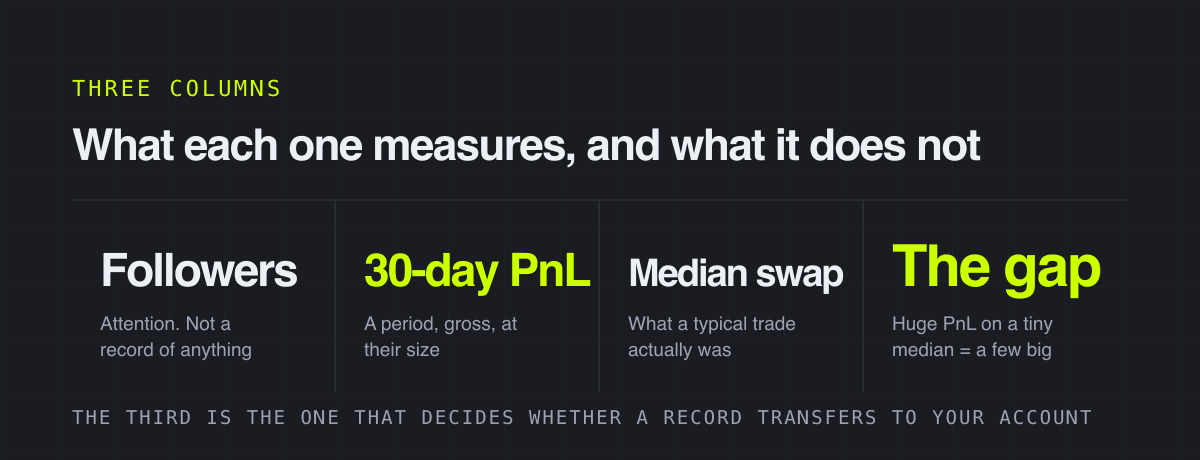
A copier reproduces the typical trade. You get the median, hundreds of times, and you get the outliers only if you happened to be copying on those specific days at a size that mattered. A record concentrated in a few positions does not transfer – it is a distribution, and you receive the middle of it.
| What you see | What it tells you | What it does not |
|---|---|---|
| Followers | How much attention they have | Anything about trading |
| 30-day PnL | One month, gross, at their size | Whether it was a few trades or many |
| Median swap | The trade you would actually copy | The size of the outliers |
| PnL against median | Where the profit is concentrated | Whether it repeats |
The other adjustments, briefly
Leaderboard PnL is usually gross and usually includes unrealised gains. It covers one address when a trader may run several. And thirty days is a sample – a record that does not include a bad market is a record of a good market.
The published figures also note which chains each trader is active on. Most of the top accounts show wallets on both Robinhood Chain and Solana, which matters if you intend to copy: half of a record made on a different chain will not reproduce on this one.
How to use the list
- Ignore the ranking. It sorts by followers, which is the least informative column on the page.
- Read PnL against median swap. A large ratio means concentrated profits that a copier will not receive.
- Prefer a moderate PnL on a median swap close to your own size – that record is the one that transfers.
- Check which chains the wallets are on before copying, since a Solana record does not reproduce here.
- Then watch the trader in the feed for two weeks before mirroring anything.
Figures above are from CopyFomo's published snapshot of the  FOMO leaderboard, dated September 2026 and refreshed by hand. They move constantly – the arithmetic is the durable part, not the numbers.
FAQ
How is the FOMO leaderboard ranked?
By follower count, with a 30-day PnL shown alongside. The ranking therefore measures attention rather than trading results, which is why the top of the list is not the same as the best traders to copy.
What is median swap size and why does it matter?
The size of a trader's typical trade. It matters because a copier reproduces typical trades – so a huge PnL on a tiny median swap means the profit came from a few outsized positions that a copier will almost certainly miss.
Can I trust the PnL shown on a leaderboard?
The arithmetic is usually right and the framing is misleading. Figures are typically gross, often include unrealised gains, cover one address when a trader may run several, and describe a period rather than a track record.
Which chains do FOMO leaderboard traders use?
Most of the top accounts show wallets on both Robinhood Chain and Solana. That matters before copying, because the part of a record made on another chain will not reproduce on this one.
More from the blog
Prediction Markets: A Price That Looks Like a Probability
A contract paying one dollar if something happens trades at the market's estimate of it happening. The gap between that and a forecast is where the money is.
Staking, and Why There Is None on This Chain
Staking pays you for securing a network. An L2 that settles to Ethereum and charges gas in ETH has nothing for you to secure.
Multisig: Removing the Single Point of Failure
Two of three signatures to move anything. It solves theft and loss at once, and introduces a problem of its own.