Pump.fun Alternatives: The Same Model on Other Chains
The bonding-curve launchpad travelled everywhere. What differs between them is the fee split, the threshold and who the fee pays.
The short answer
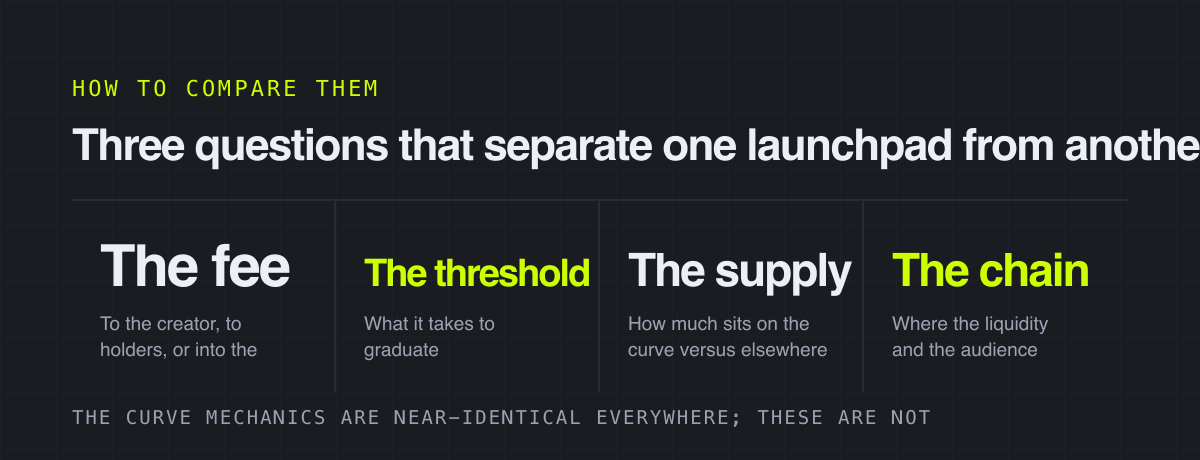
The bonding-curve launchpad model now runs on most chains, and the platforms differ in three ways that matter: where the trading fee goes, what the graduation threshold is, and what supply sits on the curve. On Robinhood Chain the main options are PONS, hood.fun and pools.trade, and they answer those three questions differently.
 Pump.fun established a pattern – instant deployment, a bonding curve, no presale or team allocation, graduation into a pool – and within a year that pattern existed on every chain with any activity. The mechanics converged. What did not converge is where the money goes.
The question that separates them
Every launchpad takes a fee on curve trading. The difference is the destination, and there are three answers in circulation: the creator, the holders, or the pool itself. Each produces a different set of incentives and a different kind of participant.
A fee to the creator makes launching a business. A fee to holders rewards sitting still. A fee into the locked pool makes the exit deeper for everyone and pays nobody directly. None of these is correct – they are different products wearing the same interface.
On Robinhood Chain
Three platforms cover the same ground with different answers.  PONS runs a curve with a graduation and a fee split that actually pays the creator.
 hood.fun publishes its mechanics in full – supply, the share on the curve, and the graduation threshold – which makes the arithmetic checkable before buying rather than after.
 pools.trade is
 Uniswap Labs' own launch flow, where the fee grows the locked pool instead of leaving as anyone's revenue.
| Where the fee goes | Who it suits | The trade-off |
|---|---|---|
| The creator | Launchers building something ongoing | Holders fund the creator's revenue |
| Holders | Buyers who intend to sit | Less incentive for the creator to stay |
| The locked pool | Everyone's exit depth | Nobody is paid to keep working on it |
| The platform only | The platform | Worth knowing before you choose it |
The thing that does not transfer
Audience. A launchpad's value to a creator is largely the people already watching new launches on it, and that is chain-specific and not a feature anyone can ship. A better fee split on a quieter chain is still a quieter chain.
Which cuts both ways. Less competition for attention on a smaller platform is a real advantage for a launch with its own audience, and a real disadvantage for one hoping to be discovered.
Choosing between them
- Decide whether you are launching or buying. The two want opposite things from a fee split.
- Read the fee destination in the documentation, not in the marketing.
- Check whether the supply and threshold are published. hood.fun publishes both, which is the standard to hold others to.
- Ask where the audience is. For discovery that matters more than every other line combined.
- For buying specifically, prefer the platform whose mechanics you can verify onchain before the purchase.
The full list of what runs on this chain is in the launchpad category of the directory, with what each one does. The comparison above is the framework; the platforms change faster than any article can.
Tools mentioned
FAQ
What are the alternatives to Pump.fun?
The bonding-curve model runs on most chains now. On Robinhood Chain the main options are PONS, hood.fun and pools.trade, which differ in where the trading fee goes, what the graduation threshold is and how much supply sits on the curve.
What is the difference between launchpads?
Rarely the curve mechanics, which have converged. The real differences are the fee destination – creator, holders or the locked pool – the graduation threshold, and whether the supply split is published and verifiable.
Which launchpad is best for launching a coin?
The one whose fee split pays you and whose audience is already watching. Those two often point at different platforms, and the audience usually matters more unless you bring your own.
Is a smaller launchpad better?
For a launch with its own audience, sometimes – less competition for attention is real. For a launch hoping to be discovered, a quieter platform is a quieter platform, and no fee split compensates for that.
More from the blog
Prediction Markets: A Price That Looks Like a Probability
A contract paying one dollar if something happens trades at the market's estimate of it happening. The gap between that and a forecast is where the money is.
Staking, and Why There Is None on This Chain
Staking pays you for securing a network. An L2 that settles to Ethereum and charges gas in ETH has nothing for you to secure.
Multisig: Removing the Single Point of Failure
Two of three signatures to move anything. It solves theft and loss at once, and introduces a problem of its own.