Tracking Whale Wallets Without Mistaking Size for Skill
A large balance is evidence of a large balance. Whether it means anything about the next trade is a separate question, and usually the answer is no.
The short answer
Whale tracking follows large holders and reports what they buy and sell. The useful part is seeing distribution before the price shows it; the trap is treating size as skill, because a large wallet's constraints – slow entries, staged exits, positions you cannot see – make its behaviour a bad template for a small account.
Whale watching is the most popular form of onchain research and the one with the worst ratio of attention to usefulness. The data is real and public. The inference people draw from it – a big wallet bought, therefore buy – is wrong for reasons that have nothing to do with whether the wallet is any good.
What counts as a whale, and why it is a weak category
There is no threshold. In practice it means any address large enough that its trades move the thing it trades, which is a relationship between the wallet and the token rather than a property of the wallet. The same balance is a whale in one pool and irrelevant in another.
Which is the first problem with the label: it groups together a fund, a market maker, a project treasury and one person who got lucky in 2021, and their transactions mean entirely different things.
Their constraints are not your constraints
A large position cannot be entered at once without moving the price, so it is accumulated over days. What you see is the last visible buy in a sequence that started well below where you are looking.
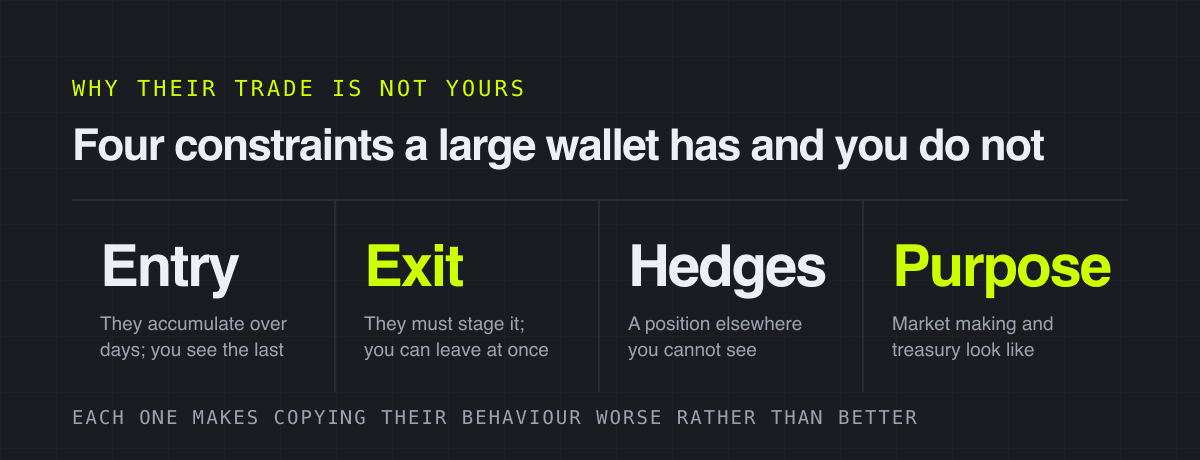
And then hedges. A visible spot buy can be one leg of a position whose other leg is a perpetual short somewhere you are not watching. The onchain data is complete about the chain and silent about everything else.
What whale tracking is actually good for
One thing, and it is worth the setup: seeing distribution before the price reflects it. When the largest holders of a token start reducing while the chart is still rising, that is a fact about supply arriving, and it is the single most actionable pattern in this data.
| What you see | Worth acting on? | Why |
|---|---|---|
| A whale buying a new token | Rarely | You are late in an accumulation you cannot see the start of |
| Top holders reducing on a green day | Yes | Supply is arriving before the price shows it |
| A transfer to an exchange | Often | Historically precedes selling, though not always |
| A transfer between their own wallets | No | Nothing changed except the address |
How to set it up
- Track holders of tokens you own rather than whales in general. The question is about your position, not about rich people.
- Use entity labels where they exist –
 Arkham names addresses, which turns an anonymous transfer into a fact about who.
 - Watch the top holders of a specific token rather than a list of large wallets, since size only means something relative to what is being traded.
- Alert on reduction, not on accumulation. The first is information you can use; the second is usually already priced.
- Check concentration with
 Bubblemaps first – several whale addresses that share a funder are one whale.
The better question
If the goal is finding someone worth following rather than watching your own bags, size is the wrong filter entirely. A wallet worth learning from is one whose record survives being adjusted to a size you could actually trade – which is what  Nock Scout ranks on, and it produces a very different list from any whale leaderboard.
Whales are worth watching when they hold what you hold. They are not worth imitating, because almost everything distinctive about how they trade is a response to a problem you do not have.
Tools mentioned
FAQ
How do I track whale wallets in crypto?
Take the top holders of a token from an explorer, label them where possible, and set alerts on reductions in their position. Tracking the holders of tokens you actually own is more useful than following a general list of large wallets.
Should I copy what whale wallets buy?
Generally no. A large position is accumulated over days, so the buy you see is the end of a sequence, and their exit has to be staged in a way yours does not. Their behaviour is shaped by constraints a small account does not have.
What is a whale wallet?
Any address large enough that its trades move the token it is trading. There is no fixed threshold – the same balance is a whale in a thin pool and unremarkable in a deep one.
What is the most useful whale signal?
The largest holders reducing their position while the price is still rising. That is supply arriving ahead of the chart, and it is the one pattern in this data worth setting an alert for.
More from the blog
Wallet Tracking You Will Actually Read
Everyone sets up alerts. Almost nobody survives the second week, because the setup was designed to catch everything.
Risk-Reward on a Token With No Floor
The ratio assumes you know where you get out. On a DEX with no stop loss, half the formula is missing – and it is the half that matters.

How People Actually Make Money on Memecoins
There are four ways, they are not equally available, and only one of them is what most people are attempting.