The RWA Narrative: What Trades, and What Ships
Two things share the name. One is a category of products settling real value; the other is a basket of tokens that move on announcements about it.
The short answer
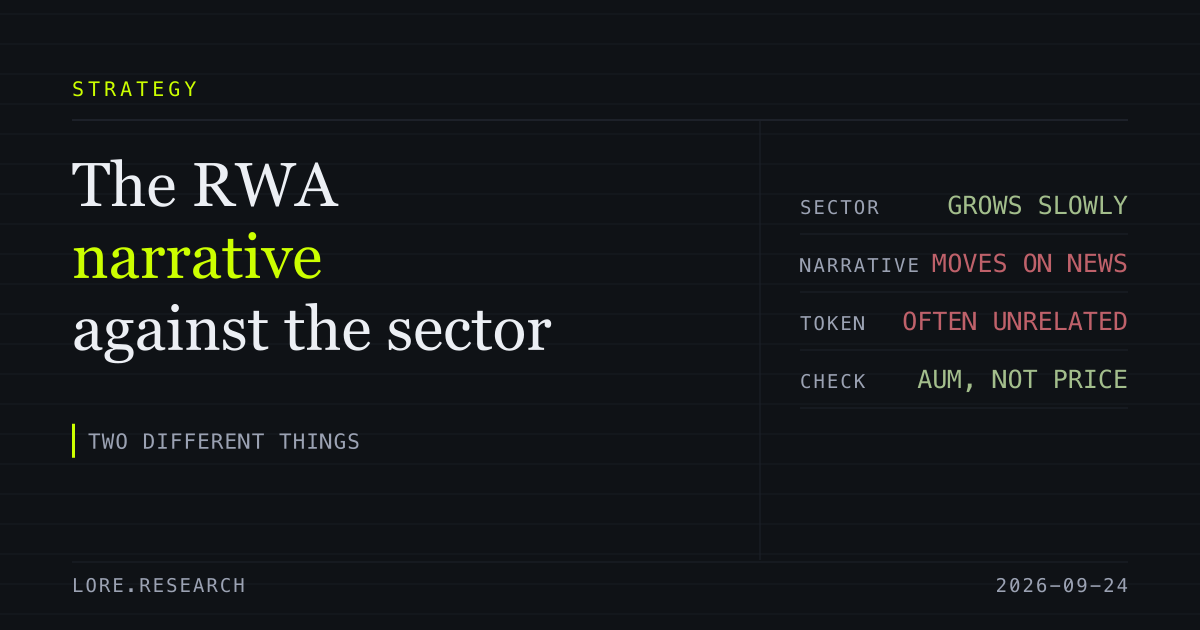
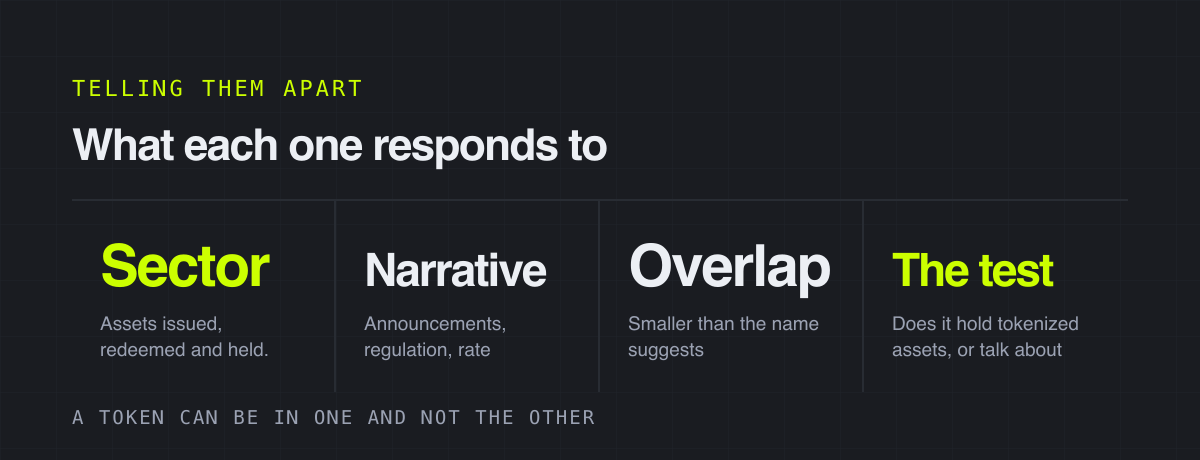
The RWA narrative is the trading theme, and it is not the same thing as the RWA sector. The sector is issuers moving Treasuries, credit and equities onchain, and it grows slowly and mostly institutionally. The narrative is a set of tokens that rally on partnership announcements, regulatory headlines and rate expectations, often without holding any tokenized asset themselves. Confusing the two is the standard error: a protocol's token can triple while its tokenized assets under management do not move, and its assets can grow all year while the token does nothing.
Every cycle produces a theme where the story and the business are easy to mistake for each other, and this one is unusually easy because the story happens to be true. Real assets are moving onchain. That does not mean the tokens named after it are exposed to the move.
What the sector actually is
Issuers wrapping instruments – short-dated government debt overwhelmingly, then private credit and equities – and the infrastructure that lets those tokens be held, transferred and used as collateral. It grows in steps as one institution after another allocates, and the numbers are public, slow and boring.
What the narrative is
A basket of tokens that respond to news about that growth. Some belong to protocols genuinely issuing tokenized assets. Others belong to chains hoping to host them, to oracles that would price them, to compliance layers that would gate them, and to projects whose connection is a blog post.
Why the two decouple
- The growth is institutional, and institutions do not buy the governance token when they allocate to the fund.
- Fees on tokenized Treasuries are thin by design – it is a scale business, and scale takes years.
- The narrative prices an outcome years out, so it reacts to evidence about the future rather than to revenue now.
- Regulatory headlines move every token in the basket at once, including those with nothing to regulate.
- When short rates fall, the product's appeal falls with them and the theme cools regardless of adoption.
How to trade it without confusing yourself
- Decide which of the two you are buying before you buy. They need different evidence and different horizons.
- For the sector: follow assets under management and redemptions, which issuers publish and
 DefiLlama RWA aggregates. For the narrative: follow announcements, because that is what actually moves it.
 - Check whether a token accrues anything from the assets it is associated with. Many do not, and that is in the documentation rather than in the pitch.
- Treat regulatory news as basket-wide. It moves things with no exposure, which cuts both ways.
- Watch the rate environment. This theme has a macro input that most crypto narratives do not.
The version of this on a chain with stock tokens
Robinhood Chain is an unusual case because the RWAs are the consumer product rather than an institutional wrapper: stock tokens trade next to memecoins in the same wallet, on the same  Uniswap pools, with
  Arcus as the venue built for them. That collapses the distance between the sector and the people trading it, and it makes the narrative question local – not whether tokenized assets will matter eventually, but whether the ones on this chain are being traded this week, which is a thing you can simply go and check.
Tools mentioned
FAQ
What is the RWA narrative in crypto?
A trading theme built around real-world assets moving onchain. It is distinct from the sector itself: the narrative is a basket of tokens responding to announcements, regulation and rate expectations, while the sector is issuers actually wrapping Treasuries, credit and equities.
Do RWA tokens benefit when tokenized assets grow?
Not automatically. Many tokens in the theme accrue nothing from the assets their protocol issues, and the growth is institutional – allocators buy the fund, not the governance token. Whether a token captures anything is in its documentation rather than in the narrative.
Why does the RWA theme cool when rates fall?
Because the largest working category is tokenized short-term government debt, and its appeal is the yield. When policy rates fall the product pays less, the case for holding it weakens, and the theme built on top of it loses its macro tailwind regardless of how adoption is going.
More from the blog
Social Trading vs Copy Trading: Not the Same Thing
One shows you what people are doing and leaves the decision with you. The other takes the decision away. That difference is the entire product.
Reading a Memecoin Community Before You Buy Into It
A busy Telegram is not demand. Four things separate a community from a room that was paid to look like one.
RWA Tokens: What Is in the Basket, and What It Owns
Every list of real-world-asset tokens mixes three unrelated things. Sorting them takes one question, and most lists never ask it.