Cold Wallet vs Hot Wallet: What Each One Is Actually For
Not a security ranking. Two different jobs, and using one for the other is where most of the pain comes from.
The short answer
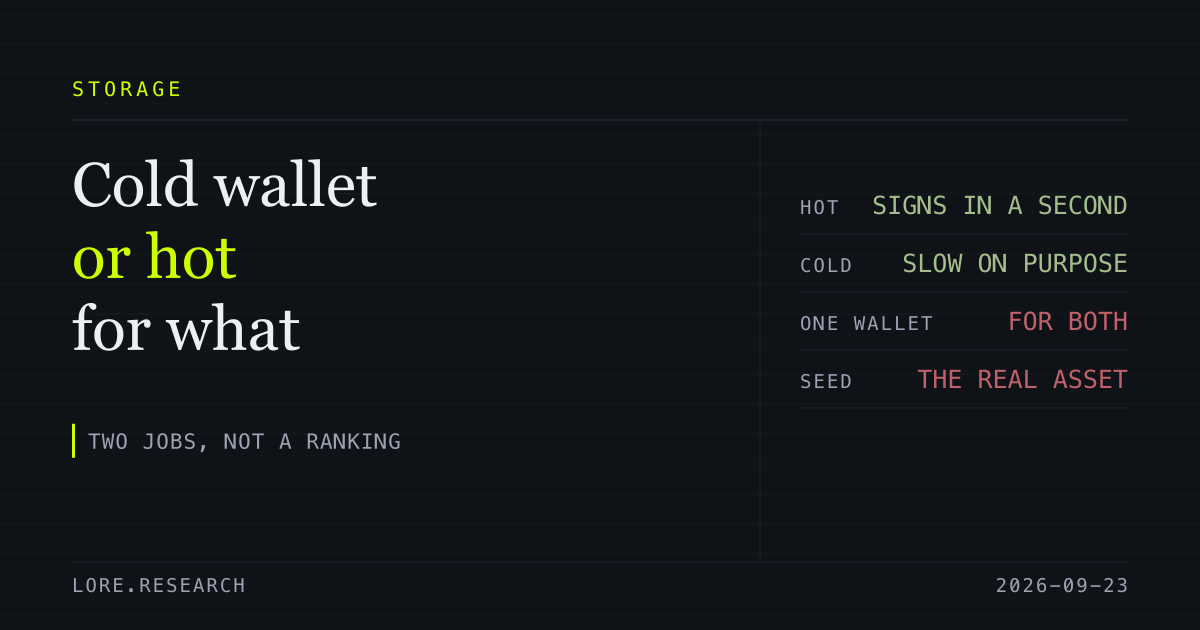
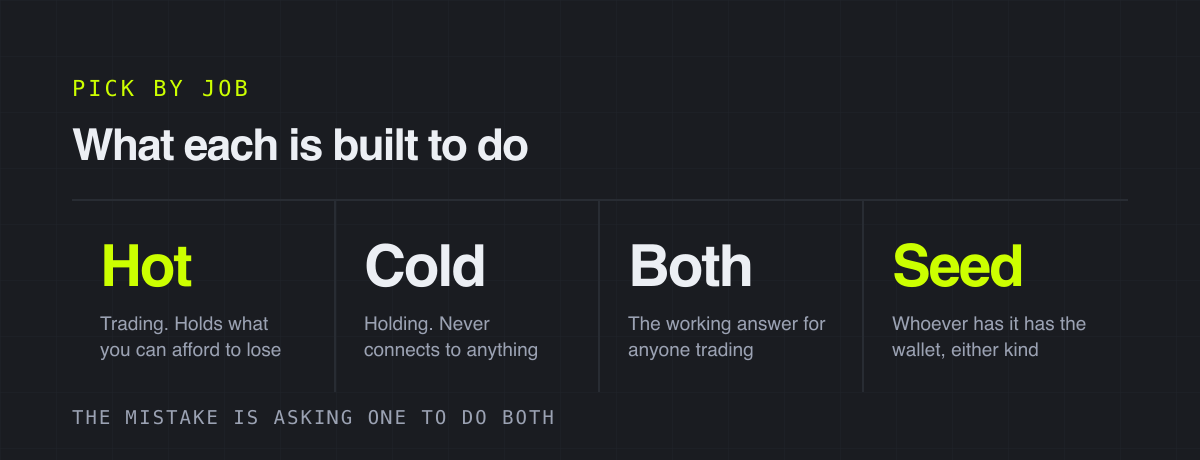
A hot wallet keeps its keys on an internet-connected device, which is what makes it able to sign a trade in a second. A cold wallet keeps them on a device that never goes online, so signing requires physical possession and a deliberate act. Cold is not simply safer – it is slower on purpose, and that slowness is the security. The working answer for anyone trading onchain is both: a hot wallet holding only what is in play, and a cold one holding everything else, with the cold one never connecting to a site it has not connected to before.
The distinction is simpler than the debate around it. It is about where the private key lives, and therefore about what an attacker has to reach in order to use it.
Hot
Keys on a machine that is online – a browser extension, a phone app. Signing takes a second, which is exactly why it is what you trade with. It is also why a compromised browser, a malicious extension or a signature you should not have given reaches the funds directly.
Cold
Keys on a device that never goes online. The transaction is built on your computer, carried to the device, signed there, and carried back. The key itself never touches the internet, so remote compromise of your computer does not reach it.
This is slower by design, and the slowness is the feature. A thing that takes deliberate physical action cannot be done by a page you opened by mistake.
Side by side
| Hot | Cold | |
|---|---|---|
| Keys live | On an online device | On an offline device |
| Signing | One click | Physical confirmation on the device |
| Reachable remotely | Yes, that is the risk | No, which is the point |
| Good for | Trading, small balances, new contracts | Holding, large balances, nothing new |
| Cost | Free | The price of the device |
| Fails when | You sign something bad | You lose the seed, or approve something anyway |
What cold does not protect you from
This is the part that surprises people. A hardware wallet signs whatever you confirm. If you connect it to a malicious site and approve an unlimited spend, the device did its job perfectly and the funds are gone. Cold storage defends against your computer being compromised; it does not defend against you authorising a theft.
It also does nothing about the seed phrase. Whoever has those words has the wallet, and no device stands between them and it.
The setup that works for trading
- A hot wallet for trading, funded with what is currently in play and nothing more.
- A cold wallet holding everything else, which connects to nothing it has not connected to before.
- No path between them except deliberate transfers you initiate.
- The seed for the cold wallet written on paper or metal, stored somewhere a house fire would not reach, never photographed and never typed.
- Approvals on the hot wallet cleared periodically with
 Revoke.cash, since that is the one meeting new contracts.
The separation does more work than either wallet choice. A hot wallet with nothing in it is not a target, and a cold wallet that never connects has almost no attack surface left to defend.
Tools mentioned
FAQ
Is a cold wallet safer than a hot wallet?
For holding, yes – the key never touches an online device, so a compromised computer cannot reach it. For trading it is not the right tool, and people who use it that way end up leaving it connected and approving freely, which is a hot wallet with extra friction.
Can a hardware wallet be hacked?
Remotely, essentially no – that is the design. But it signs whatever you confirm, so connecting it to a malicious site and approving an unlimited spend empties it exactly as fast as a browser wallet would. And anyone holding the seed phrase has the wallet, device or not.
Do you need both?
If you trade onchain, yes. A hot wallet holding only what is in play, a cold one holding everything else, and no automatic path between them. The separation protects you more than either wallet choice does on its own.
More from the blog
Arbitrum Orbit: The Stack Robinhood Chain Is Built On
Not a brand on a box. A specific set of choices about who orders transactions, where the data goes, and what you are trusting when you bridge in.
What Volume Means, and When the Number Is Manufactured
Volume is how much traded, not how many wanted to. Two wallets with a script can produce a week of it in an afternoon.

How to Swap Tokens, and the Four Screens That Matter
The swap itself is two clicks. Everything that decides whether it was a good one happens on the screens around it.