Revenge Trading: How One Loss Becomes Five
The trade after a loss is the most dangerous one you will place, because it is not aimed at the market. It is aimed at the last trade.
The short answer
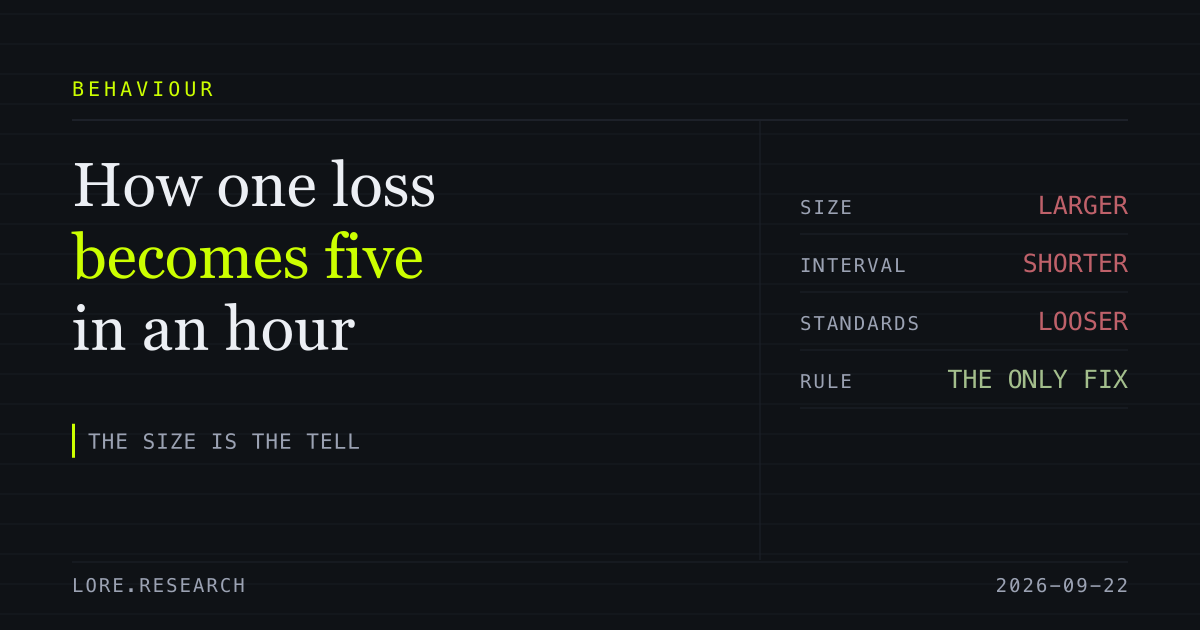
Revenge trading is entering a position to recover a loss rather than because the position is good. It shows up as a larger size than usual, a shorter time between trades, and looser standards about what qualifies – all three at once, immediately after a loss. It is dangerous because the goal has quietly changed from making money over time to getting one specific number back, and that goal is best served by taking more risk. The only reliable countermeasure is a rule that removes the decision: a stop after a set number of losses, or a fixed interval before the next entry.
There is a specific trade that does most of the damage in a trading account, and it is not the losing one. It is the next one.
What changes after a loss
The objective quietly moves. Before the loss you were trying to make money over some horizon. After it, you are trying to get back to where you were – a specific figure, ideally today. That is a different problem, and it has a different optimal strategy: take more risk, because the distance has to be covered quickly.
Nobody experiences this as a decision to increase risk. It is experienced as an unusually attractive opportunity appearing at a convenient moment, which is what a lowered standard feels like from the inside.
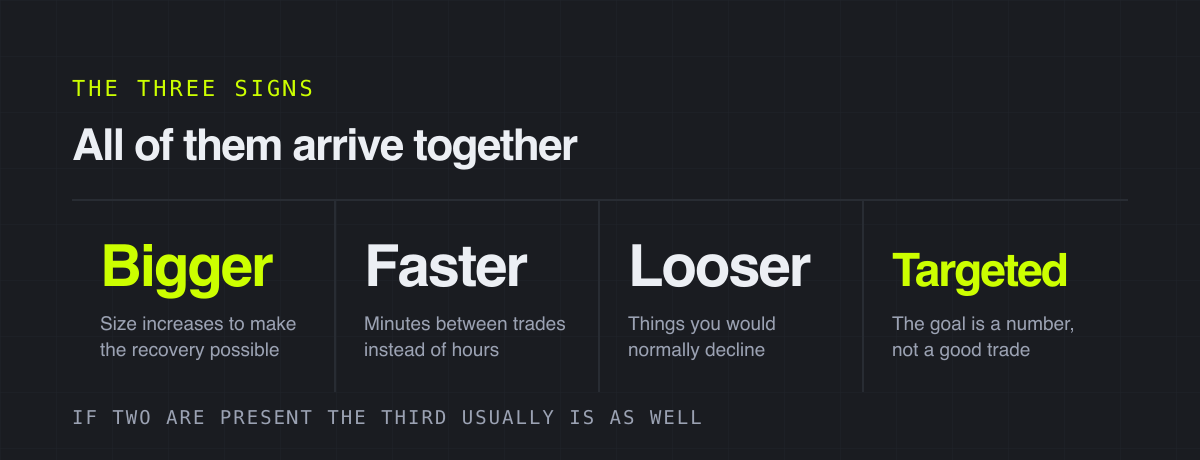
The three signs, which travel together
Size goes up, because the old size cannot recover the loss fast enough. The gap between trades shrinks, because waiting is unbearable while down. And the filter loosens, because at a normal standard there is nothing to trade right now, and doing nothing is the thing being avoided.
Why it compounds
The second loss is larger than the first, because the size was larger. The distance to recover is now bigger, the urgency is higher, and the same logic applies with more force. Three or four iterations of that is how an account that was down two percent at lunchtime is down twenty by evening, without a single trade that seemed insane at the time.
Why insight does not fix it
Everyone who has done this recognised it afterwards, often immediately afterwards. Recognition is not the problem. The problem is that the recognition has to arrive during a state in which your judgment is the thing that has been altered, and you are proposing to fix it using that judgment.
Which is why the countermeasure cannot be a decision. It has to be a rule set in advance, by a version of you that was not down money.
Rules that hold
- A maximum number of losing trades in a day. Reached, you stop – not reduce size, stop.
- A minimum interval after any loss before the next entry. Long enough that the state passes; an hour is usually plenty.
- A fixed position size that is not permitted to change intraday, in either direction.
- A daily loss limit in money, decided when flat, written where you will see it.
- Recording every trade with a reason, because the reason column is where 'to get it back' becomes visible to you in your own handwriting.
The onchain version is worse
There is no close, no margin call and nobody to ring the bell. The market runs continuously, the next candidate is thirty seconds old, and execution takes one click from a wallet that is already connected. Every piece of friction that a traditional venue accidentally provides has been removed on purpose. The rules have to supply it instead.
FAQ
What is revenge trading?
Placing a trade to recover a recent loss rather than because the trade is good. The objective shifts from making money over time to retrieving one specific number, and that objective is best served by taking more risk – which is why it shows up as larger size, faster entries and looser standards.
How do you stop revenge trading?
With a rule decided in advance, because the decision cannot be made reliably in the state that produces the behaviour. A maximum number of losses per day, a mandatory interval after a loss, and a position size that cannot change intraday all work without requiring judgment at the moment it is impaired.
Why does one loss turn into several?
Because each recovery attempt is larger than the trade before it. A bigger loss creates a bigger distance to recover and more urgency, which justifies more size again. Three or four rounds of that produce a very large drawdown out of a small one, with no single trade that felt irrational at the time.
More from the blog
Is Crypto Arbitrage Profitable? Yes, and Not for You
The opportunity is real and it is measured in milliseconds. By the time a price difference is visible on a screen, it has been taken.
What a DEX Aggregator Does, and When It Costs You
It searches every pool for the best route and splits your trade across them. That is worth real money on a large order and worth nothing on a small one.
Token Approvals: The Permission You Forgot You Gave
Every swap asks for permission to move a token, and most of those permissions are unlimited and permanent. They stay live long after the trade is done.