Renounced Ownership: What It Guarantees and What It Cannot
Renouncing removes the owner's powers permanently. It also removes the ability to fix anything, and it does nothing about the largest risk.
The short answer
Renouncing ownership sets a token contract's owner to an address nobody controls, permanently disabling every function restricted to the owner. That removes the risk of minting, blacklisting or fee changes – and removes any ability to fix a bug. It has no effect on whether the deployer sells the tokens they already hold.
Renounced ownership appears in every launch announcement as though it settled the question of safety. It settles one specific question completely and permanently, which is genuinely valuable, and it is routinely read as answering a much larger one.
What renouncing does
A token contract usually has an owner – an address allowed to call privileged functions. Depending on how the contract was written, that might include minting new supply, adding addresses to a blacklist, changing transaction fees, or pausing transfers entirely.
Renouncing transfers ownership to an address nobody holds the key to, typically the zero address. Every owner-restricted function becomes permanently uncallable. It is irreversible by construction – there is no key to recover.
Which risks that actually removes
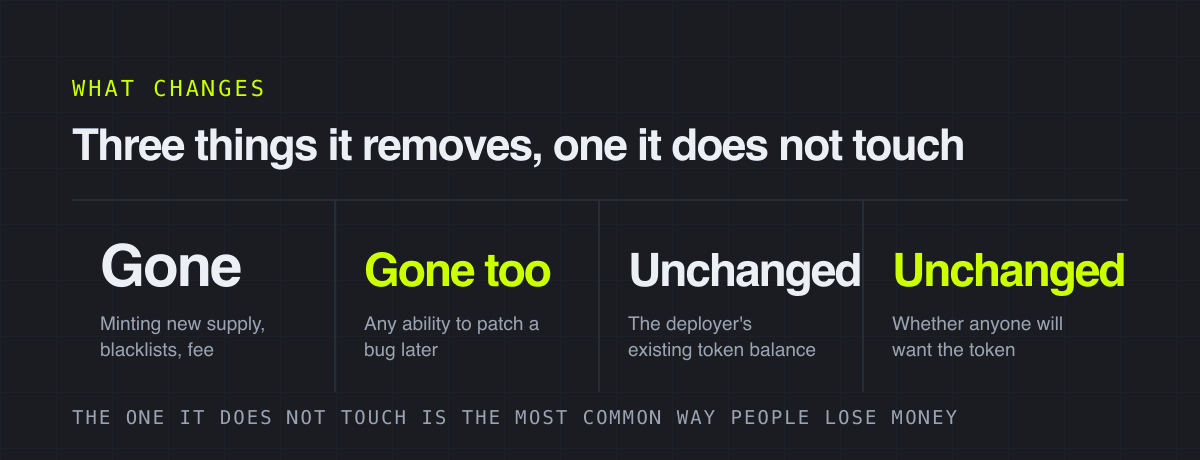
The mechanical ones, and it removes them completely. Nobody can mint more supply and dilute you. Nobody can blacklist your address so you cannot sell. Nobody can raise the sell fee to 99% after you buy. Those are real attacks, they happen regularly, and renouncing ends all of them at once.
What it costs
The same permanence cuts the other way. If the contract has a bug, it cannot be fixed. If an exploit appears, transfers cannot be paused while it is addressed. If a legitimate upgrade is needed, there is no mechanism. A renounced contract is frozen in whatever state it was in, including its mistakes.
For a memecoin with no roadmap, that trade is usually correct – there is nothing to upgrade and the owner powers are pure risk. For anything with ongoing development, renouncing early is a choice with a real cost.
| Risk | Renouncing fixes it? |
|---|---|
| Owner mints more supply | Yes, permanently |
| Owner blacklists sellers | Yes, permanently |
| Owner raises the sell fee | Yes, permanently |
| Deployer sells their own tokens | No – that is not an owner function |
| Liquidity is withdrawn | No – that depends on who holds the LP position |
| A bug is found later | Made worse – nothing can be patched |
The thing it does not touch
Selling tokens you hold is not a privileged function. It is what the contract is for. A deployer holding 30% of supply can renounce ownership, announce it, and sell the entire position the next day, and nothing about those two facts is in tension.
Which is why renouncing should sit alongside the other checks rather than replacing them. Read the deployer's address and the holder concentration – those answer the question that renouncing does not.
How to verify it yourself
- Open the contract on
 Blockscout Explorer and find the owner variable in the read functions.
- Confirm it is the zero address or another address with no transaction history, not simply a different wallet the team controls.
- Check the renounce transaction itself and when it happened – renouncing after the deployer sold is a different story from renouncing at launch.
- Then read what owner functions existed at all. Renouncing a contract that never had dangerous powers proves less than it sounds.
Tools mentioned
FAQ
What does contract renounced mean?
That the token contract's owner has been set to an address nobody controls, permanently disabling every function restricted to the owner – typically minting, blacklisting, fee changes and pausing.
Is a renounced contract safe?
It is safe from a specific set of attacks and nothing else. It does not stop the deployer selling tokens they hold, does not affect liquidity, and means any bug in the contract can never be fixed.
Can ownership be un-renounced?
No. Ownership is transferred to an address with no known key, so there is nothing to recover. That permanence is the point, and it is also why it removes the ability to patch problems.
Should I only buy renounced tokens?
It is a reasonable filter, not a sufficient one. Check it alongside the deployer's balance and the holder concentration, since renouncing says nothing about who holds the supply or what they intend to do with it.
More from the blog
Prediction Markets: A Price That Looks Like a Probability
A contract paying one dollar if something happens trades at the market's estimate of it happening. The gap between that and a forecast is where the money is.
Staking, and Why There Is None on This Chain
Staking pays you for securing a network. An L2 that settles to Ethereum and charges gas in ETH has nothing for you to secure.
Multisig: Removing the Single Point of Failure
Two of three signatures to move anything. It solves theft and loss at once, and introduces a problem of its own.