Dollar Cost Averaging Into Something That Can Reach Zero
DCA converts timing risk into time. It does nothing about the asset being worthless, which is the risk that actually applies here.
The short answer
Dollar cost averaging buys a fixed amount at regular intervals, which removes the need to pick an entry and lowers the average cost in a volatile market. It protects against being wrong about timing. It provides no protection whatever against being wrong about the asset, which is the dominant risk in memecoins.
Dollar cost averaging is buying a fixed amount on a fixed schedule regardless of price. It is genuinely good advice in the context it came from, and that context matters more than the technique does.
What it actually does
It removes the entry decision. Instead of one purchase at one price that might be the top, you get many purchases at many prices whose average is somewhere in the middle. In a volatile asset the average cost ends up below the average price, because a fixed sum buys more units when the price is low.
That is a real effect and not a trick. It is also the entire benefit, and the benefit is specifically about timing.
The assumption underneath
DCA works on assets expected to be worth something in the long run. Every version of the advice assumes recovery – that a lower price is a better price for the same thing, and that waiting is rewarded.
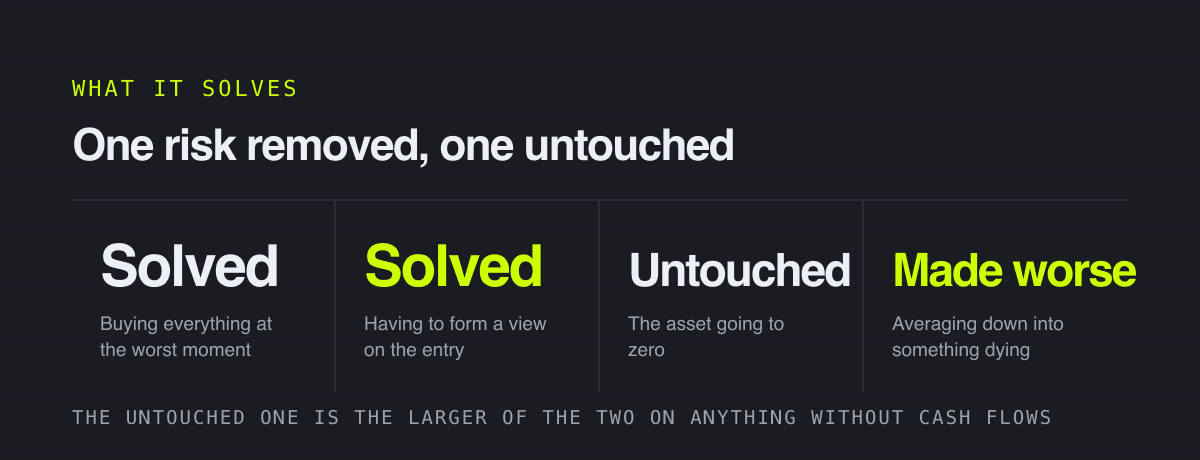
Where the distinction lands
| Asset | Does DCA fit? | Why |
|---|---|---|
| Broad index exposure | Yes | Recovery is the base case |
| Major crypto assets | Reasonably | Volatile, but has recovered before |
| A tokenized stock | Depends on the company | It is an equity with the usual questions |
| A memecoin | No | Most go to zero and stay there |
The honest description of most memecoins is that they are a bet with an expiry nobody announces. Scheduling more purchases into that is a way of ensuring your average entry includes the whole decline.
What to use instead on a volatile token
Scaling into a position over hours or days is not the same thing as DCA, and it does work. The difference is that scaling in has a thesis and an end – you are building a planned position size across several fills rather than committing to buy indefinitely regardless of what happens.
- Decide the total position first, then split it. The total does not grow because the price fell.
- Set the number of fills and stop when they are used, whatever the chart is doing.
- Distinguish scaling into a thesis from adding because it is cheaper. The second has no stopping rule.
- If the reason you are buying more is that you are down, that is not a strategy with a name – it is the position managing you.
Where DCA genuinely applies here
On the assets on this chain with something underneath them –  Robinhood Stock Tokens, a tokenized index fund, ETH itself – the original logic holds, because the assumption it depends on is defensible. The technique is fine. It is the asset class it gets applied to that decides whether it is help or a slower way to lose the same money.
Tools mentioned
FAQ
Does dollar cost averaging work with crypto?
It works on assets where recovery is a reasonable base case, because that is the assumption the technique depends on. It lowers your average cost in volatile markets and removes the need to time an entry.
Should I dollar cost average into memecoins?
No. DCA solves timing risk and does nothing about the asset being worthless, and most memecoins go to zero and stay there. Scheduling further purchases into a decline guarantees your average includes all of it.
What is the difference between DCA and scaling into a position?
Scaling in splits a decided total across several fills and stops when they are used. DCA is an open-ended commitment to keep buying on a schedule. The first has an end; the second assumes recovery.
Is averaging down the same as DCA?
No, though they get confused constantly. DCA is a fixed schedule set in advance. Averaging down is buying more because the price fell, which has no stopping rule and is usually a reaction rather than a plan.
More from the blog
Prediction Markets: A Price That Looks Like a Probability
A contract paying one dollar if something happens trades at the market's estimate of it happening. The gap between that and a forecast is where the money is.
Staking, and Why There Is None on This Chain
Staking pays you for securing a network. An L2 that settles to Ethereum and charges gas in ETH has nothing for you to secure.
Multisig: Removing the Single Point of Failure
Two of three signatures to move anything. It solves theft and loss at once, and introduces a problem of its own.