Launching a Coin on Pump.fun, and What It Costs to Fail
The deployment is trivial and cheap. Everything that decides whether it works happens before and after, and none of it is on the platform.
The short answer
Launching is a form and a small deployment cost: a name, ticker, image and description, after which the coin is instantly tradable on a bonding curve with no presale, no team allocation and no liquidity to seed. The platform makes deploying free of friction, which is exactly why deploying is not the hard part.
The platform's pitch is accurate: anyone can create a coin, there is no presale, no team allocation and no liquidity to seed, and the coin is tradable the moment it exists. That removes every barrier that used to make launching hard – and reveals that the barriers were never the difficult part.
The mechanics
A name, a ticker, an image, a description and optional links. Deploy, pay a small cost in the chain's native asset, and the coin exists on a bonding curve. Anyone can buy immediately; the curve prices it and provides the liquidity, so nothing needs to be funded.
Creators can buy their own coin at launch, which most do. That is a position rather than an allocation – bought on the curve like anyone else's, and visible as such.
What it costs to fail
Almost nothing, and that is the whole economic structure of the platform. Deployment is cheap enough that launching a hundred coins to see which one catches is a viable strategy, and a great many people run exactly that strategy.
What actually decides the outcome
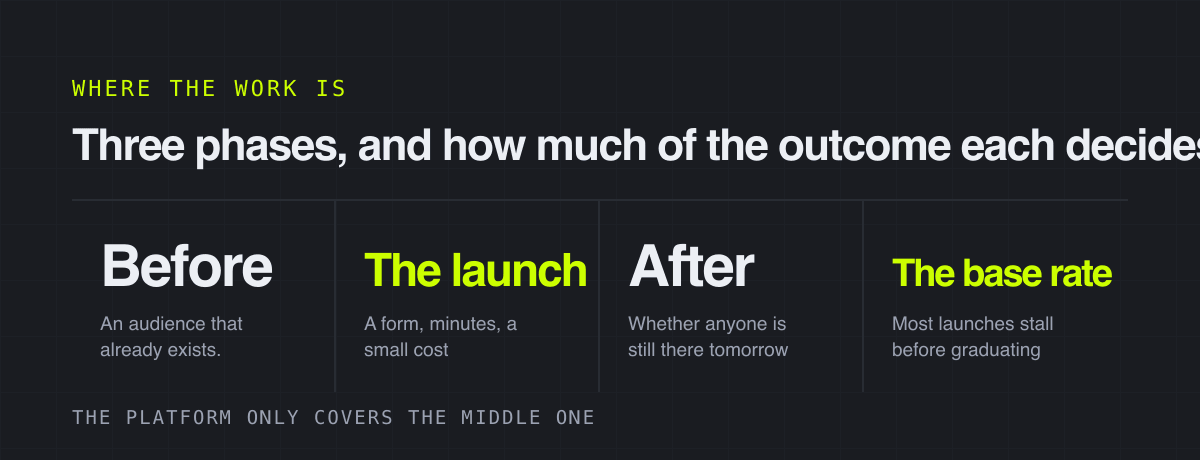
Distribution, before the launch exists. A coin with no audience has no mechanism to acquire one – the platform surfaces new coins to people watching new coins, which is a specific and small group of traders looking for exactly this.
| Input | Under your control? | How much it decides |
|---|---|---|
| An existing audience | Yes, before launching | Most of it |
| Name, ticker, image | Yes | More than it should |
| Timing | Yes | Some – attention is not constant |
| Whether the idea is good | Yes | Less than you would hope |
| Whether anyone cares | No | All of the rest |
The revenue question
Creator fees changed why people launch. A share of trading volume routing to the deployer means a coin that trades actively is a revenue stream rather than a single sale, and it makes launching a business with recurring income instead of a one-time exit.
That is worth understanding before deciding this is easy money. The coins that generate meaningful fee revenue are the ones with sustained volume, and sustained volume is the same scarce thing it always was.
If you are launching on Robinhood Chain instead
The mechanics transfer and the numbers do not.  PONS runs a bonding curve with a graduation and a published fee split that pays the creator;
 hood.fun publishes its own supply and threshold;
 pools.trade routes its fee into the locked pool rather than to anyone's revenue. Read each platform's own mechanics – they differ in ways that matter to a creator.
- Build the audience first. Every other decision is downstream of whether anyone is watching.
- Assume it fails, because the base rate says so. Launch accordingly rather than emotionally.
- If you buy your own coin, do it visibly – a deployer position is readable and pretending otherwise is worse than disclosing.
- Read the fee split on whichever platform you use, since it decides whether this is a business or a sale.
Tools mentioned
FAQ
How do you launch a coin on Pump.fun?
Fill in a name, ticker, image and description, then deploy for a small cost in the chain's native asset. The coin is instantly tradable on a bonding curve – there is no presale, no team allocation and no liquidity to seed.
How much does it cost to launch a coin?
Very little – a small deployment cost plus whatever you choose to buy of your own coin. The low cost is the point, and it is also why the overwhelming majority of launches go nowhere.
Can you make money launching coins?
Through creator fees, yes, if the coin sustains volume. That turns launching into a business with recurring revenue rather than a single sale – but sustained volume is the scarce input, and it is not created by launching.
What percentage of launched coins succeed?
A small fraction reach graduation. Because deployment is nearly free, launching many coins to see which catches is a common strategy, which is why the base rate is so low.
More from the blog
Prediction Markets: A Price That Looks Like a Probability
A contract paying one dollar if something happens trades at the market's estimate of it happening. The gap between that and a forecast is where the money is.
Staking, and Why There Is None on This Chain
Staking pays you for securing a network. An L2 that settles to Ethereum and charges gas in ETH has nothing for you to secure.
Multisig: Removing the Single Point of Failure
Two of three signatures to move anything. It solves theft and loss at once, and introduces a problem of its own.