Pump.fun Creator Fees: The Revenue Behind Launching
A share of trading goes to whoever deployed the coin. That one rule changed what a launch is for.
The short answer
Creator fees route a share of a coin's trading volume to the wallet that launched it, claimable by the creator. It turns launching from a single sale of an allocation into an ongoing revenue stream tied to volume – which changes the incentive from dumping supply to keeping the coin traded.
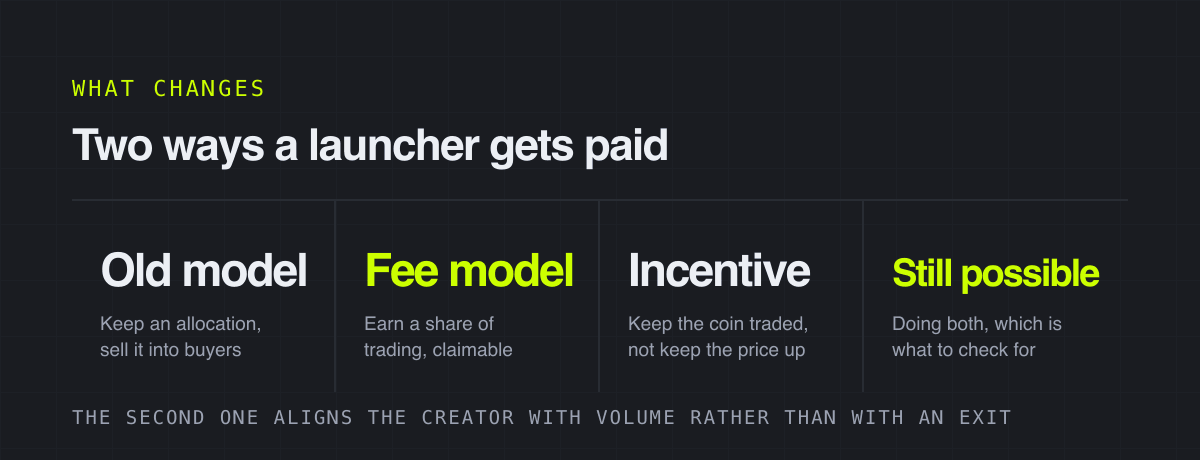
The original way a launcher made money was to keep tokens and sell them. Creator fees replace that with something structurally different: a share of the trading volume on the coin, paid to the deploying wallet and claimable as it accrues.
Why the change matters
Under the allocation model, a creator's best outcome is a high price at the moment they sell, and their selling is what ends the run. The interests of the creator and the holders point in opposite directions from the first day.
Under a fee model the creator earns from volume. Volume is highest when a coin is actively traded, which means the creator's incentive is for the thing to keep being interesting rather than for one high price on one day.
What to actually check
Whether the creator holds tokens as well as the fee claim. Those are two separate positions and only one of them aligns with you. A deployer earning fees and sitting on a third of supply has the same exit risk as any other large holder.
| Creator position | What it means for a holder |
|---|---|
| Fees only, no allocation | Aligned with volume – the best case |
| Fees plus a small allocation | Mostly aligned, with a bounded exit |
| Fees plus a large allocation | The allocation dominates; the fees are a bonus |
| Fees unclaimed for months | Either abandoned, or not worth claiming |
Reading the claims
Fee accrual and claims are onchain, which makes creator behaviour legible in a way most things are not. A creator who claims steadily is treating it as revenue. A creator who has stopped claiming has usually stopped caring, and that is an earlier signal than anything the chart provides.
Rates and mechanics change – platforms adjust the split, add conditions, and alter who can claim. Read the current documentation rather than a number from a post six months old, including this one.
The same idea, closer to home
The model travelled. On Robinhood Chain,  PONS routes a share of trading fees to the creator with the split published and enforced by contract, and
 hood.fun publishes its own mechanics. The design question is identical wherever it appears: is the split disclosed, is it enforced by code rather than by promise, and does the creator also hold supply.
- Find the split in the documentation, not in the announcement.
- Check whether it is enforced in the contract or administered by the platform.
- Read the creator's wallet for an allocation alongside the fee claim.
- Watch whether claims continue – stopping is the quietest abandonment signal there is.
FAQ
How do Pump.fun creator fees work?
A share of the coin's trading volume routes to the wallet that launched it and accrues as a claimable balance. It replaces the older model where a creator's only income was selling an allocation they kept at launch.
Do creator fees stop a creator dumping?
No. They make it less necessary by providing income from volume instead, but a creator can collect fees and still hold and sell an allocation. Checking their wallet for tokens as well as a fee claim is the relevant step.
How do I check creator fees on a coin?
Fee accrual and claims are onchain, so the creator's claim history is readable. A creator claiming steadily is treating the coin as revenue; one who has stopped claiming has usually stopped working on it.
Do other launchpads have creator fees?
Yes – the model spread quickly. On Robinhood Chain, PONS routes a published share of trading fees to creators enforced by contract, and other launchpads publish their own splits. The questions to ask are the same everywhere.
More from the blog
Prediction Markets: A Price That Looks Like a Probability
A contract paying one dollar if something happens trades at the market's estimate of it happening. The gap between that and a forecast is where the money is.
Staking, and Why There Is None on This Chain
Staking pays you for securing a network. An L2 that settles to Ethereum and charges gas in ETH has nothing for you to secure.
Multisig: Removing the Single Point of Failure
Two of three signatures to move anything. It solves theft and loss at once, and introduces a problem of its own.