Wallet Tracking You Will Actually Read
Everyone sets up alerts. Almost nobody survives the second week, because the setup was designed to catch everything.
The short answer
A wallet tracker sends you a notification when an address you follow transacts. The setup that works is small and filtered: a handful of wallets, a minimum trade size, a dedicated channel, and a rule for what you do when one fires. Tracking thirty wallets produces a feed nobody reads, which is identical in value to no tracker at all.
Wallet tracking is the cheapest edge available onchain and the one most reliably wasted. The tools are free or nearly free, the data is public, and the failure is always the same: the setup catches everything, the feed becomes wallpaper, and within two weeks it is a muted channel.
What a tracker does
It watches addresses and notifies you when they transact – a buy, a sell, a transfer, a new position.  Cielo Finance does this across more than twenty-five chains into Telegram or Discord with filters on the wallet's record;
  RayBot and
  Drops Bot cover similar ground with different emphases.
The mechanism is not the hard part. Every one of these works. The hard part is that an alert is information about the past, arriving faster than you can act on it, in a volume you did not plan for.
Three wallets, not thirty
The instinct is to follow everyone interesting. Thirty wallets on an active day is hundreds of notifications, and the honest description of hundreds of notifications is zero notifications, because you stop reading them individually.
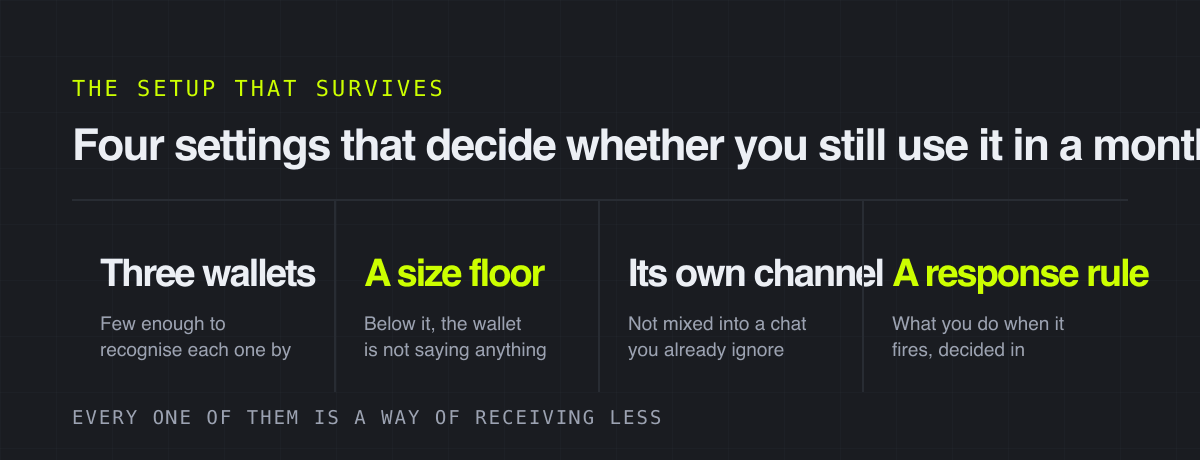
Three to five is where most people find it works. Few enough that you recognise a name when it appears and know what that wallet usually does, which is the context that makes a single alert mean anything.
Filter on size, not on excitement
A wallet's small transactions are noise even when the wallet is good – rotations, dust, test buys, closing something from months ago. Set a floor in dollar terms below which you are not notified, and set it high enough that a trade clearing it is the wallet actually doing something.
| Setting | The version that fails | The version that lasts |
|---|---|---|
| How many wallets | Everyone interesting | Three to five you can name |
| Size filter | Everything | A floor that means conviction |
| Destination | A chat you already use | A dedicated channel |
| On an alert | Decide in the moment | A rule written beforehand |
| Review | Never | Monthly, against what you did |
Decide the response before the alert
This is the step that separates tracking from gambling faster. An alert is not an instruction, and the default reaction – buy what they bought, immediately – is the worst available use of the information, because you are arriving after a wallet whose entry is already better than yours.
- Write the rule: does an alert mean look, research, or act? For most people the honest answer is look.
- If it means act, the size is decided in advance, not by how strong the alert felt.
- Log what you did and what happened. Without that, a month of alerts teaches you nothing.
- Review monthly and remove wallets whose alerts you did not act on. They are costing attention and paying nothing.
What tracking is genuinely for
Not for copying trades in real time – the timing is against you and the fees are stacked. It is for learning how a good trader behaves: what they size up on, what they skip, how long they hold, whether they sell into strength. That is a slow education and it is the actual return on a tracker.
If you want the mirroring rather than the learning, that is copy trading, it costs more than it looks, and the wallet you pick matters less than the sizing rules underneath it.
Tools mentioned
FAQ
What is a crypto wallet tracker?
A tool that watches blockchain addresses you choose and notifies you when they transact – typically into Telegram or Discord, with filters on size, token or the wallet's own track record.
How many wallets should I track?
Three to five. The value of an alert comes from reading and thinking about it, and attention is fixed – thirty wallets produces a feed that gets muted, which is worth the same as no tracker.
Are wallet trackers free?
Mostly there is a free tier covering a modest setup, with paid tiers raising the number of wallets and the alert volume. Since a small setup is the one that works, the free tier is often the right one.
Should I buy what a tracked wallet buys?
Usually not immediately. You are arriving after a wallet whose entry is already better than yours, and the fees and slippage of a reactive buy eat most of the difference. Tracking is better used to learn how a good trader behaves than to mirror them by hand.
More from the blog
Tracking Whale Wallets Without Mistaking Size for Skill
A large balance is evidence of a large balance. Whether it means anything about the next trade is a separate question, and usually the answer is no.
Risk-Reward on a Token With No Floor
The ratio assumes you know where you get out. On a DEX with no stop loss, half the formula is missing – and it is the half that matters.

How People Actually Make Money on Memecoins
There are four ways, they are not equally available, and only one of them is what most people are attempting.