Tokenized Real Estate: Why It Keeps Not Working
Tokenizing a building solves settlement. What real estate is short of is buyers, and those are different problems.
The short answer
Tokenized real estate splits ownership of a property into tradable tokens, usually through a company that owns the building and issues tokens representing shares in it. The technology works and has for years. What has not appeared is a secondary market: a fractional claim on one specific building has about as many potential buyers as the building itself, so most tokens trade rarely or not at all, and holders discover that the liquidity they were sold is the ability to list rather than the ability to sell. The category also carries every ordinary property risk plus an issuer and a legal wrapper on top.
The pitch has been identical for most of a decade and it is genuinely appealing: property is the largest asset class in the world, it is illiquid and slow to transfer, and a chain settles instantly and divides infinitely. Put the two together and an asset that took months to sell trades in seconds.
The reason it keeps not happening is in the sentence itself.
Illiquidity is not a settlement problem
A house takes months to sell because finding someone who wants that house at that price takes months. The paperwork is slow too, and tokenization fixes the paperwork. It does nothing about the search, and the search is the constraint.
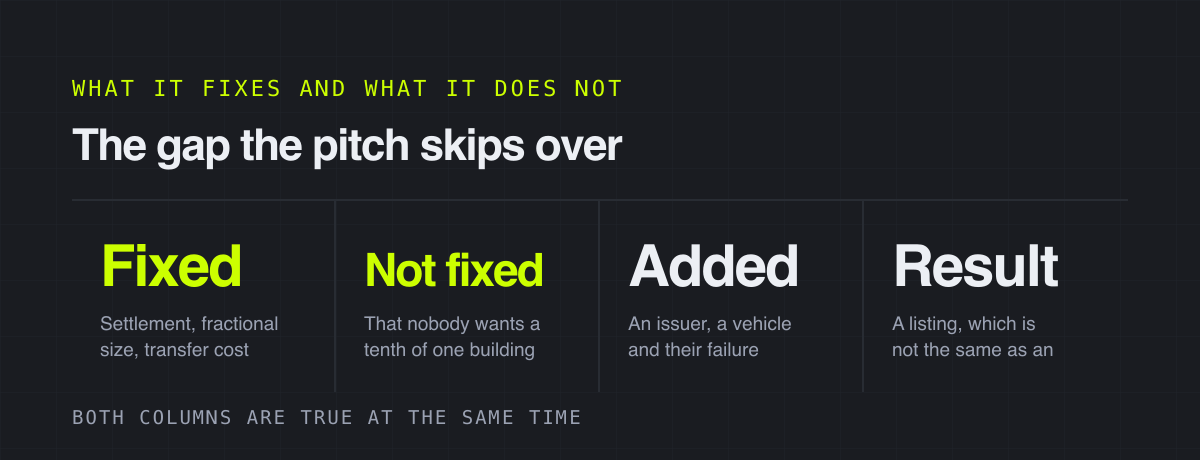
Fractionalising makes it harder rather than easier. A buyer for a whole property at least gets a property. A buyer for one percent of one property gets an income share, no control, no ability to force a sale, and an exit that depends on finding the next holder of a claim nobody else is looking for.
What the structure adds
- An issuer who must stay solvent and keep operating for the claim to mean anything.
- A legal vehicle whose terms decide what you own – usually a share in a company, not the deed.
- A property manager whose decisions you do not vote on, and whose fees come out of the yield.
- Transfer restrictions, because a security representing property ownership is a security.
- Every original risk: vacancy, maintenance, local prices, and the roof.
Where it has worked, and why
Structures pooling many properties behave better than single-building tokens, for the same reason a fund behaves better than a share in one flat: the claim becomes generic. A buyer of a diversified pool is buying exposure to a market rather than to a particular roof, and generic claims find buyers. That is closer to a tokenized REIT than to what the category usually promises, and it is the version that has held up.
Before buying a tokenized property
- Look for trades, not for a listing.
 Blockscout shows whether the token has changed hands at all in the last month, and at what spread.
 - Read what you own – shares in a vehicle, a debt claim, or something else. It is rarely the deed.
- Find the exit terms. If redemption depends on the property selling, your horizon is the property's horizon.
- Count the fees between the rent and you: management, platform, vehicle administration.
- Ask why this property needed tokenizing, when the ones with buyers do not.
That final question is unkind and it is the most useful one in the list.
Tools mentioned
FAQ
How does tokenized real estate work?
A legal vehicle owns the property and issues tokens representing shares in that vehicle. Holders receive a share of rental income and any gain on sale. The token records ownership of the claim; the property itself is held and managed off the chain.
Is tokenized real estate liquid?
Rarely. Tokenization fixes settlement, not demand, and a fractional claim on one specific building has about as many potential buyers as the building does. Most single-property tokens trade very thinly, and being able to list one is not the same as being able to sell it.
Do you own the property if you hold the token?
Almost never directly. You usually own shares in a company or fund that owns the building, with no control over management or over when it sells. The exact claim is in the offering documents rather than on the chain.
More from the blog
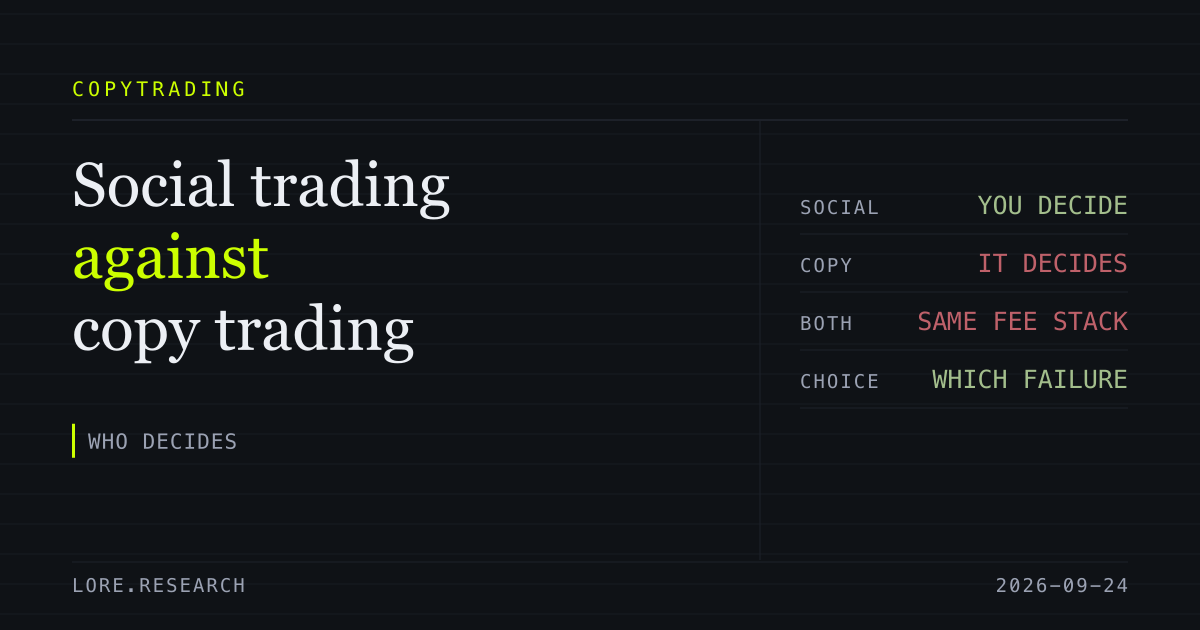
Social Trading vs Copy Trading: Not the Same Thing
One shows you what people are doing and leaves the decision with you. The other takes the decision away. That difference is the entire product.
Reading a Memecoin Community Before You Buy Into It
A busy Telegram is not demand. Four things separate a community from a room that was paid to look like one.
RWA Tokens: What Is in the Basket, and What It Owns
Every list of real-world-asset tokens mixes three unrelated things. Sorting them takes one question, and most lists never ask it.