Robinhood Chain Best Yields: What's Real and What's an Emission Mirage
A 23,669% APR and a 4.6% APY are both on this chain. Only one of them means what it says.
The short answer
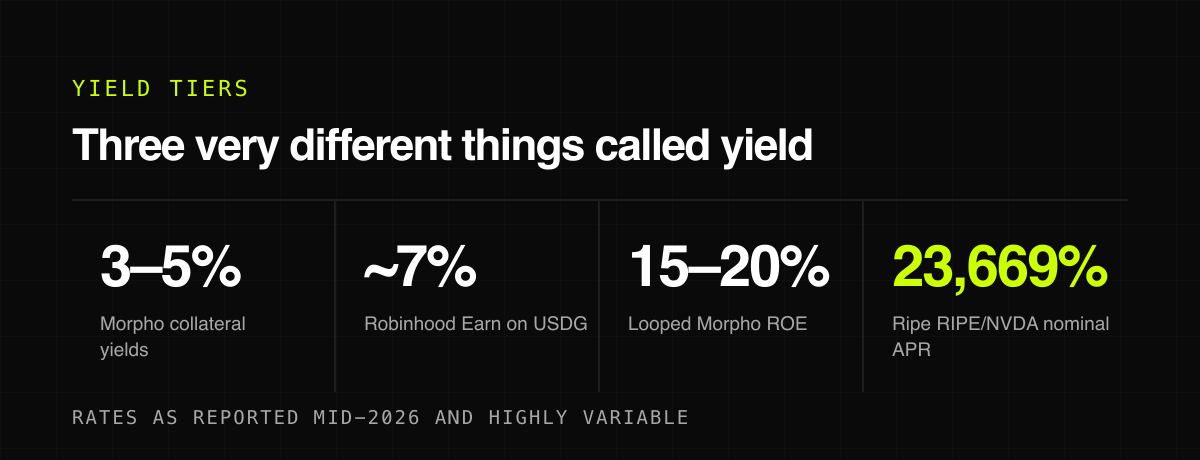
Yields on Robinhood Chain split into three tiers. Lending on Morpho is the base layer, with collateral-side yields around 3–5% that loop into an estimated 15–20% return on equity. Robinhood's own in-app Earn product pays roughly 7% APY on USDG. At the far end, incentivised farms such as Ripe Protocol have advertised nominal APRs above 23,000% on a RIPE/NVDA pair — a real number paid in a volatile emission token whose price typically falls as rewards are sold. Treat the first two as yield and the third as a directional bet on the emission token.
Robinhood Chain has one of the widest yield spreads of any network right now. Understanding why the top and bottom of that range exist is most of the work.
Tier one: lending on Morpho
Morpho is the main lending market on the chain and one of its two largest TVL holders, crossing $300 million in total deposits within three weeks of launch. Collateral-side yields have run roughly: syrupUSDG around 4.6%, USDe around 4.5%, spUSDG around 3.2%.
Part of the USDe figure is not organic. Ethena has been running a reward programme paying an additional ~4.5% directly to USDe posted as collateral in these specific markets — a subsidy to bootstrap USDe on the chain, not USDe's normal protocol yield. When the programme ends, that component goes with it.
Looped, these markets have produced an estimated 15–20% return on equity. That is leverage on a spread, with liquidation risk attached — not a savings account.
Tier two: Robinhood Earn
Robinhood's own product pays roughly 7% estimated APY on USDG lending, powered by Morpho, inside the Robinhood app. It is the simplest option on this page and the only one with no on-chain execution required. It is also the only one where you are not self-custodying.
Tier three: incentivised farms
Ripe Protocol brought old-school DeFi farming to the chain: deposit a portfolio — ETH, stablecoins, and Robinhood-issued stock tokens like NVDA, AAPL and GME — and borrow GREEN against the lot. Its farms have advertised nominal APRs around 23,669% on the RIPE/NVDA pair and 8,423% on the standalone RIPE farm.
The LP layer
Supplying liquidity to Uniswap pools earns trading fees rather than emissions, which makes it the most honest yield on the chain and the hardest to get right. Concentrated ranges amplify both fees and impermanent loss; on volatile memecoin and stock-token pairs, IL routinely exceeds fees earned.
If you do not want to manage ranges by hand, automated liquidity managers do it for you. Arrakis skews toward low-risk strategies and suits stable and correlated pairs; Gamma offers a wider strategy menu with stronger external incentives. Compare net-of-fee historical performance per vault rather than the strategy label.
A sane default
- Start with DefiLlama's yield page filtered to Robinhood Chain — it is the neutral scoreboard and it shows TVL alongside APY.
- Discount any APY paid in a protocol's own token by at least half before comparing it to a stablecoin yield.
- Check how much of a rate is a temporary incentive rather than protocol revenue.
- For LP positions, model impermanent loss first and fees second. APR is the last thing that decides your return, not the first.
How to read an APR without fooling yourself
Every yield figure on a new chain is a claim about the future made from a snapshot of the present. The question is always the same: what would have to stay true for this number to hold?
- Fee yield needs volume to persist. It is the most durable category, and the least advertised because the numbers are small.
- Lending yield needs borrowing demand to persist. Durable while the chain is growing, compresses as capital arrives.
- Incentive yield needs a specific programme to keep running. Ends on a date, sometimes without notice.
- Emission yield needs the emission token's price to hold. Almost never does, because the people earning it are selling it.
Rank any opportunity by which of those four it is before comparing headline numbers. A 5% fee yield and a 5,000% emission yield are not the same asset class and should not appear in the same comparison.
The looping question
The 15–20% return on equity figure quoted for looped Morpho positions is real and it is leverage. You supply collateral, borrow against it, supply the borrowed asset, and repeat. Each turn amplifies the spread between supply yield and borrow cost — and amplifies your liquidation risk in exactly the same proportion.
Loops unwind badly. A move that would be survivable unlevered becomes a liquidation at three or four turns, and liquidations happen fastest precisely when the chain is congested and you cannot add collateral. If you loop, do it at a leverage you can defend during a bad hour, not during a calm one.
 Morpho
 Uniswap
FAQ
What is the highest yield on Robinhood Chain?
Incentivised protocol farms have advertised the highest nominal rates — Ripe Protocol's RIPE/NVDA pair has shown around 23,669% APR. These are paid in a volatile emission token, so realised returns are typically far lower.
Is Robinhood Earn's 7% APY real?
It is Robinhood's own in-app product paying roughly 7% estimated APY on USDG, powered by Morpho. It is custodial — you are not holding the assets yourself — which is the trade-off for the simplicity.
Where is most of the TVL on Robinhood Chain?
Concentrated in Morpho for lending and Uniswap for AMM liquidity. Morpho crossed $300 million in deposits within three weeks of launch.
What is impermanent loss and why does it matter here?
When the two assets in a pool diverge in price you end up holding more of the loser and less of the winner than if you had simply held. On volatile memecoin and stock-token pairs it frequently exceeds the fees earned, and concentrated ranges amplify it.
More from the blog
How to Find a Wallet Worth Copying on Robinhood Chain
Leaderboards rank by total profit, which is mostly size and luck. Five checks that separate a repeatable edge from one lucky position.
Is Copytrading Profitable? The Arithmetic Nobody Runs First
Copytrading pays you the leader's return minus four deductions. Here is what each one costs, and the win rate a wallet needs before following it makes money.

Copytrading vs Trading Yourself: Which Actually Suits You
One rents someone else's research at a fixed price. The other charges you in time instead of fees. The honest comparison on cost, control and what you learn.