Are Crypto Trading Bots Legal?
Automating your own trades is not the part regulators care about. Three other things are.
The short answer
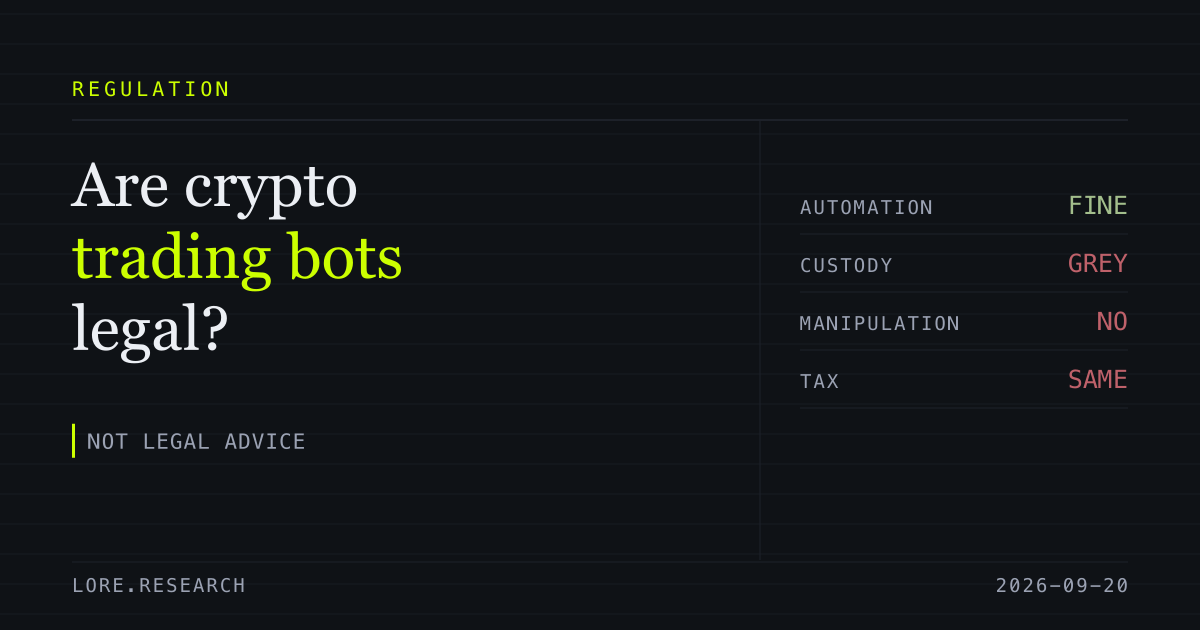
Automating your own trades is legal in most places, and using a bot to do it is no more remarkable than using a limit order. Nothing about writing a script that buys a token is prohibited in itself. What draws regulatory attention is elsewhere: a bot that holds other people's funds may be operating as an unlicensed custodian or exchange; market manipulation is still manipulation when a bot does it; and your tax authority treats every automated trade as a taxable event exactly like a manual one. The legal risk in practice is less about you running a bot and more about who is holding your money while it runs. This is not legal advice.
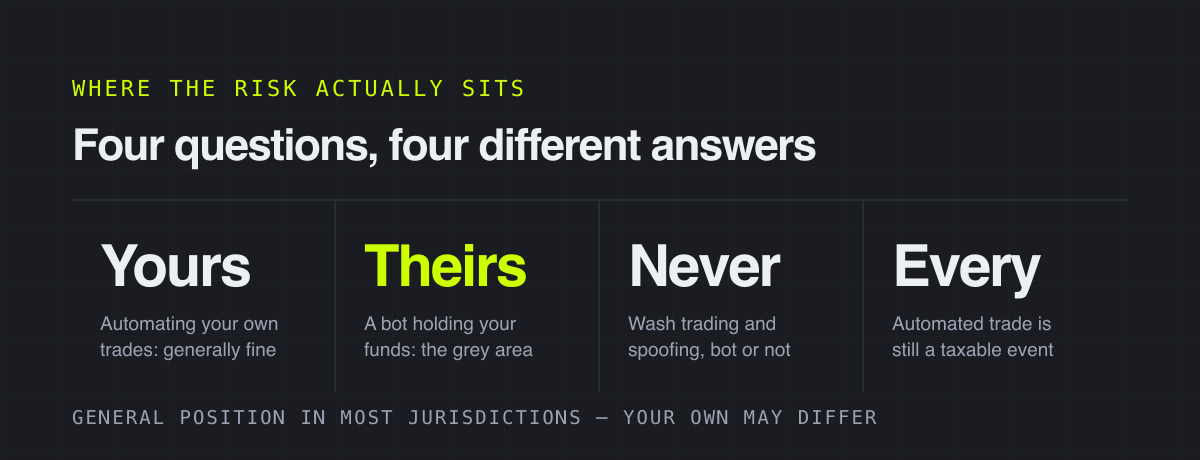
The short version: the automation is not the problem. A bot placing your orders is, in most jurisdictions, the same thing as a limit order placed by software – which is how essentially all electronic trading has worked for decades. Nobody is going to object that a machine pressed the button.
Where the actual exposure is
Custody
This is the real one. A Telegram bot that generates a wallet and holds the key is holding customer funds. Depending on where its operator sits, that can look a great deal like operating as a custodian or an unregistered exchange. This is not a hypothetical distinction: it is why these products are anonymous, offshore and quick to move, and why they occasionally disappear. Your exposure here is not a fine – it is that there is nobody to complain to.
Manipulation
Wash trading, spoofing and coordinated pumps are prohibited conduct in most markets, and automating them does not change that. It makes them easier to prove, because a bot leaves a regular, machine-shaped pattern in public data that a human does not.
Tax
Every swap a bot makes on your behalf is a disposal in most tax systems, exactly like one you made yourself. A bot that trades forty times a week produces forty taxable events a week, and a custodial bot wallet is still your wallet for that purpose. This is the most commonly overlooked consequence of automation and the one most likely to actually affect you.
What this means practically
- Running a bot on your own funds is not the risky part of this activity.
- Letting a bot hold your funds carries counterparty risk that no law will make good for you.
- Keeping records matters more with a bot than without one, because the trade count explodes. Track it as you go – reconstructing a year of automated swaps afterwards is miserable.
- A non-custodial terminal removes the custody question entirely. You sign, so nobody else holds anything.
The practical conclusion is the same as the security one: the legal texture of this category is mostly about custody. Use a bot for what it is good at, keep the balance inside it small, and the question stops being interesting.
FAQ
Is it illegal to use a trading bot?
Automating your own trades is legal in most jurisdictions. What can be illegal is what you use the automation for – wash trading and manipulation are prohibited whether a human or a bot does them.
Are Telegram trading bots regulated?
Generally not. Most operate anonymously and offshore while holding customer funds, which is the combination regulators would take an interest in. For you the consequence is practical rather than legal: there is no regulator to appeal to if the funds go.
Do I pay tax on bot trades?
In most systems yes, and on each one. A bot does not change the nature of a disposal, only the number of them. Keep a record as the trades happen rather than reconstructing them at year end.
More from the blog
How to Start Trading Memecoins
Six things to set up before the first buy, in the order that stops the common mistakes.

What “Smart Money” Means, and When the Label Lies
A wallet that made money is not the same as a wallet that knows something. Telling them apart is the whole skill.
What to Do After a Rug Pull
Nothing gets the money back. Several things stop the next hour being worse than the last one.