LP Tokens and Why Yours Might Be an NFT
One design gives you a fungible receipt. The other gives you a unique position. The difference decides what you can do with it afterwards.
The short answer
An LP token is the receipt for a liquidity position. In the older pooled design it is a fungible ERC-20 representing a share of the whole pool. In concentrated liquidity it is an NFT, because every position has its own price range – which is why it cannot be staked, lent or swapped the way the older kind can.
When you deposit into a liquidity pool you get something back that proves the deposit is yours. What that something is has changed, and the change matters more than it sounds, because it decides what else you can do with the position while it sits there.
The old design: a share of everything
In the original pooled model, every provider's capital was spread identically across all prices. That made every deposit the same kind of thing, differing only in size – so the receipt could be a fungible token. Hold 1% of the LP tokens, own 1% of the pool.
Because it is an ordinary ERC-20, it can be moved, staked in a farm, deposited as collateral, or traded. That composability is why an entire layer of yield products was built on top of LP tokens: they are a standard input.
The new design: your position is unique
Concentrated liquidity broke that, necessarily. Once every provider picks their own price range, no two positions are the same, and a fungible token cannot represent them. So the receipt became an NFT – a unique token recording your pair, your fee tier, your lower and upper bound and your share at those prices.
What you lose, practically
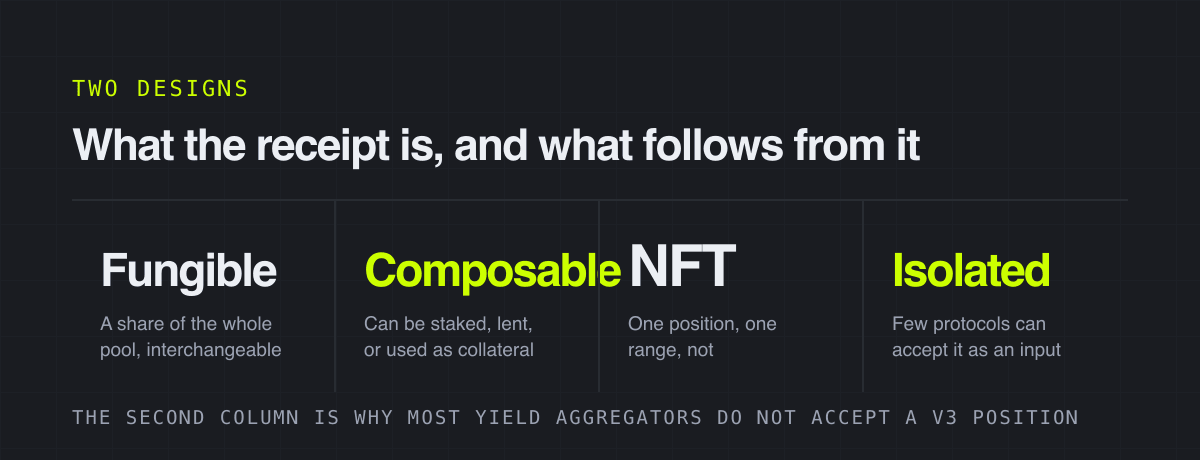
Most protocols that accept LP tokens as input cannot accept a position NFT, because they were built to take a fungible balance. That means no straightforward staking in a third-party farm, limited use as collateral, and no simple way to sell half a position.
| Fungible LP token | Position NFT | |
|---|---|---|
| Represents | A share of the whole pool | One range, yours |
| Transferable | Yes, like any token | Yes, as an NFT |
| Divisible | Yes, to any amount | No – it is one position |
| Usable as collateral | Widely | Rarely |
| Fees | Compounded into the pool | Accrue separately, claimed manually |
The fee difference nobody mentions
In the pooled design, fees were added to the pool itself, so your share of a growing pool grew in value automatically. With position NFTs, fees accrue to your position and wait for you to collect them. Nothing compounds on its own, which is a real gap between a quoted rate and a received one.
What managers actually do
This is the problem  Arrakis Finance, Gamma and similar products solve. They hold the position NFTs, manage the ranges, and issue you a fungible token representing your share of their vault – restoring composability by putting a layer in between.
 Liquidity Ladder does the range part without the wrapper, running several positions instead of one.
- If you want to stake or lend the position, you need a manager's fungible wrapper, not a raw NFT.
- If you hold the NFT yourself, claiming fees is a transaction you have to remember.
- Transferring the NFT transfers the whole position, including uncollected fees.
- Check what you actually hold before assuming a protocol will take it – the two receipts share a name and almost nothing else.
Tools mentioned
FAQ
What is an LP token?
The receipt for a liquidity position. In the older pooled design it is a fungible ERC-20 representing a proportional share of the entire pool; in concentrated liquidity it is an NFT, because each position has its own price range.
Why is my Uniswap position an NFT?
Because you chose a price range. Once positions differ by range, fee tier and bounds, no two are interchangeable, and a fungible token cannot represent them. The NFT records those parameters.
Can I stake a liquidity position NFT?
Rarely directly. Most protocols that accept LP tokens expect a fungible balance. Managed vaults solve this by holding the NFTs themselves and issuing a fungible share token in return.
Do LP token fees compound automatically?
In the old pooled design, yes – fees were added to the pool and your share grew with it. With position NFTs fees accrue separately and must be claimed, so nothing compounds unless you do it.
More from the blog
Prediction Markets: A Price That Looks Like a Probability
A contract paying one dollar if something happens trades at the market's estimate of it happening. The gap between that and a forecast is where the money is.
Staking, and Why There Is None on This Chain
Staking pays you for securing a network. An L2 that settles to Ethereum and charges gas in ETH has nothing for you to secure.
Multisig: Removing the Single Point of Failure
Two of three signatures to move anything. It solves theft and loss at once, and introduces a problem of its own.