Social Trading vs Copy Trading: Not the Same Thing
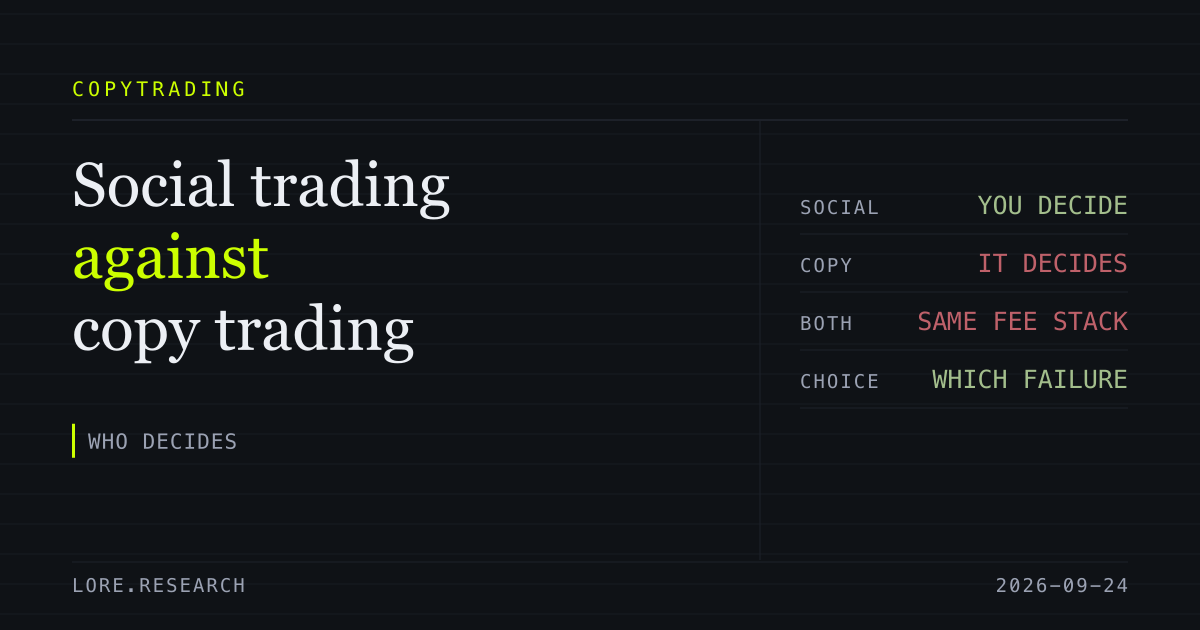
One shows you what people are doing and leaves the decision with you. The other takes the decision away. That difference is the entire product.
The short answer
Social trading means seeing what other traders are doing – their positions, their reasoning, a feed of who bought what – and deciding for yourself. Copy trading means a system mirrors somebody else's trades into your account automatically. The gap between them is where every decision lives: social trading keeps the judgment with you and costs you the chance to be slow, copy trading removes the judgment and along with it the chance to decline. Both have the same fee and latency arithmetic underneath, so the choice is not about returns but about which failure you would rather have.
The two get used as synonyms and they describe opposite arrangements. One is a source of information. The other is an execution system that happens to take its instructions from a person.
Social trading
A feed. Who bought what, which wallets are accumulating, what a trader you follow said before they took a position. You read it and decide, which means you will be late to everything and you will also never hold something you would have refused.
Onchain this is the default state of affairs rather than a product, because every address's activity is public. A social trading tool is mostly a matter of making that readable – attaching names, filtering noise, pushing alerts somewhere you will see them.
Copy trading
An instruction. You allocate a size, point it at an address or an account, and trades appear in your wallet without you. The lag shrinks from minutes to a block or two, and in exchange every trade the leader takes is a trade you took, including the ones you would have looked at and passed on.
What they share, which is most of it
| Social | Copy | |
|---|---|---|
| Who decides | You | The system |
| Speed | Minutes, or whenever you look | A block or two behind |
| Can you decline a trade | Yes | No, that is the point |
| Fee stack | Pool fee and gas on what you take | Plus a bot fee, both directions |
| Your fill vs theirs | Worse, by however long you took | Worse, by the latency |
| If the leader stops | You notice nothing happening | You notice nothing happening |
The bottom three rows are identical in substance. Neither approach escapes being behind the person you are following, and neither tells you whether they have stopped trading or are simply waiting.
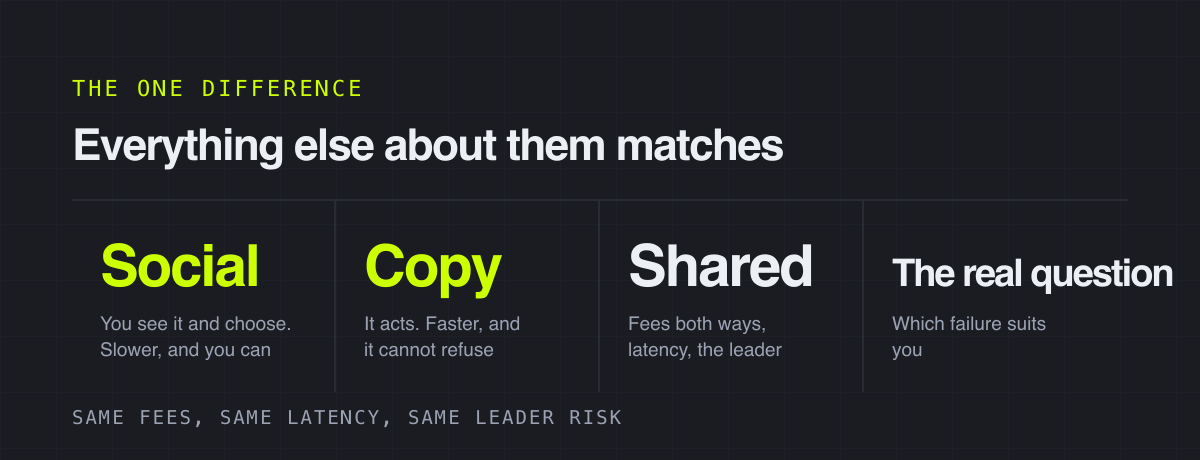
Which failure do you want
Social trading fails by omission. You see the entry, hesitate, and miss the move – and the trades you missed are invisible, so the cost never shows up in a record anywhere. It feels free and is not.
Copy trading fails by commission. It buys the thing you would have refused, at a size you set weeks ago, while you were asleep. That cost is extremely visible, which is why copy trading feels worse than it performs and social trading feels better.
The arrangement most people end up with
- Alerts on a handful of wallets through
 Cielo Finance, read rather than acted on automatically – this is the selection stage, and it costs nothing to run for weeks.
 - A record of which signals you would have taken, kept before any money is involved.
- Copying only the wallet that survived that record, at a fixed small size –
 GMGN Copy Trade or
  CopyFomo do the mirroring.
 - Exits mirrored as well as entries, which is the setting that decides the outcome and the one most often left off.
- The alerts left running afterwards, because they are the only way to notice the wallet has changed behaviour.
That sequence uses both, in the order that makes each one good at what it is good at: the feed for choosing, the bot for executing, and never the bot for choosing.
Tools mentioned
FAQ
What is the difference between social trading and copy trading?
Social trading shows you what other traders are doing and leaves the decision with you. Copy trading mirrors their trades into your account automatically. Everything else – the fee stack, the latency, the risk that the leader stops – is the same in both.
Is copy trading just faster social trading?
No. It removes the veto. Social trading means you are late to everything but never hold something you would have refused; copy trading means you are a block behind and you own every trade the leader takes, including the ones you would have passed on.
Which is better for a beginner?
Alerts first. Following a few wallets and recording which signals you would have taken costs nothing and answers the only question that matters – whether the wallet is worth copying – before any money is exposed to it.
More from the blog
Reading a Memecoin Community Before You Buy Into It
A busy Telegram is not demand. Four things separate a community from a room that was paid to look like one.
RWA Tokens: What Is in the Basket, and What It Owns
Every list of real-world-asset tokens mixes three unrelated things. Sorting them takes one question, and most lists never ask it.
Where Tokenized Stocks Trade, and Why the Venue Decides
The same ticker exists on several chains as several different instruments. What you can do with it depends entirely on which one you bought.