Tokenized Private Credit: The Yield Is Someone Else's Loan
The highest yields in RWA come from the part with no public market, no daily price and no easy exit. That is not a coincidence.
The short answer
Tokenized private credit puts loans to private companies onchain as a token paying interest. The yield is higher than treasuries because the borrowers are riskier and the position is illiquid – and tokenizing it changes how the claim is recorded, not what happens when a borrower stops paying.
Private credit is lending to companies that do not borrow from public bond markets. It has been one of the fastest growing corners of traditional finance for a decade, and it has arrived onchain for the obvious reason: the yields are visibly higher than anything treasuries pay, and a higher number attracts attention.
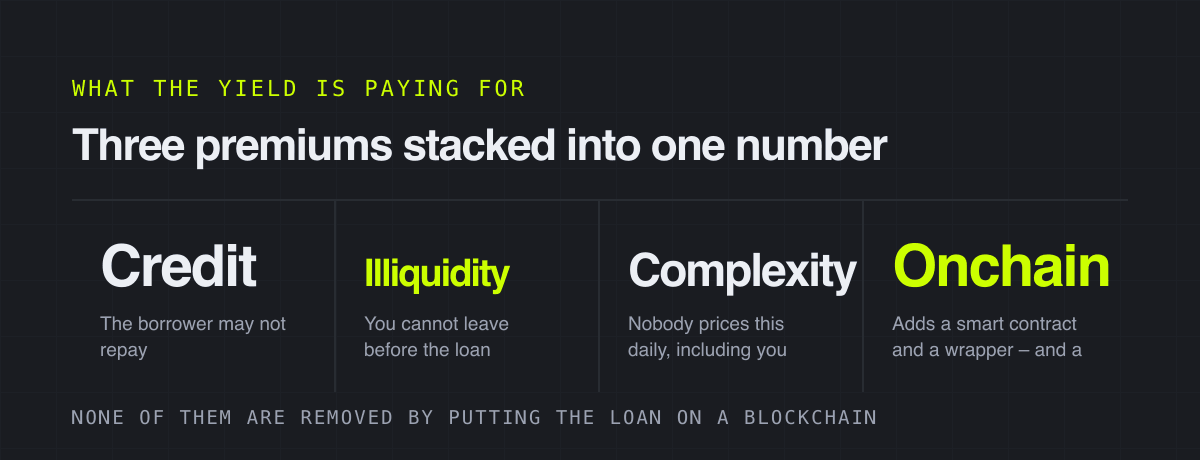
The higher number is not free. It is the market paying you for three things at once, and it is worth being able to name all three before deciding whether the payment is adequate.
What the yield compensates
The first is credit risk. These borrowers do not have public bond ratings, and some of them will not repay. A diversified pool spreads that, which helps and does not remove it.
The second is illiquidity, and it is the one that actually bites. A loan has a term. Until it matures, your money is lent out. The token might trade, but if it does, it trades in a thin market at whatever price someone offers – which is not the same as redeeming at par.
The third is complexity. Private loans are not priced daily by a market. The value you see is a model or a manager's mark, and marks lag reality in both directions. A stable-looking number does not mean a stable underlying.
What tokenization genuinely improves
There are real gains and they are worth stating fairly. Settlement is faster. Minimums drop, so exposure that required an institutional ticket becomes available in smaller sizes. Positions are visible onchain rather than in a quarterly statement. And a token can be used as collateral in ways a fund interest cannot.
Those are genuine. They are improvements in plumbing, which is what most honest RWA products are.
| Question | What a good answer looks like |
|---|---|
| Who are the borrowers? | A named strategy and sector, not just a yield number |
| What is the default history? | Published, including the bad years |
| How is the position valued? | A stated methodology and an independent check |
| How do I exit? | Redemption terms and notice period, in writing |
| What happens in a default? | A recovery process someone has actually run |
The question that matters most
Ask how you get out, and get a specific answer. Redemption at par on notice is a different product from selling into whatever secondary market exists. If the answer is that the token trades, look at the depth of that market – then assume you will want to exit at exactly the moment everyone else does, because that is when illiquidity becomes a number instead of a word.
For the shape of the category rather than any single issuer's pitch,  DefiLlama RWA tracks assets under management across products, and a strategy with very little of it is a strategy that has not been tested by anyone else's money either.
How to hold it, if you hold it
- Size it as illiquid from the first day. Assume you cannot exit early, because sometimes you cannot.
- Read the default history rather than the target yield. Target yields are marketing; defaults are data.
- Treat a stable displayed value with suspicion rather than comfort. Nothing lending to private companies is genuinely stable week to week.
- Keep it separate from the part of your portfolio you might need. That is what the illiquidity premium is paying you for.
Tools mentioned
FAQ
What is tokenized private credit?
Loans to private companies, packaged so that a token represents a share of the loans and the interest they pay. The token can be held and transferred onchain, but the underlying is still a set of illiquid private loans.
Why is the yield on tokenized private credit so high?
It pays for three things: borrowers who may default, money you cannot withdraw before maturity, and a position nobody prices daily. Putting the loan on a blockchain removes none of the three.
Is tokenized private credit safe?
It is a credit product, so no – it carries default risk by design. The specific onchain risks are added on top: the smart contract, the wrapper, and a secondary market that may not be there when you want to sell.
Can I sell tokenized private credit whenever I want?
Only if a secondary market exists and has depth, which is usually the weak point. Many products offer redemption at set intervals with notice instead, which is a different thing from selling and the detail to confirm before you buy.
More from the blog
Tokenized Bonds Beyond Treasuries: Credit, Coupons and Who May Hold Them
A tokenized treasury is a short government loan with no credit question. Everything else in the bond market has one, and it changes the product.
Tokenized Commodities: What Is Behind the Barrel
Gold sits in a vault. Oil does not sit anywhere convenient, which is why almost every oil token is a fund and not a barrel.
Tokenized ETFs: A Wrapper Around a Wrapper
An ETF is already a basket you do not hold directly. Tokenizing it adds a second layer, and the second layer is where the differences live.