A Memecoin Strategy That Survives Contact With a Launch
Most strategies are a list of indicators. This one is four decisions made before you open the chart, because afterwards you will not make them.
The short answer
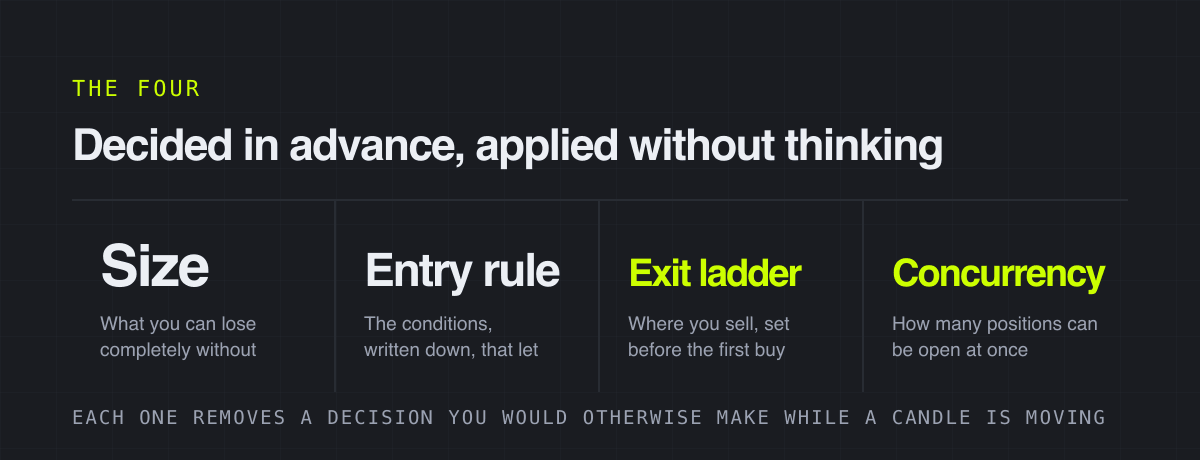
A workable memecoin strategy is four decisions taken before entry: what size is survivable, what has to be true to buy, where the exit is, and how many positions run at once. The edge is not in picking better tokens – it is in having already decided the things you will not be able to decide at speed.
Ask for a memecoin strategy and you get indicators. Volume thresholds, holder counts, a moving average someone found on a chart of something else. None of them are the problem. The problem is that on a live launch you have about forty seconds and no capacity for judgement, so every decision you have not already made will be made badly.
What follows is four decisions. They are made once, away from a chart, and then applied mechanically.
One: the size that does not change how you behave
The correct position size for a memecoin is the amount whose total loss would not alter a single thing you do next. Not the amount you can afford. The amount that, at zero, leaves your next trade unaffected.
This is testable. If losing it would make you size up to recover, the size was wrong. Revenge trading is not a character flaw, it is what happens when the position was large enough to matter.
Two: what has to be true before you buy
Write the conditions down. Not a feeling about the chart – a list you can check in under a minute. Most workable lists are short: liquidity above a floor you set, a bundle share you can live with, the deployer wallet not already selling, and a reason to be in it that is not the price going up.
 Dexscreener and
  GMGN both put liquidity, holders and recent trades on one screen, which is what makes a sixty-second check possible at all.
Three: the exit, decided before the entry
The only exit plan that survives is one written before you have a position, because afterwards every level you set becomes negotiable. A ladder works better than a single target: take part of the position at a multiple that pays back the entry, leave the rest running, and accept that the remainder going to zero is the cost of the part that did not.
| Stage | Action | What it protects |
|---|---|---|
| First multiple | Sell enough to return the original stake | Turns the trade risk-free in cash terms |
| Second multiple | Sell a further slice on the way up | Converts a paper number into a real one |
| Remainder | Run it with no target | Keeps the tail without needing to call the top |
| Thesis broken | Exit fully, regardless of price | Stops a trade becoming a bag |
Four: how many at once
Concurrency is the decision nobody writes down, and it is the one that quietly determines your results. Five open positions means each gets a fifth of your attention, and the one that needed watching was not the one you were watching. Most people are better with two.
- Cap the number of open positions before the session, not during it.
- A new entry requires closing something, not adding to the pile.
- Track the cap you actually ran against the one you set – the gap is the honest measure of discipline.
- If you cannot name every open position from memory, you have too many.
What this strategy does not do
It does not improve your token selection. It will not find the launch that runs a hundred times, and nothing in it is an edge over anyone with faster execution. What it does is stop the losing trades from being the large ones, which is the only variable in this market most people can actually control.
The traders who last are not the ones with better entries. They are the ones whose worst month was survivable because the size was decided in advance.
Tools mentioned
FAQ
What is the best memecoin trading strategy?
The one you can execute in under a minute under pressure. In practice that means deciding size, entry conditions, exit ladder and how many positions you run at once before you look at any chart – because none of those decisions can be made well while a price is moving.
How much should I risk on a single memecoin?
An amount whose complete loss would not change your next trade. If losing it would make you size up to get it back, it was too large, whatever the percentage looked like on paper.
Should I take profit or let it run?
Both, in stages. Selling enough at the first meaningful multiple to return your original stake removes the pressure from the rest, which is what lets you actually hold the remainder instead of panicking out of it.
How many memecoin positions should I hold at once?
Few enough to name from memory. Most people degrade sharply past two or three, because attention is the scarce resource in a market that moves in seconds.
More from the blog
Tokenized Bonds Beyond Treasuries: Credit, Coupons and Who May Hold Them
A tokenized treasury is a short government loan with no credit question. Everything else in the bond market has one, and it changes the product.
Tokenized Private Credit: The Yield Is Someone Else's Loan
The highest yields in RWA come from the part with no public market, no daily price and no easy exit. That is not a coincidence.
Tokenized Commodities: What Is Behind the Barrel
Gold sits in a vault. Oil does not sit anywhere convenient, which is why almost every oil token is a fund and not a barrel.