How People Actually Make Money on Memecoins
There are four ways, they are not equally available, and only one of them is what most people are attempting.

The short answer
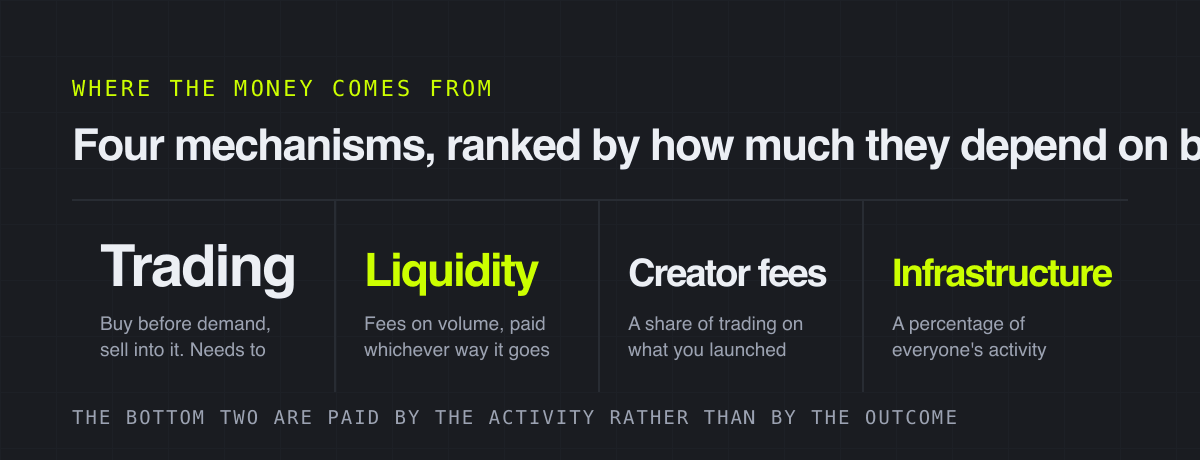
Four mechanisms: buying early and selling into later demand, providing liquidity and collecting fees on the volume, earning creator or holder rewards built into a launchpad's fee split, and operating infrastructure that charges everyone regardless of direction. Only the first depends on being right about a token.
The question gets asked as though there is one answer and a technique behind it. There are four mechanisms, they pay from different places, and the difference between them explains most of why the market looks easy from the outside and is not.
One: buying before the demand
The obvious one. Acquire supply at a price, find someone who wants it at a higher one. This is what nearly everyone is doing, it is the only one of the four that requires being right about a specific token, and the money for your gain comes from a later buyer rather than from any economic activity.
That is not a moral objection, it is a structural fact with a consequence: the returns are a transfer, so the average participant cannot do well by definition. A minority does very well, most do poorly, and the distribution is much more skewed than in markets with cash flows underneath them.
Two: providing the liquidity
Every trade pays a fee to whoever supplied the pool. On a token doing heavy volume, that is real revenue collected in both directions, from buyers and sellers, whether the price rises or collapses.
The catch is divergence loss on a pair where one side can fall ninety percent, which is why the fee tier on these pools is the highest available. Whether it pays is measurable rather than a matter of opinion – the impermanent loss calculator on this site is the comparison against simply holding.
Three: launching and earning the fee split
Several launchpads route a share of trading fees to the token's creator, and some route a share to holders. That turns launching into a business with revenue rather than a single sale – the creator earns on volume, not on selling their own allocation.
The honesty of the model depends on the split being published and enforced by contract, which on  PONS and
  hood.fun it is. The dishonest version is the same business funded by selling the allocation quietly.
| Mechanism | Paid by | Needs you to be right? |
|---|---|---|
| Trading | A later buyer | Yes, about the token |
| Liquidity provision | Everyone who trades | About the pair, not the direction |
| Creator or holder fees | Trading volume | About attracting volume |
| Infrastructure | All participants | No |
Four: selling shovels
Terminals, bots, launchpads and aggregators charge a percentage of activity.  GMGN,
GMGN,  Maestro and every trading bot in the catalogue earn on volume regardless of whether their users made money, which is the most reliably profitable position in the entire market and the one nobody asking this question is in.
What this means for you
- If you are doing the first one, you are in the hardest of the four. That is worth knowing before concluding you are bad at it.
- The second is available to anyone, is measurable, and is almost never considered by people trading the same tokens.
- The third is a business, with the workload of a business.
- The fourth explains why every tool is free to start and takes a percentage forever.
The useful reframe is that only one of the four asks you to predict anything. Most people never learn that the other three exist, and spend years getting better at the hardest one.
FAQ
How do people make money on memecoins?
Four ways: buying early and selling into later demand, providing pool liquidity and collecting trading fees, earning a creator or holder share of a launchpad's fee split, or operating the tools that charge a percentage of everyone's activity.
Is trading memecoins profitable?
For a minority, substantially. Because gains come from later buyers rather than from any underlying earnings, the average participant cannot do well by construction – the distribution is far more skewed than in markets with cash flows.
Can you make money providing liquidity to memecoins?
Yes, and the income arrives whether the price rises or falls, since fees are paid on both sides. The risk is divergence loss on a pair where one asset can collapse, which is why these pools use the highest fee tier.
What is the most reliable way to make money in memecoins?
Charging a percentage of other people's activity – terminals, bots and launchpads earn on volume regardless of outcome. It is also the only one of the four mechanisms that requires building something rather than trading.
More from the blog

Tracking Whale Wallets Without Mistaking Size for Skill
A large balance is evidence of a large balance. Whether it means anything about the next trade is a separate question, and usually the answer is no.
Wallet Tracking You Will Actually Read
Everyone sets up alerts. Almost nobody survives the second week, because the setup was designed to catch everything.
Risk-Reward on a Token With No Floor
The ratio assumes you know where you get out. On a DEX with no stop loss, half the formula is missing – and it is the half that matters.