How RWA Tokenization Actually Works, Step by Step
Four parties, one legal wrapper and a contract. The chain is the least complicated part of it, which is why the interesting risks are all off-chain.
The short answer
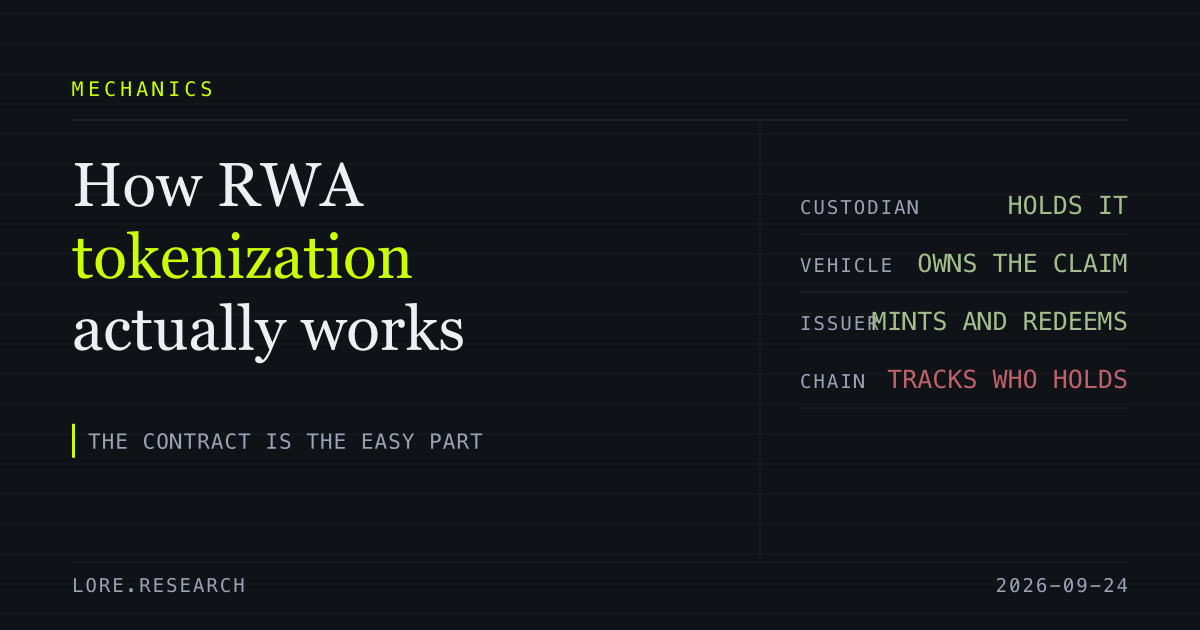
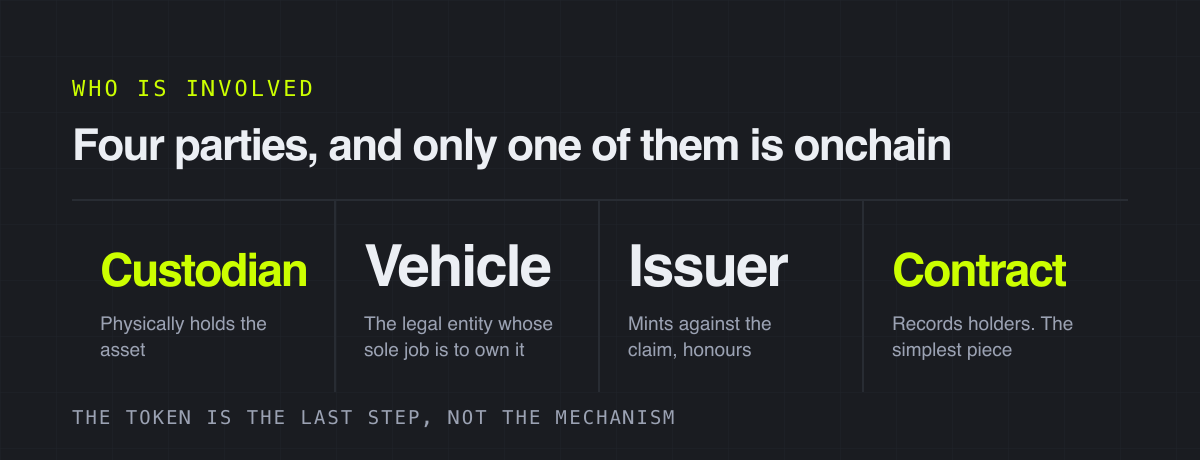
Tokenizing a real-world asset takes four parties: an owner or originator who holds the asset, a custodian who keeps it, a legal vehicle that gives the token a claim on it, and an issuer who mints tokens against that claim and honours redemptions. The smart contract is the simplest component – usually a standard token with transfer restrictions bolted on so only permitted addresses can hold it. Everything that decides whether the token is worth anything happens in the legal wrapper and the custody arrangement, both of which are off the chain and neither of which a block explorer can show you.
Explanations of tokenization usually start with the contract, which is the wrong end. The contract is a fortnight of work. The structure it sits on top of is the part that takes a year and decides everything.
Step one: the asset is isolated
A legal vehicle is created whose only purpose is to own the asset – a special-purpose entity, a fund, a trust, depending on jurisdiction. The point is isolation: if the sponsor fails, the asset belongs to the vehicle and not to the sponsor's creditors. When people say a tokenized asset is bankruptcy-remote, this is the step they mean.
Step two: custody
Somebody physically holds it. A regulated custodian for securities, a bank for cash instruments, a title held in the vehicle's name for property. The chain has no visibility into this, and every attestation about it is a document produced by a third party rather than a fact readable onchain.
Step three: the claim becomes a token
An issuer mints tokens representing entitlement against the vehicle. The contract is normally a familiar standard with restrictions added: an allowlist of addresses permitted to hold it, a freeze function, sometimes forced transfer. These exist because the issuer has regulatory obligations that a bearer instrument cannot satisfy.
Step four: redemption, which is the real test
Issuance is easy and every project does it. Redemption is where structures are tested: who accepts the token back, at what price, on what schedule, with what minimum, and what happens when many people ask at once. A tokenization that has never processed a redemption under stress has not yet been tested at all.
Where this leaves the chain
Doing the least interesting and most valuable job: instant settlement, continuous trading hours, transfer without an intermediary clearing it, and composability with everything else onchain. That last one is the genuine innovation – an asset that can be collateral in a lending market the same afternoon it was issued is doing something the traditional plumbing cannot.
What the chain cannot do is verify the first three steps. A token can be perfectly implemented and represent a claim on nothing.
How to read a tokenized asset before buying it
- Find the issuer and the regulator. If neither is stated plainly, that is the finding.
- Find the custodian, and whether reserves are attested and how often.
- Read the redemption terms – minimum size, schedule, who may redeem. Many permit only institutions.
- Check the contract on
 Blockscout for freeze and forced-transfer functions, and assume they will be used as documented.
 - Look for secondary liquidity. Issuance without a market is a one-way door.
Tools mentioned
FAQ
How does RWA tokenization work?
A legal vehicle is created to own the asset, a custodian holds it, and an issuer mints tokens representing a claim against that vehicle. The token contract is usually a standard one with transfer restrictions added. The chain records holders and settles transfers; it does not hold the asset.
Why do RWA tokens have transfer restrictions?
Because the issuer has regulatory obligations – know-your-customer, sanctions screening, sometimes investor eligibility – that a freely transferable bearer token cannot satisfy. Allowlists, freeze functions and forced transfers are the price of the structure being permitted to exist.
What is the hardest part of tokenizing an asset?
Not the contract. The legal vehicle, custody and redemption terms take the time and carry the risk, and none of the three is visible on a block explorer. A structure that has never processed redemptions under stress has not been tested.
More from the blog
Social Trading vs Copy Trading: Not the Same Thing
One shows you what people are doing and leaves the decision with you. The other takes the decision away. That difference is the entire product.
Reading a Memecoin Community Before You Buy Into It
A busy Telegram is not demand. Four things separate a community from a room that was paid to look like one.
RWA Tokens: What Is in the Basket, and What It Owns
Every list of real-world-asset tokens mixes three unrelated things. Sorting them takes one question, and most lists never ask it.