How a Token Trends on DEX Screener
Five of the inputs are onchain. Two are not, and those two are the reason trending is not a measure of trading.
The short answer
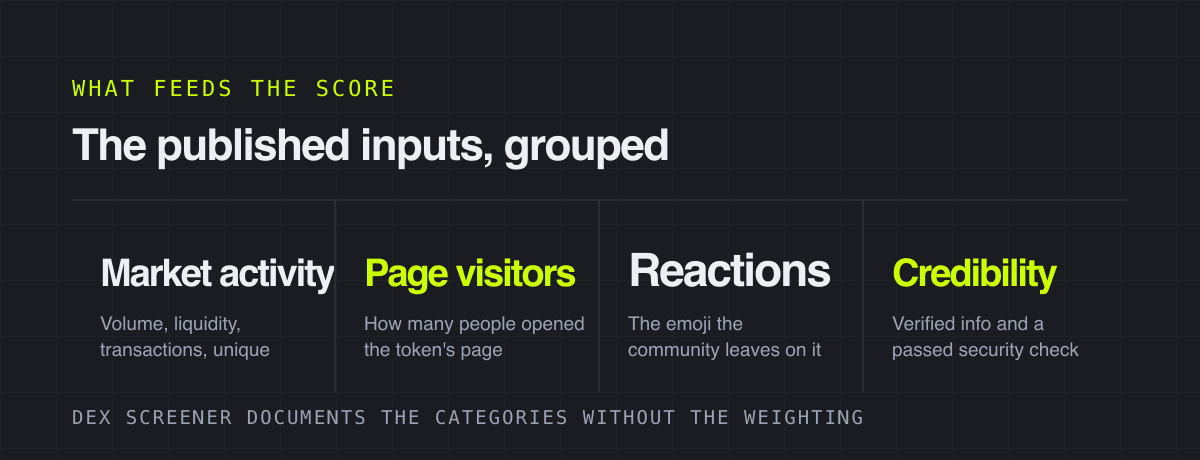
DEX Screener assigns every token a Trending Score built from volume, liquidity, transactions, unique makers and holders, plus two off-chain inputs: how many people visited the token's page on the site and app, and the emoji reactions left there. Verified token info and a passed security check raise it further.
The trending bar is the first thing most people look at, and it is treated as a readout of what is being traded. It is not.  DEX Screener publishes the categories that feed its Trending Score, and two of them have nothing to do with the chain.
The onchain half
Volume, liquidity, transactions, unique makers and holders. These are the sensible ones and they are measured directly from the chain – DEX Screener runs its own indexer over raw logs rather than pulling from external APIs, so the numbers are the chain's own.
Unique makers is the most interesting of the five, because it is the one that is awkward to fake cheaply. Volume can be produced by two wallets passing a token back and forth. Distinct participants cannot, not at the same cost.
The half that is not onchain
Two inputs come from the site itself: how many people visited the token's page on the website and in the app, and the reactions the community leaves there – the rocket, the fire, and the two less flattering ones.
The platform is explicit about this in its own documentation, and it tells projects as much: robust trading activity and community engagement on DEX Screener are both routes to the top. Engagement is a thing a project can organise.
The credibility inputs
Tokens with verified information get a boost, particularly through the paid Enhanced Token Info product, and tokens that are open-source and pass security checks score better. Both are reasonable signals and both are partly a function of a team's budget and effort rather than of the market.
| Input | Onchain? | Can a project influence it directly? |
|---|---|---|
| Volume | Yes | Yes, at a cost |
| Liquidity | Yes | Yes, by adding it |
| Unique makers | Yes | Only by having real buyers |
| Holders | Yes | Partly – distribution is arrangeable |
| Page visitors | No | Yes, by directing traffic |
| Reactions | No | Yes, by asking a community |
| Verified info | No | Yes, by paying for it |
What this means for reading the list
Trending is a composite of market activity and marketing effort, and the documentation does not publish the weighting. So a token near the top has some combination of real trading and organised attention, and the ranking alone will not tell you the ratio.
- Use the new-pairs feed rather than trending for discovery. By the time something trends, the attention that got it there has already been paid for.
- When something is trending, check unique makers against volume. Many makers is the hardest input to manufacture.
- Read liquidity before anything else, because that is your exit regardless of how the token ranks.
- Treat a high rank as a question rather than an answer.
None of this makes the score dishonest. It is published, it is explained, and a composite of activity and interest is a defensible thing to rank by. It simply is not the thing most people assume they are reading.
Tools mentioned
FAQ
How does DEX Screener trending work?
Every token gets a Trending Score built from market activity – volume, liquidity, transactions, unique makers and holders – plus page visitors and community reactions on DEX Screener itself, with additional weight for verified token info and passed security checks.
Is DEX Screener trending based only on trading?
No. Two of the published inputs are off-chain: how many people visit the token's page on the site and app, and the emoji reactions left there. Both are things a project can organise directly.
Can a project influence its trending score?
Yes, through several of the published inputs – by directing traffic to its page, encouraging reactions, paying for verified token info, and by buying Boosts, which apply a multiplier to the score.
What is the most reliable signal in the trending list?
Unique makers. Volume can be produced by a small number of wallets trading with each other; a large count of distinct participants is the input that costs the most to fake.
More from the blog
Prediction Markets: A Price That Looks Like a Probability
A contract paying one dollar if something happens trades at the market's estimate of it happening. The gap between that and a forecast is where the money is.
Staking, and Why There Is None on This Chain
Staking pays you for securing a network. An L2 that settles to Ethereum and charges gas in ETH has nothing for you to secure.
Multisig: Removing the Single Point of Failure
Two of three signatures to move anything. It solves theft and loss at once, and introduces a problem of its own.