Checking a Wallet's Real PnL Before You Follow It
A leaderboard number is a claim. Five adjustments separate it from what the wallet actually made, and they usually point the same way.
The short answer
A wallet's displayed PnL is usually gross, unrealised, single-address and survivorship-filtered. Checking it properly means adjusting for realised versus paper gains, related wallets, fees and gas, position size relative to what you could trade, and how long the record is.
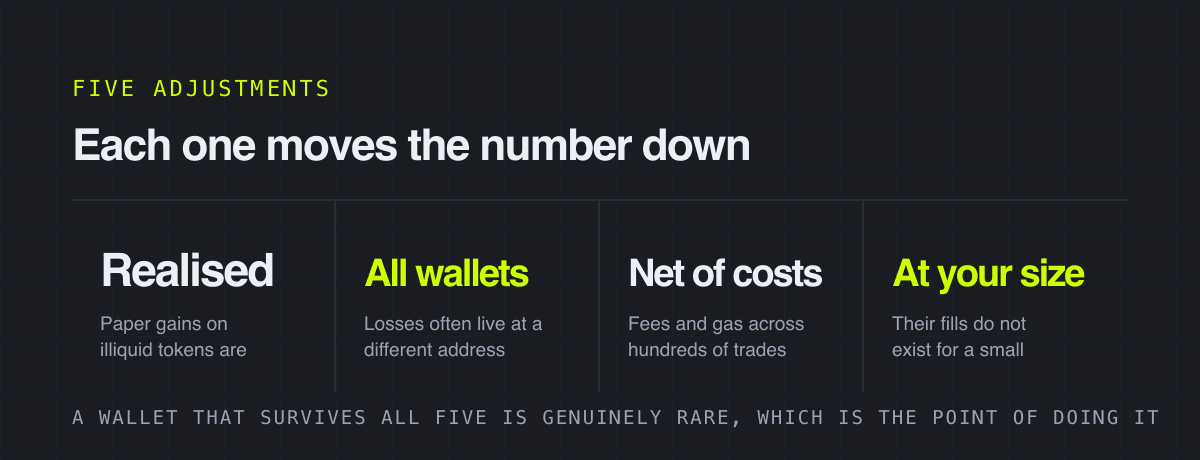
Every copytrading decision starts with a number next to a wallet address. The number is real in the sense that it was computed from onchain data, and misleading in four or five specific ways that all push it in the same direction.
One: realised against unrealised
A large share of most displayed PnL is the current value of tokens still held. If those tokens are illiquid, that value is a quote rather than a price – the wallet cannot exit at it, and neither could you.
Separate the two. A wallet with most of its gains realised has demonstrated it can sell, which is a different and much harder skill than buying.
Two: the wallets you are not looking at
The strongest distortion. A trader running several addresses can show a clean record on one while the failures sat elsewhere, and there is nothing dishonest required – separating a speculative wallet from a main one is ordinary practice.
 Bubblemaps clusters addresses sharing a funding source, which is the fastest way to find the rest of the set.
 Arkham puts entity labels on addresses where it can, turning a hex string into a name you can check.
Three: costs
Displayed PnL is usually gross. Across hundreds of trades, pool fees, terminal fees and gas are a material subtraction – and a high-frequency wallet's headline number is inflated by exactly the trading that generated those costs.
Four: size
This is the adjustment almost nobody makes and it changes the ranking more than the others. A wallet trading size gets fills a small account cannot, in pools where the small account would move the price. Conversely a wallet trading tiny amounts into thin pools has a record that will not scale to your capital.
| What the number shows | What to adjust it to |
|---|---|
| Total PnL | Realised PnL only |
| One address | Every address sharing a funder |
| Gross | Net of fees and gas |
| Their position sizes | Sizes you could actually trade |
| All time | A period that includes a bad market |
Five: how long the record is
A spectacular three-week record is a sample, not evidence. The useful question is whether the wallet traded through a period where most things lost money, because that is when the difference between skill and beta shows up. A record entirely inside one good month tells you about the month.
The shortcut
 Nock Scout does the size adjustment directly – it ranks wallets by what a one to three ETH copier would have made rather than by the wallet's own returns, which is the correct adjustment and produces a very different order from any raw leaderboard.
 Cielo Finance filters on win rate and PnL when you are building a shortlist by hand.
- Compute realised PnL separately before anything else.
- Look for the sibling wallets before believing the record.
- Ask whether the record includes a bad month, and discount it if not.
- Then judge on whether a copier at your size would have got those fills.
A wallet that survives all five is rare, and finding one is worth considerably more than scanning a hundred leaderboard entries that have survived none.
Tools mentioned
FAQ
How do I check a wallet's PnL?
Start with a tracker's figure, then adjust it: separate realised from unrealised gains, find related addresses sharing a funding source, subtract fees and gas, and consider whether the fills would exist at your position size.
Are wallet PnL leaderboards accurate?
The arithmetic is usually right and the framing is usually misleading. Figures are typically gross, include unrealised gains on illiquid tokens, and cover a single address when the trader runs several.
Why does a wallet's real PnL differ from what a tracker shows?
Four reasons, all pointing the same way: paper gains counted as profit, losses sitting at a different address, fees and gas excluded, and fills that only existed at that wallet's size.
What is the best way to find a wallet worth copying?
Rank by what a copier at your size would have made rather than by the wallet's headline return, and require a record long enough to include a bad market. Both filters remove most of any leaderboard.
More from the blog
Prediction Markets: A Price That Looks Like a Probability
A contract paying one dollar if something happens trades at the market's estimate of it happening. The gap between that and a forecast is where the money is.
Staking, and Why There Is None on This Chain
Staking pays you for securing a network. An L2 that settles to Ethereum and charges gas in ETH has nothing for you to secure.
Multisig: Removing the Single Point of Failure
Two of three signatures to move anything. It solves theft and loss at once, and introduces a problem of its own.