How to Provide Liquidity, Step by Step
Six steps, and the two that decide the outcome happen before you click anything.
The short answer
Providing liquidity means depositing two assets into a pool so traders can swap between them, in exchange for a share of the fees. The mechanical steps take five minutes; the two decisions that determine whether it works – which pair, and how wide a price range – are made before any of them.
Providing liquidity is depositing two assets so that other people can swap between them, and being paid a share of the fee on every swap that uses your capital. The clicking is simple. What decides the result is two choices made before the wallet opens, and a third thing nobody mentions until afterwards.
Before anything: pick the pair
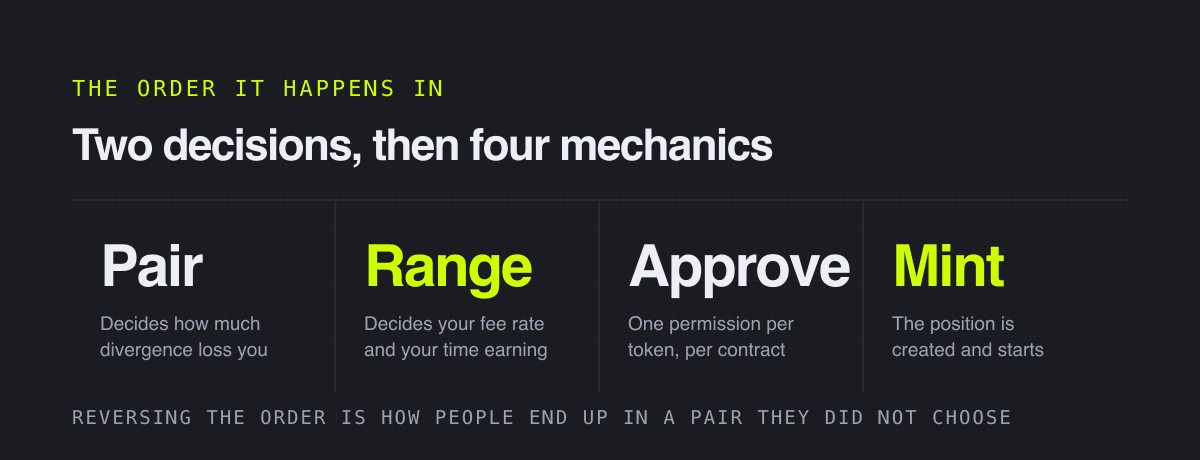
The pair determines how much divergence loss you will carry, and that is the largest variable in the whole exercise. Two assets that move together barely diverge. A volatile token against ETH can diverge enormously, and the fees have to cover it.
Be clear with yourself about what you are agreeing to: a liquidity position sells the asset that rises and buys the one that falls, continuously, without asking. If you would be unhappy holding less of the winner, you have picked the wrong pair.
Then: pick the range
On a concentrated liquidity venue you set a lower and an upper price. Inside it you earn; outside it you hold one asset and earn nothing. Narrow multiplies the rate and cuts the hours.
The mechanical part
- Connect a wallet to
 Uniswap and select the two tokens. Check the contract address of anything that is not a major asset – the ticker is not the name.
- Choose the fee tier. Stable pairs at the lowest, volatile pairs at the highest; it is the fee that pays you for the risk.
- Set the range. The interface will show what share of your deposit goes into each token, and that ratio changes as you move the bounds.
- Approve each token. This is a permission granted to a contract, and it persists after you leave –
 Revoke.cash is how you take it back later.
- Mint the position. On a concentrated liquidity venue you receive an NFT rather than a fungible token, because your range makes the position unique.
- Note the position's price bounds somewhere you will see them. Nothing will tell you when the price leaves.
The third thing
Fees do not compound. They accrue to your position and sit there uncollected until you claim them, which costs gas. A position left alone for a month has earned its fees and none of them have been reinvested, which is the gap between the advertised rate and what you actually receive.
| What the interface shows | What it means |
|---|---|
| Estimated APR | Last period's fees, annualised, assuming you stay in range |
| In range | Currently earning. Not a promise about tomorrow |
| Uncollected fees | Yours, but not compounding until claimed |
| Position value | The two assets at today's price, not what you deposited |
What to check a week later
- Is it still in range, and what share of the week was it earning?
- What is the position worth against simply having held the two tokens? That comparison is the only honest scorecard, and the impermanent loss calculator on this site runs it.
- Are uncollected fees large enough to be worth the gas to claim?
- Would you open the same position again today, knowing what the pair did?
If the answer to the last one is no, close it. A liquidity position is a trade with a view on a pair, and there is no rule that says you keep it because you opened it.
Tools mentioned
FAQ
How do I provide liquidity on a DEX?
Connect a wallet, pick the two tokens and a fee tier, set a price range, approve both tokens and mint the position. The steps take minutes – the choices of pair and range are what determine whether it is profitable.
How much do I need to provide liquidity?
There is no minimum in the protocol, but there is a practical one: gas to open, adjust and close the position is charged regardless of size, so a small position can spend most of its fees on its own maintenance.
Do I get paid automatically?
Fees accrue to your position but are not compounded. They sit uncollected until you claim them, which costs gas – so the advertised rate assumes reinvestment that does not happen by itself.
Can I lose money providing liquidity?
Yes, in two ways. Divergence loss means the position can be worth less than simply holding the two assets, and the tokens themselves can fall. Fees offset the first and do nothing about the second.
More from the blog
Prediction Markets: A Price That Looks Like a Probability
A contract paying one dollar if something happens trades at the market's estimate of it happening. The gap between that and a forecast is where the money is.
Staking, and Why There Is None on This Chain
Staking pays you for securing a network. An L2 that settles to Ethereum and charges gas in ETH has nothing for you to secure.
Multisig: Removing the Single Point of Failure
Two of three signatures to move anything. It solves theft and loss at once, and introduces a problem of its own.