USDT vs USDC: What Actually Differs, and Which Is Safer
Both are worth a dollar until the day one of them is not. The difference is what stands behind the dollar, and who you can ask about it.
The short answer
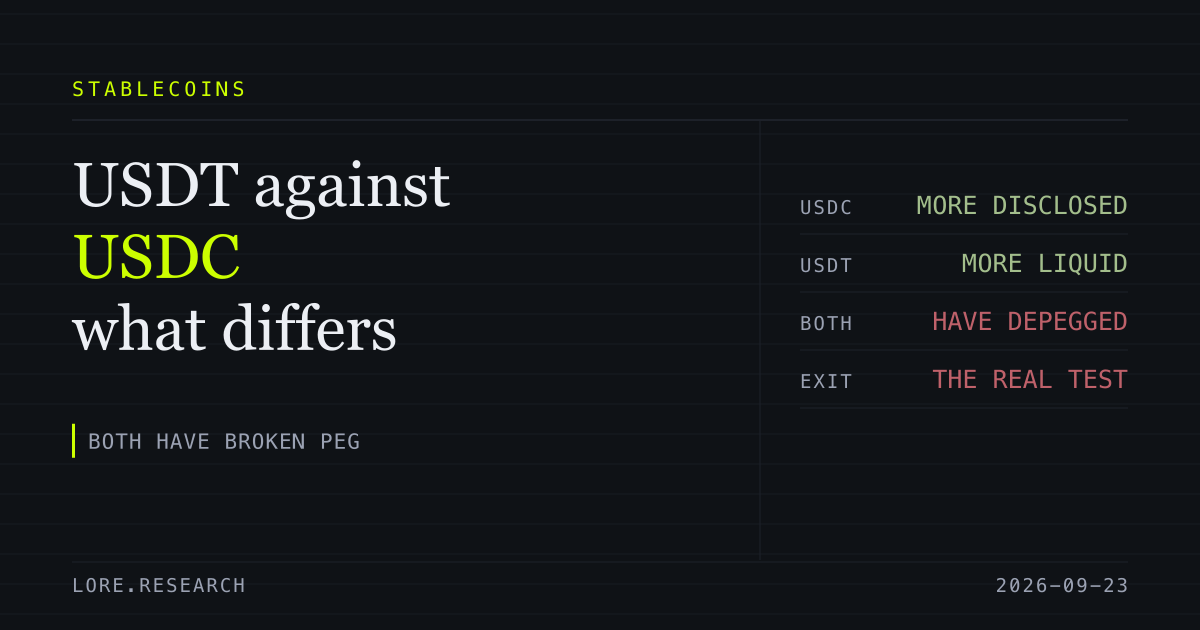
USDC is issued by Circle, a US-regulated company that publishes monthly attestations and holds reserves in cash and short-dated Treasuries. USDT is issued by Tether, holds a broader reserve including commercial paper historically and other assets now, and publishes quarterly attestations rather than full audits. USDT is larger and more liquid almost everywhere; USDC is more transparent about what backs it. Both have broken their peg – USDC to about $0.87 in March 2023 when part of its reserve sat in a failed bank – so the practical question is not which never breaks, but which you would rather be holding when one does, and how fast you could get out.
Both tokens promise the same thing: one of them is worth one dollar, and you can have the dollar. The promise is only as good as whoever is making it, and that is the whole of this comparison.
Who issues them
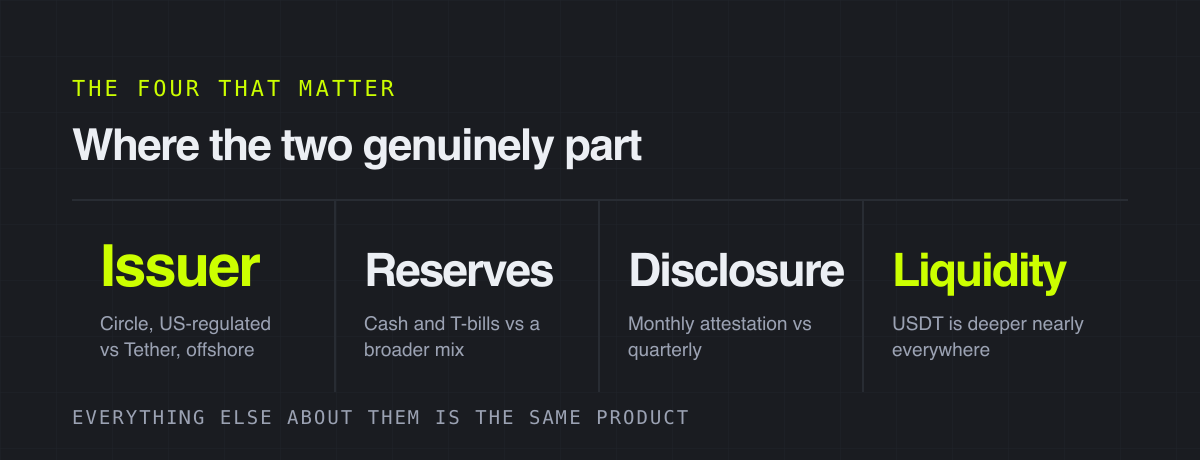
USDC comes from Circle, a US company operating under US money transmission rules, which publishes monthly reserve attestations from an accounting firm. USDT comes from Tether, incorporated offshore, which publishes quarterly attestations and has never completed a full audit in the sense that word normally carries.
Neither of those facts settles anything by itself. Regulation is not a guarantee, and offshore is not a verdict. What they change is how much you can find out before you decide, and how quickly you would hear if something were wrong.
What sits behind the dollar
| USDC | USDT | |
|---|---|---|
| Issuer | Circle, US-regulated | Tether, offshore |
| Reserves | Cash and short-dated Treasuries | A broader mix, disclosed by category |
| Reporting | Monthly attestation | Quarterly attestation |
| Redemption | Direct, for verified institutional accounts | Direct, for verified accounts, with a minimum |
| Size | Large | Larger, and the default pair on most venues |
| Onchain depth | Good | Usually deeper |
Both have broken
In March 2023 USDC fell to roughly 87 cents over a weekend, because a portion of Circle's reserve was held at a bank that failed and nobody knew until Monday whether it would come back. It did, and the peg recovered. USDT has traded below a dollar in several stress episodes on similar logic – not because the dollars were gone, but because for a few hours nobody could prove they were there.
The lesson is not that one is fake. It is that a peg is a belief about a balance sheet, and beliefs move faster than balance sheets.
Which to hold, in practice
- Trading actively: whichever has the deeper pair on the venue you are using – on this chain that is usually the
 Uniswap pool. Slippage on every entry and exit costs more than the difference in issuer risk over a short hold.
 - Parking a balance for weeks: the disclosure difference starts to matter, which argues for USDC.
- Parking a large balance: split them. The failure modes are not correlated, and the cost of splitting is nothing.
- Bridging between chains: check which one has real liquidity on the destination before you send it, and compare routes on
 Jumper (LI.FI) rather than taking the first. A wrapped stablecoin on a thin chain is a third asset with its own risk.
 - Anywhere: know your exit route before you need it. The time to discover your pair is shallow is not during a depeg.
The question that actually decides it
Not which issuer you trust more, but how long you intend to hold and how fast you could leave. Over an afternoon, liquidity is the only variable that matters. Over a quarter, it is the one that matters least.
Tools mentioned
FAQ
Is USDC safer than USDT?
USDC discloses more: a US-regulated issuer, reserves in cash and short-dated Treasuries, and monthly attestations against Tether's quarterly ones. That makes it more verifiable, not immune – USDC is the one that fell to about 87 cents in March 2023, when part of its reserve sat in a failed bank.
Which stablecoin has more liquidity?
USDT, on most venues and most chains. For active trading that usually outweighs the disclosure difference, because slippage is paid on every entry and exit while issuer risk is only paid on the rare day it matters.
Should you hold both?
For a balance large enough to care about, yes. Their failure modes are not correlated – one is a US banking and regulatory exposure, the other an offshore reserve and counterparty one – and splitting costs nothing beyond one extra swap.
More from the blog
Arbitrum Orbit: The Stack Robinhood Chain Is Built On
Not a brand on a box. A specific set of choices about who orders transactions, where the data goes, and what you are trusting when you bridge in.
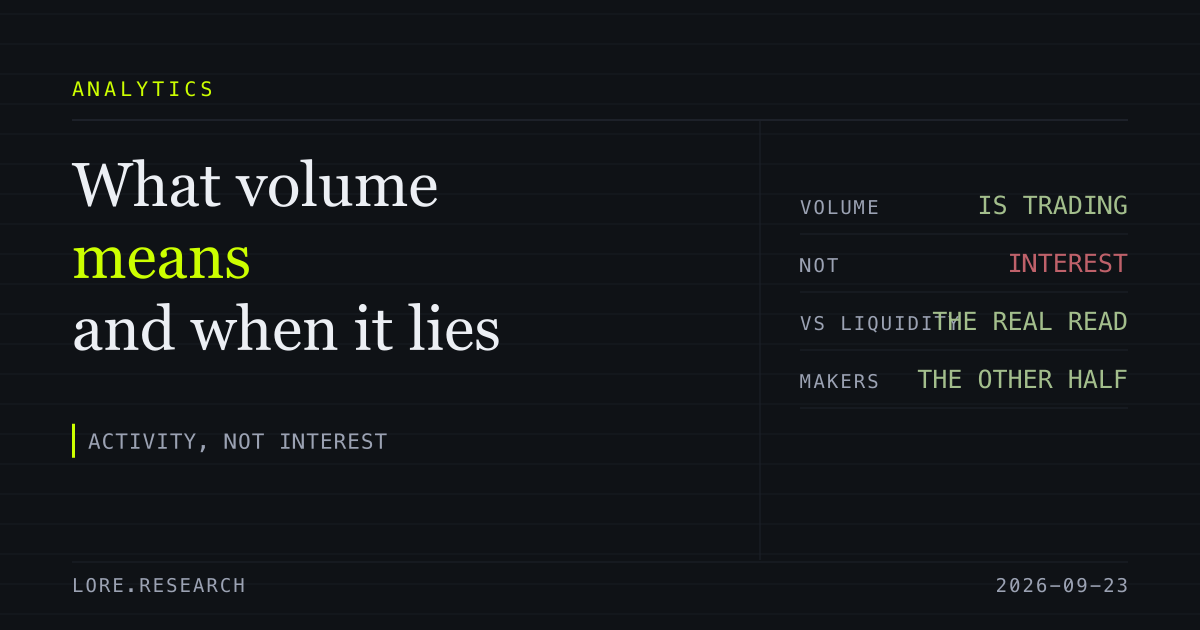
What Volume Means, and When the Number Is Manufactured
Volume is how much traded, not how many wanted to. Two wallets with a script can produce a week of it in an afternoon.

How to Swap Tokens, and the Four Screens That Matter
The swap itself is two clicks. Everything that decides whether it was a good one happens on the screens around it.