What to Do After a Rug Pull
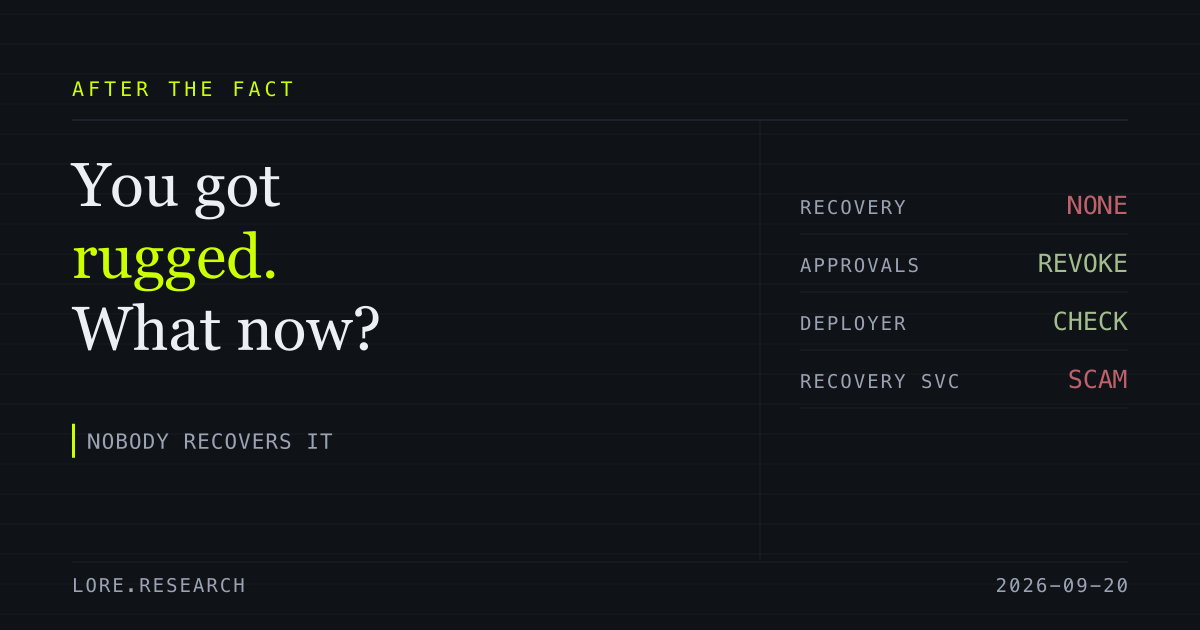
Nothing gets the money back. Several things stop the next hour being worse than the last one.
The short answer
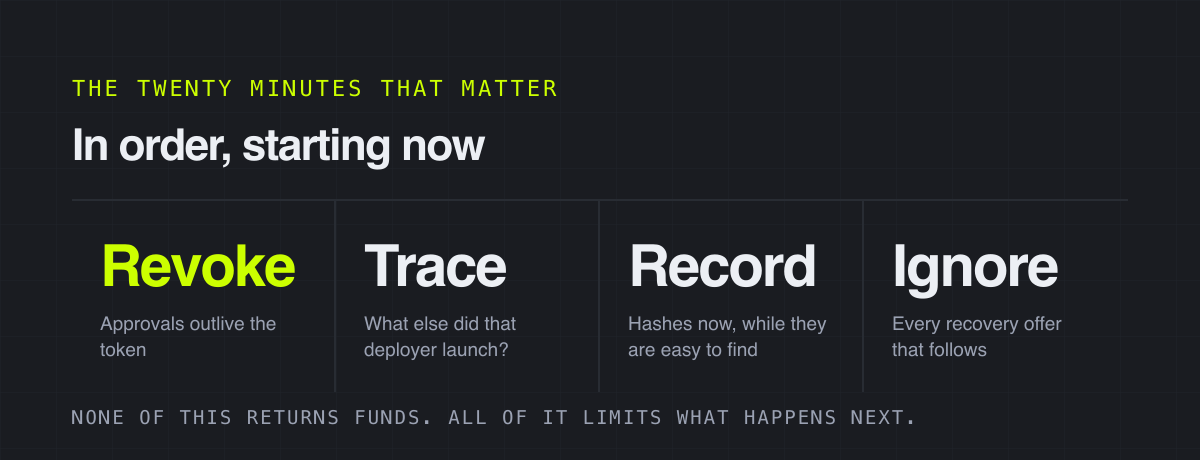
The money is gone and no service will recover it – anyone claiming otherwise is running the second scam, which targets people who have just lost to the first. What is worth doing takes about twenty minutes: revoke the approvals that token's contract still holds over your wallet, check whether the same deployer launched anything else you hold, record the transaction hashes while you can still find them, and move remaining funds if you signed anything you did not fully read. Then write down what you skipped before buying, because that is the only part of this that pays anything back.
First, the part nobody says plainly: it is not coming back. There is no support desk, no reversal, no authority that can unwind a transaction you signed. Every service advertising crypto recovery is either useless or is the follow-up scam, and they find people at exactly this moment because the search history makes them easy to find.
What follows is not a recovery plan. It is damage control, and it is worth doing now rather than tomorrow.
Revoke the approvals
When you bought, you granted a contract permission to move that token from your wallet. That permission does not expire and does not care that the token is worthless. If the contract has any ability to act on it, it still does. Open Revoke.cash, connect the wallet, and clear the approvals tied to that token and anything else you no longer trade.
Check what else the deployer touched
Open the token on Blockscout, find the contract creator, then open that address. Its history shows every other contract it has deployed. Serial deployers are the norm rather than the exception, and it is not unusual to find you hold two tokens from the same author. If you do, treat the second one as already gone and exit while it still has liquidity.
Record it while it is easy
Save the token address, the deployer address, your transaction hashes and the dates. If you ever need this – for a tax return, for a report, or simply to remember what happened – it is trivial to collect today and tedious in six months. Portfolio trackers like DeBank or Zerion will have most of it if you would rather not do it by hand.
Decide whether the wallet is still clean
If you bought through a link you did not vet, or signed a transaction whose contents you did not read, assume the wallet may have signed more than a swap. Move the remaining balance to a fresh wallet. This is over-cautious in most cases and cheap in all of them.
The part that actually pays
Write down what you skipped. Not the feeling – the specific check. Did you read the transfer history for existing sells? Did you look at holder concentration? Did you verify the contract address rather than searching the ticker? Was the position sized so that this outcome was survivable?
Almost everyone who loses money this way knew the checks existed and moved quickly instead. The value in a loss is entirely in naming which step you skipped, because that is the one you will skip again.
And about the messages that arrive next
- No legitimate service recovers stolen crypto. Not for a fee, not for a percentage, not with a court order.
- Nobody who contacts you first is helping. People who find you after a loss found you because you lost.
- Never sign anything to prove ownership. That request is the attack.
- A seed phrase is never needed for support. There is no support.
Tools mentioned
 Revoke.cash
 DeBank
 Zerion
FAQ
Can you recover money from a rug pull?
No. The transaction is final and there is no authority that can reverse it. Services offering recovery are the second scam, and they target this moment specifically.
How does a rug pull work?
The people holding the token's liquidity or the bulk of its supply sell into the buyers, or withdraw the pool entirely. It can be a single moment or a slow distribution over days. Either way it needs you to be on the other side of the sell.
Should I report a rug pull?
You can, and in some jurisdictions there is a route for it, but set expectations honestly – anonymous deployers on a public chain are rarely pursued. Recording the addresses and hashes costs nothing and is worth doing regardless.
More from the blog
How to Start Trading Memecoins
Six things to set up before the first buy, in the order that stops the common mistakes.
What “Smart Money” Means, and When the Label Lies
A wallet that made money is not the same as a wallet that knows something. Telling them apart is the whole skill.
How to Spot a Crypto Honeypot Before You Buy
A token you can buy and cannot sell. The tell is in the contract, and it is readable in about a minute.