What a Funding Rate Is, and Who Is Paying It
A perpetual has no expiry, so something has to keep it tethered to spot. That something is a payment between traders, every few hours, and you are on one side of it.
The short answer
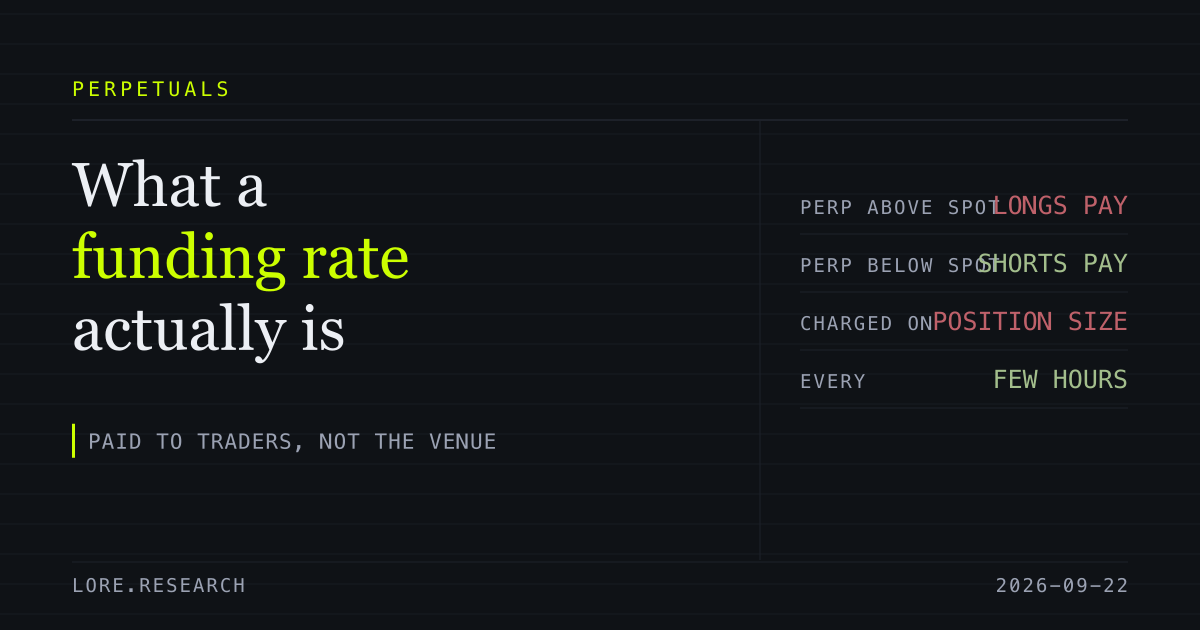
A funding rate is a periodic payment between long and short holders of a perpetual contract, used to keep its price tethered to spot. When the perpetual trades above spot the rate is positive and longs pay shorts; when it trades below, shorts pay longs. It is not a fee the venue takes – it moves between traders – and it is charged on position size, not on margin, so at high leverage it can be many times larger than it looks. A position held through a strongly positive funding period can be right about direction and still lose.
A futures contract with an expiry converges to spot because it has to – on the settlement date, the two are the same thing. A perpetual has no expiry, so nothing forces convergence. Funding is the mechanism invented to replace that force.
How it works
At regular intervals, commonly every eight hours, the venue compares the perpetual's price to spot. If the perpetual is trading higher, holders of long positions pay holders of short positions. If it is trading lower, the payment runs the other way. The size of the payment scales with how far apart the two prices are.
The effect is a continuous incentive to take the unpopular side. If everyone is long and the perpetual is above spot, being short starts paying you to wait, and that pressure is what pulls the contract back.
The part that costs people money
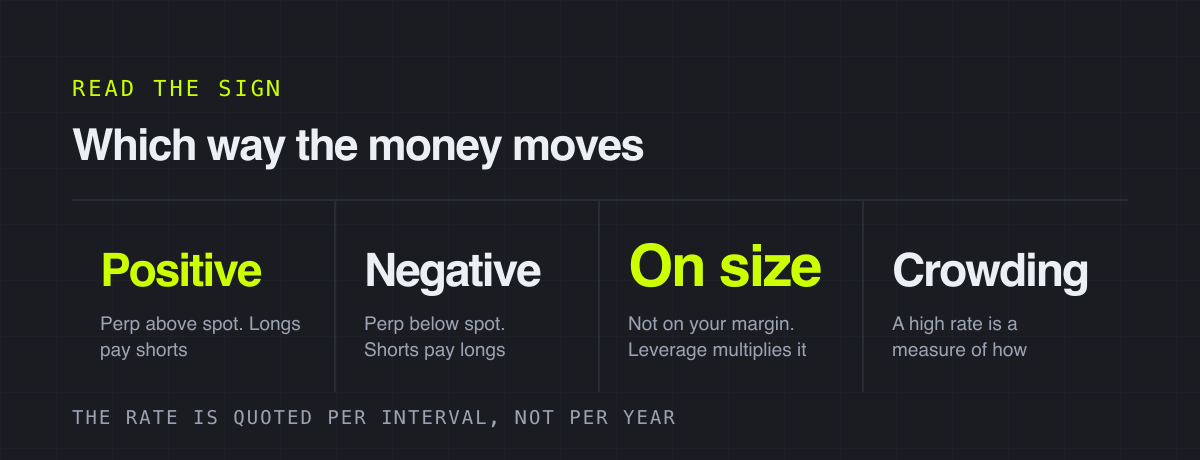
Funding is charged on the notional size of your position, not on the margin you posted. At ten times leverage, a rate that looks like a rounding error against your collateral is ten times that against your collateral.
Held across several intervals, in a market that is heavily one-sided, this stops being a detail. A position can be directionally correct for a week and still come out behind, entirely on funding.
Reading it as a signal
A persistently high positive rate means the long side is crowded enough to pay for the privilege. That is information: it tells you how the book is positioned, and crowded books unwind faster than balanced ones. It is not a timing tool – crowding can persist far longer than a leveraged position can – but as a read on where the pressure sits it is one of the more honest numbers a venue publishes.
Funding rate arbitrage, and why it is not free
The trade people describe is simple: hold spot, short the perpetual against it, collect funding while carrying no directional exposure. It works, and it is how a large part of the market's yield is manufactured.
What it is not is riskless. The rate can flip while you hold. The short leg needs margin and can be liquidated on a wick even though your spot leg is fine. Two venues means two counterparties. And the returns are quoted from periods when funding was high, which is precisely when everyone else is doing the same trade.
Before you hold a perp overnight
- Find the current rate and the interval, and multiply them out for the time you intend to hold.
- Compute the cost against your position size, not against your margin.
- Check the sign. Being paid to hold a position changes the calculation entirely.
- Look at how long the rate has been where it is – a spike and a fortnight of crowding are different situations.
- Decide whether the move you expect is bigger than the funding you will pay waiting for it.
FAQ
Who pays the funding rate?
Traders pay each other. When the perpetual trades above spot the rate is positive and longs pay shorts; when it trades below, shorts pay longs. The venue is not the recipient – it is a transfer between the two sides of the book.
Is a high funding rate bullish or bearish?
It tells you the long side is crowded, not what happens next. Crowded positioning unwinds faster when it turns, so a persistently high rate is a measure of fragility rather than a signal to fade. It can stay high for a long time.
How much does funding actually cost?
It is charged on position size rather than on your margin, so leverage multiplies it directly. Take the rate, multiply by the number of intervals you will hold, and apply it to the notional – at high leverage the result is frequently larger than traders expect.
More from the blog
Is Crypto Arbitrage Profitable? Yes, and Not for You
The opportunity is real and it is measured in milliseconds. By the time a price difference is visible on a screen, it has been taken.
What a DEX Aggregator Does, and When It Costs You
It searches every pool for the best route and splits your trade across them. That is worth real money on a large order and worth nothing on a small one.
Token Approvals: The Permission You Forgot You Gave
Every swap asks for permission to move a token, and most of those permissions are unlimited and permanent. They stay live long after the trade is done.