What an MEV Bot Is, and Whether One Is Eating Your Trades
Not a hacker and not a bug. A category of profit that exists because somebody chooses the order of transactions – and on this chain, that somebody is not an open auction.
The short answer
An MEV bot is software that profits from controlling the order of transactions in a block. The three common forms are arbitrage between venues, liquidating undercollateralised loans, and sandwiching – buying in front of a visible trade and selling into the price it creates. All three depend on seeing pending transactions or on paying for position in the block. Robinhood Chain has no public mempool, which removes the sandwich vector in its usual form, because there is no queue to read. What remains is a latency race to the sequencer and the fact that ordering is decided by one party rather than an open auction.
MEV stands for maximal extractable value, which is a precise phrase for a simple idea: if you decide what order transactions go in, some orderings are worth more than others, and the difference is money. An MEV bot is software built to collect it.
It is not an attack on the chain and not a flaw in a contract. It is a consequence of the fact that somebody, somewhere, puts transactions in a sequence.
The three forms you will meet
Arbitrage
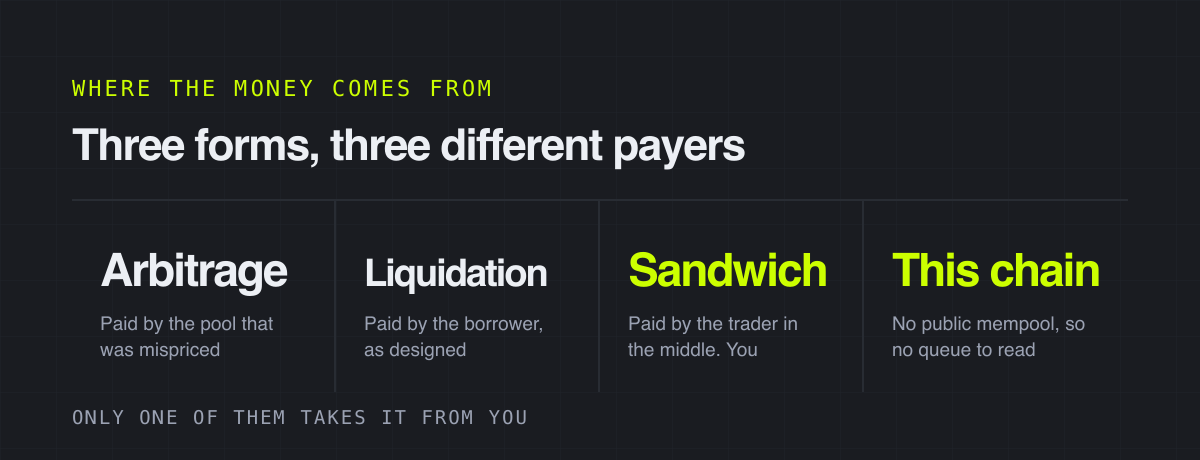
The same token trades at two prices on two venues. A bot buys on the cheap one and sells on the expensive one in a single transaction. Nobody is worse off for it – the pools were mispriced and are now not – and this is the large majority of MEV by volume.
Liquidations
A loan falls below its collateral requirement and the protocol offers a reward to whoever closes it. Bots compete to be first. The borrower pays, exactly as the protocol documented when they borrowed.
Sandwiching
This is the one people mean. A bot sees a large buy waiting to be included, places its own buy immediately in front, lets your trade push the price up, and sells into it in the same block. Your fill is worse by roughly what the bot made. You paid for it and you did not agree to.
What sandwiching needs in order to work
Two things. The bot has to see your transaction before it is final, and it has to be able to buy position in the ordering – normally by outbidding you on fees. Remove either and the attack stops being mechanical.
On most chains both are available. Pending transactions sit in a public mempool that anyone can read, and priority fees are an open auction for placement.
Why this chain is different
Robinhood Chain does not have a public mempool. Transactions go to the sequencer and are ordered there; there is no queue sitting in the open for a bot to watch, and no priority-fee auction to win. The classic sandwich, which depends entirely on reading that queue, does not have its input.
This is worth knowing precisely rather than approximately, because a great deal of advice written for other chains assumes a mempool that is not here. Slippage guidance framed as anti-sandwich protection is solving a problem that arrives in a different shape.
What you have instead
- A latency race. Being early is still worth money, and it is now a question of who reaches the sequencer first rather than who pays most.
- Trust in one ordering party. Private ordering means the decision is made somewhere you cannot audit, which is a different risk, not the absence of one.
- Ordinary slippage. Your trade still moves the price on a thin pool, and that cost has nothing to do with bots.
- Launchpad-level defences. Some launch mechanisms tax the opening block heavily on purpose, which addresses the first-buyer race directly.
So is a bot eating your trade?
If you are getting a worse price than the screen showed, the likeliest explanations in order are: the pool is thinner than you assumed, your slippage tolerance was set wide enough to absorb it, or the price genuinely moved between your click and inclusion. On a chain without a public mempool, a sandwich is far down that list – which makes it the wrong first thing to blame and the wrong first thing to fix.
FAQ
Is running an MEV bot illegal?
Arbitrage and liquidations are ordinary market activity and are explicitly rewarded by the protocols involved. Sandwiching is more contested and has drawn enforcement attention in some jurisdictions where it combined with other conduct. This is a description of how the mechanism works, not legal advice.
Can you protect yourself from sandwich attacks?
On chains with a public mempool, by using private transaction routing and by keeping slippage tight enough that the attack is unprofitable. On a chain without one, the vector is largely closed already – the price movement you see is more likely to be pool depth than a bot.
Does Robinhood Chain have MEV?
It has arbitrage and liquidations, which exist wherever there are multiple venues and lending markets. What it lacks is the public mempool that classic sandwiching reads, so that specific form does not have its usual input. Ordering is decided by the sequencer instead of by an open fee auction.
More from the blog
Do You Pay Tax on Memecoin Trades? What Creates an Event
Not advice, and not jurisdiction-specific. A description of which onchain actions tax authorities generally treat as events, and what records you will need if yours does.
A Trading Journal for Onchain Trades: What to Record
The chain already logs every transaction you made. What it cannot log is why you made it, and that is the column the journal exists for.
Paper Trading Memecoins When No Paper Mode Exists
There is no demo account on a DEX. Here is how to practise anyway – and the one thing simulation can never teach you.