Robinhood Chain Memecoins: How a Stock-Token Chain Became a Casino
CASHCAT, stock-paired tokens and 167,000 launches. What actually happened, and how people trade it.
The short answer
Robinhood Chain was built for tokenized real-world assets, but memecoins drove most of its early activity. CASHCAT was the first breakout — named after the original working name for Robinhood — followed by tokens like VLAD, HOOD and CHAD. New tokens launch mainly through bonding-curve launchpads, with PONS the largest at 167,000+ tokens and roughly $4 billion in cumulative trades. The chain's native twist is stock-paired tokens: memecoins launched against Robinhood Stock Tokens like TSLA or NVDA, which exist on no other chain.
Robinhood announced a chain for tokenized equities and real-world assets. Within days, the thing pulling users in was memecoins. That gap between design intent and actual usage is the most interesting fact about Robinhood Chain, and it is worth understanding before you trade there.
CASHCAT and the first wave
The first genuine breakout was CASHCAT, whose name references 'Cash Cat' — the working name the Robinhood founders considered before settling on Robinhood. It became the number-one trending token by weekly volume on Uniswap and later got perp listings on Lighter with 3x leverage.
Others followed: VLAD, HOOD, CHAD, then ROBINCAT and Fatcoin with multi-hundred-percent runs, and an AMC-themed token that reached a nine-figure market cap. The pattern is familiar to anyone who has traded a new chain — early tokens trade on chain-identity references rather than any claim to utility.
Where the tokens come from
Almost everything launches through a bonding-curve launchpad. Tokens start trading against a formula-priced curve; once enough has been bought, accumulated liquidity deploys into a real AMM pool — usually Uniswap — and the token 'graduates'.
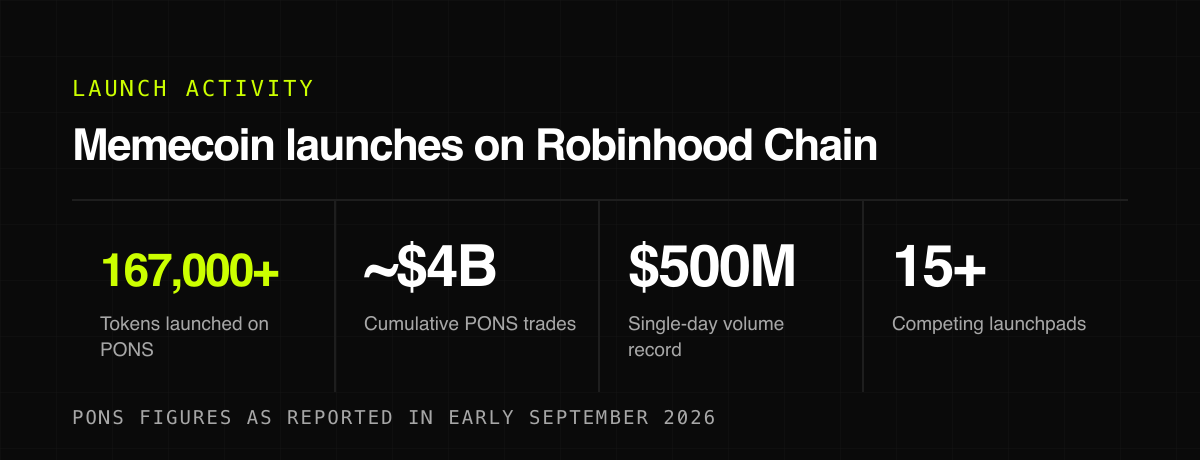
- PONS — the largest by a distance. 167,000+ tokens live, fixed supply, locked Uniswap V3 liquidity, non-custodial. It posted a $500 million single-day volume record with roughly $4 billion cumulative.
- hood.fun — free launches, gas only, no platform fee, with anti-snipe and community-takeover mechanics.
- pools.trade — Uniswap Labs' own launch flow, issuing straight into a pool.
- Long — memecoins paired against stock tokens; $15M+ volume with $710K in stock TVL.
- Bankr — stock-paired launches against TSLA, AAPL or SPY.
The stock-paired trade is the chain's real novelty
This is the part that exists nowhere else. Because Robinhood Stock Tokens are standard ERC-20s, a memecoin can be launched paired directly against NVDA or TSLA rather than against ETH or a stablecoin. Your memecoin position then carries embedded equity exposure, and the pair's price action reflects both.
How people actually trade it
- Watch a launch radar or the new-pairs feed rather than social media — by the time a ticker is in your timeline, the first leg has usually run.
- Run the contract through a scanner for mint and blacklist permissions, liquidity lock and honeypot behaviour.
- Check holder clustering. A supply that looks distributed is often one entity across many wallets.
- Size for a total loss. On a chain producing thousands of tokens a day, most go to zero, and the ones that do not are not identifiable in advance.
The tooling for all four steps exists on the chain now — screeners, scanners, holder maps and terminals. What does not exist is an edge from simply being early to Robinhood Chain; that window closed in July.
What the launch numbers actually tell you
A launchpad reporting 167,000 tokens is not reporting 167,000 opportunities. On every chain that has run this pattern, the distribution of outcomes is brutally skewed: the overwhelming majority of tokens never graduate the bonding curve, a small fraction reach a real pool, and a handful produce the returns that get screenshotted.
The useful reading of that number is different. It tells you the cost of launching is near zero, which means supply is effectively infinite and attention is the only scarce input. Any strategy that assumes scarcity of tokens is built on a false premise.
The lifecycle, and where money is made and lost
- Deployment — the contract exists but has no pool. Visible on the explorer, invisible to screeners.
- Curve — trading against a formula price. Early buyers are early by definition, and the deployer usually holds the largest position.
- Graduation — accumulated liquidity deploys into a real AMM pool. This is the moment most screeners first surface the token.
- Open market — price is now set by flow rather than formula. This is where most retail participants enter and where the first cohort exits.
The structural observation: by the time a token is discoverable through the channels most people use, it has already passed through the stages where the asymmetry lived. That is not a reason to avoid trading them. It is a reason to be honest about which stage you are entering at.
Why this chain's memecoins behave differently
Two things make Robinhood Chain memecoins structurally unlike Solana's. The first is the stock-paired mechanic, which gives some tokens a second price driver that has nothing to do with crypto sentiment. The second is the user base — a chain attached to a brokerage with more than 23 million customers brings in participants whose reference point is equities, not memecoins.
Whether that makes the market easier or harder depends entirely on whether you think an audience new to on-chain trading is a source of liquidity or of competition. It is worth deciding which view you hold before sizing anything.
Tools mentioned
 Uniswap
 Lighter
 PONS
PONS Robinhood Stock Tokens
FAQ
What was the first big Robinhood Chain memecoin?
CASHCAT, named after 'Cash Cat' — the name Robinhood's founders considered before choosing Robinhood. It became the top trending token by weekly volume on Uniswap and later received perp listings on Lighter.
What is a stock-paired memecoin?
A memecoin launched with its liquidity pair being a Robinhood Stock Token such as TSLA, NVDA or AAPL instead of ETH or a stablecoin. It gives the position embedded equity exposure and is unique to Robinhood Chain.
Which launchpad is biggest on Robinhood Chain?
PONS, with 167,000+ tokens launched, roughly $4 billion in cumulative trades and a $500 million single-day volume record. It uses fixed supply with locked Uniswap V3 liquidity.
How do I find new Robinhood Chain tokens early?
Use a launch radar or the Dexscreener new-pairs feed filtered to the chain, and set alerts on liquidity added above a threshold. Blockscout's token list is the rawest possible signal.
More from the blog
How to Find a Wallet Worth Copying on Robinhood Chain
Leaderboards rank by total profit, which is mostly size and luck. Five checks that separate a repeatable edge from one lucky position.
Is Copytrading Profitable? The Arithmetic Nobody Runs First
Copytrading pays you the leader's return minus four deductions. Here is what each one costs, and the win rate a wallet needs before following it makes money.
Copytrading vs Trading Yourself: Which Actually Suits You
One rents someone else's research at a fixed price. The other charges you in time instead of fees. The honest comparison on cost, control and what you learn.