Where Tokenized Stocks Trade, and Why the Venue Decides
The same ticker exists on several chains as several different instruments. What you can do with it depends entirely on which one you bought.
The short answer
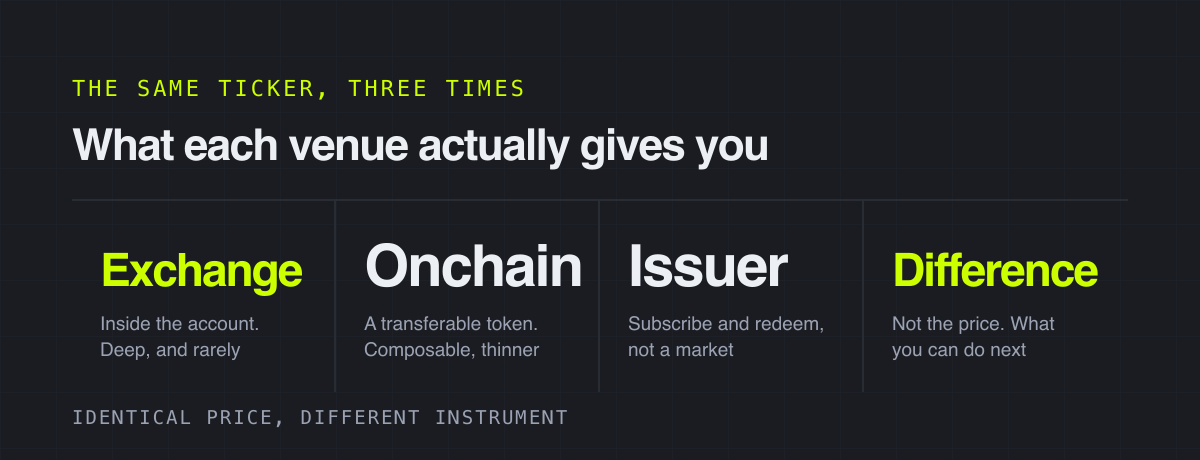
Tokenized equities exist in three places and they are not interchangeable. On a centralised exchange they are an internal product, tradable inside the account and rarely withdrawable. On a chain they are transferable tokens with a wallet, a pool and composability, which is where Robinhood Chain's stock tokens sit. And through issuers directly they are a fund-like structure with subscription and redemption rather than a market. The ticker is the same in all three; the liquidity, the restrictions and what you can do with the position afterwards are not, and the last of those is usually what people did not check.
Searching for a tokenized stock returns several venues offering what looks like the same thing, and the price is indeed the same. Everything else about them differs, starting with whether the token can leave the place you bought it.
On a centralised exchange
Listed as a tradable product inside the account, usually with the deepest book of the three because the exchange makes the market itself. What you generally cannot do is withdraw it to a wallet: it is an internal balance, and the tokenization is an implementation detail rather than something you hold.
Fine for trading. Not useful for anything else, because everything else requires the token to move.
On a chain
A transferable token in your own wallet. Thinner than an exchange book, and in exchange the position can do things: sit in a liquidity pool, be pledged as collateral, be paired against something else, be moved to another address at two in the morning.
Robinhood Chain is the case where this is the consumer product rather than an institutional one – stock tokens as ordinary ERC-20s in the same wallet as everything else, which is how a memecoin ends up quoted against an equity in a single  Uniswap pool. That arrangement exists nowhere in traditional markets, and it is the reason the chain is interesting rather than merely another venue.
Directly from an issuer
Subscription and redemption rather than a market: you buy from the issuer and sell back to the issuer, on their schedule and at their minimum. Frequently restricted to qualified or non-US investors. There is no spread to pay and no pool to worry about, and equally no way out between redemption windows.
What actually differs
| Exchange | Onchain | Issuer | |
|---|---|---|---|
| Withdrawable | Usually not | Yes, that is the point | To an allowlisted address |
| Liquidity | Deepest | Pool depth, varies by ticker | None – you redeem instead |
| Hours | Continuous | Continuous | Redemption windows |
| Usable as collateral | Inside that venue | Anywhere onchain | Rarely |
| Who you are exposed to | The exchange | The issuer and the pool | The issuer |
| Access | An account | A wallet | Eligibility checks |
The question that picks the venue
Not where is it cheapest, but what do I intend to do with it after buying. Holding a directional view for a month makes the deepest book correct. Using the position as collateral, pairing it in a pool, or hedging something else onchain makes the transferable token the only option that works at all. And if the answer is that you want a large position and never intend to move it, the issuer route avoids both spreads.
One thing to check on any of them
Weekend pricing, which  StalkChain Stock Premium Tracker exists to watch. Tokenized equities trade when the underlying market is shut, so the price over a weekend is whatever the pool or the book says rather than a quote anchored to anything. That gap is a real feature for anyone reacting to news on a Saturday, and a real hazard for anyone assuming a tokenized share is priced the way the share is.
Tools mentioned
FAQ
Where can you trade tokenized stocks?
Three places: inside a centralised exchange as an internal product, onchain as a transferable token in your own wallet, or directly with an issuer through subscription and redemption. The price is much the same across them; what you can do with the position afterwards is not.
Can you withdraw tokenized stocks from an exchange?
Usually not. On most centralised venues the tokenization is internal plumbing and the balance stays in the account, which means none of the onchain uses – collateral, pools, transfers – are available to it.
Why trade tokenized stocks onchain instead of on an exchange?
Composability, and nothing else. An exchange book is deeper. A token in your wallet can be collateral, sit in a liquidity pool, or be paired against another asset – and on a chain where stock tokens and memecoins share the same pools, that produces positions traditional venues have no equivalent for.
More from the blog
Social Trading vs Copy Trading: Not the Same Thing
One shows you what people are doing and leaves the decision with you. The other takes the decision away. That difference is the entire product.
Reading a Memecoin Community Before You Buy Into It
A busy Telegram is not demand. Four things separate a community from a room that was paid to look like one.

RWA Tokens: What Is in the Basket, and What It Owns
Every list of real-world-asset tokens mixes three unrelated things. Sorting them takes one question, and most lists never ask it.