The Dev Wallet: What the Deployer's Address Tells You
One address explains more about a launch than the chart, the site and the Telegram combined. It is public, and almost nobody opens it.
The short answer
The dev wallet is the address that deployed the contract. It tells you what the deployer holds, where their funding came from, and what they have launched before – which together predict a launch's behaviour better than any other single input. All of it is readable on an explorer in a few minutes.
Every token has a deployer, the address that paid gas to put the contract onchain. It is stamped on the contract permanently, it is the first thing an explorer shows you, and it is the single most informative piece of data about a launch. Most people never look at it.
What the deployer holds
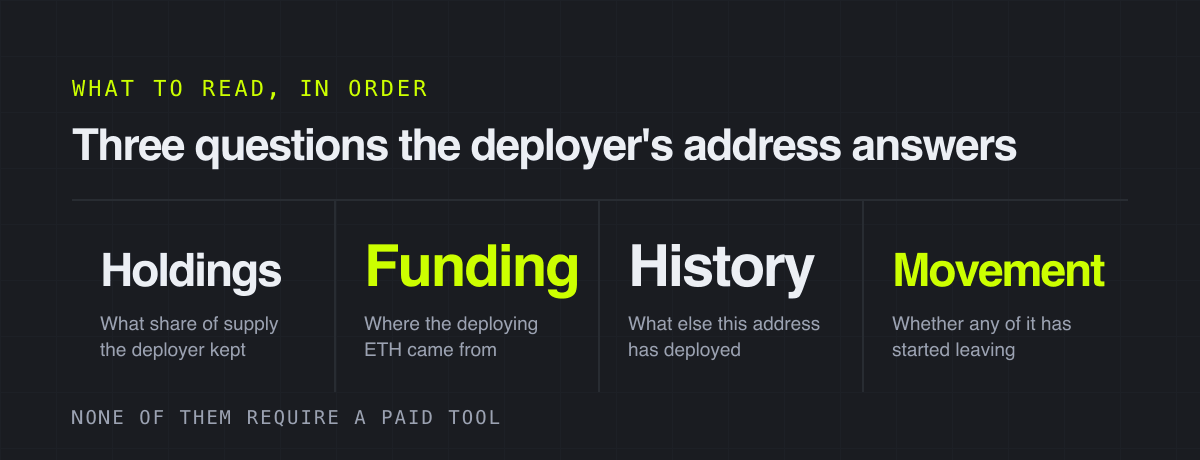
Start with the obvious question. Does the deploying address still hold tokens, and how many as a share of supply? A deployer with nothing is either trustworthy or using different wallets, and telling those apart is the next step. A deployer holding a large share has an exit that is larger than the market.
Note this is not the same question as whether the launch was bundled. Bundling spreads the position across many addresses; this is the one address that is definitely theirs.
Where the gas came from
This is the part that repays the effort. The deploying address needed ETH, and that ETH came from somewhere – a bridge, an exchange withdrawal, or another wallet. Follow it back one or two hops and you frequently land on an address with a history.
 Blockscout Explorer shows the incoming transactions on any address, and
  Bubblemaps does the clustering step automatically – it draws wallets that share a funder as one group, which is exactly the relationship worth knowing.
What else they have launched
A deployer address with previous contracts is a track record, and it reads in both directions. Someone who has launched three tokens that still trade is a different proposition from someone whose previous three went to zero within a week of the deployer selling.
| What you find | What it usually means |
|---|---|
| First deployment, funded from an exchange | A genuine first-timer, or someone being careful |
| First deployment, funded by a serial deployer | The same operation wearing a new address |
| Several previous launches, all dead | A production line, and you are the customer |
| Several previous launches, some alive | The best signal available, and rare |
Watching it afterwards
The deployer's position is not static, and the moment it starts moving is the most actionable information in the whole memecoin market. Selling, transferring to a fresh address, or splitting a holding across several – all of it is visible, and all of it happens before the chart reflects it.
- Put an alert on the deployer address rather than on the price.
 Cielo Finance does this into Telegram, and it is the one alert worth having.
 - Treat a transfer out as equivalent to a sale until proven otherwise – moving to a fresh wallet is how selling is made to look like holding.
- Re-check after a large move. A deployer who held through a 5x is telling you something; one who did not is telling you something louder.
- Compare their holding against what the launchpad's mechanics say they should have.
 PONS and
  hood.fun publish the split, so an excess came from buying.
What it does not tell you
A clean deployer does not make a token good. Plenty of honest launches go to zero because nobody cared, which is the normal outcome and has nothing to do with the deployer's behaviour. The address tells you about one specific risk – that the person who made the token is planning to be your counterparty – and nothing about whether anyone will want it.
Tools mentioned
FAQ
What is a dev wallet in crypto?
The address that deployed the token's contract, usually also holding whatever share of supply the creator kept. It is recorded permanently onchain and visible on any block explorer.
How do I find the dev wallet of a token?
Open the contract on a block explorer and look at the contract creation transaction – the address that sent it is the deployer. From there you can read its balance, its funding history and anything else it has deployed.
Is it bad if the dev holds tokens?
Not automatically. Some allocation is normal and on many launchpads it is disclosed. What matters is the size relative to supply, whether it was disclosed, and whether it has started moving – a transfer to a fresh wallet is usually the first step of selling.
Can a developer hide their wallet?
They can use a fresh address for each launch, but funding has to come from somewhere, and tracing the incoming ETH one or two hops often lands on an address with a history. Clustering tools do that step automatically.
More from the blog
Tracking Whale Wallets Without Mistaking Size for Skill
A large balance is evidence of a large balance. Whether it means anything about the next trade is a separate question, and usually the answer is no.
Wallet Tracking You Will Actually Read
Everyone sets up alerts. Almost nobody survives the second week, because the setup was designed to catch everything.
Risk-Reward on a Token With No Floor
The ratio assumes you know where you get out. On a DEX with no stop loss, half the formula is missing – and it is the half that matters.