Why DEX Screener's Market Cap Is Not the Number You Expect
The formula subtracts burned supply and nothing else. Which is why market cap and FDV are usually identical here, and occasionally are not.
The short answer
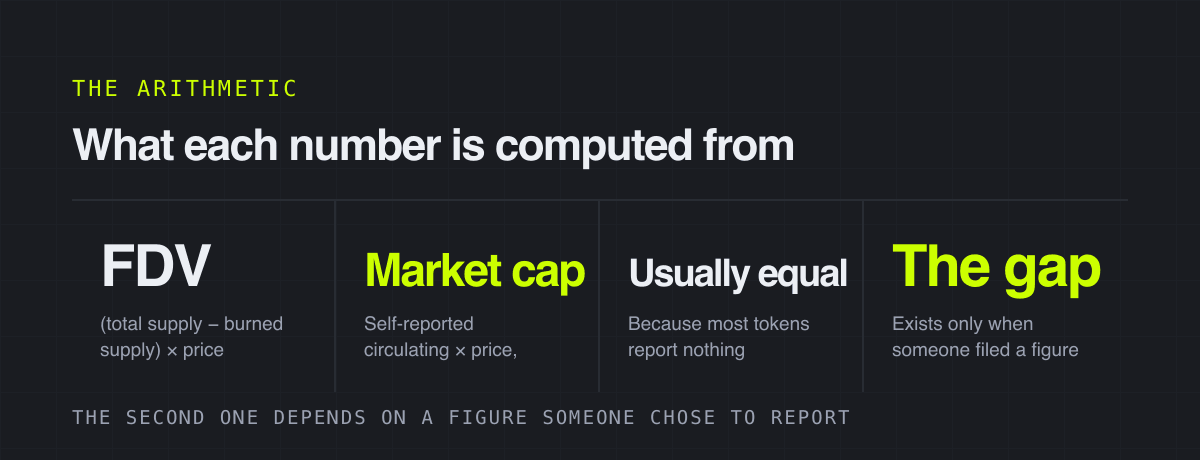
DEX Screener computes fully diluted valuation as total supply minus burned supply, times price. For tokens that do not burn uncirculated supply, it looks for a self-reported circulating figure from Enhanced Token Info or CoinGecko and uses that for market cap instead – so the two numbers match unless someone supplied the difference.
Two valuation numbers appear on a  Dexscreener token page and people assume they mean what they mean elsewhere. The documented formula is narrower than that, and knowing it explains both why they usually agree and what it means on the occasions they do not.
The formula
Fully diluted valuation is computed as total supply minus burned supply, multiplied by price. That is the whole calculation and it is derived entirely from the chain – no judgement about what is locked, vesting or held by a team.
Market cap is meant to be the circulating portion, but the chain does not know which tokens are circulating. So the platform looks for a self-reported circulating supply, from its paid Enhanced Token Info product or from CoinGecko, and uses that when it exists.
Why they usually match on memecoins
Most memecoins launch with all supply in circulation and nothing burned, so total supply minus zero, times price, is both numbers. The gap that matters on venture-backed tokens – a small float against a large locked allocation – simply does not exist here, which is why the ratio is almost always one.
That is a genuine difference between this market and the one the FDV concept came from, and it is why a memecoin's market cap is a more honest number than a venture token's.
| Situation | What DEX Screener shows | What to make of it |
|---|---|---|
| All supply circulating, nothing burned | FDV = market cap | Both are real |
| Supply burned | FDV excludes the burn | Correct, and verifiable onchain |
| Project reports circulating supply | Market cap uses the report | A claim – check it |
| Large gap between the two | A big uncirculated allocation | Future supply with a schedule |
Showing market cap on the chart
The chart can be switched between price and market cap, which is the single most useful display change available and the one people ask about most. Price on its own means nothing without supply – a token at a thousandth of a cent and one at four dollars can be the same size – and the market cap view removes that comparison problem entirely.
- Switch the chart to market cap when comparing two tokens. Price per token is not comparable across different supplies.
- If market cap and FDV differ, find where the circulating figure came from before trusting it.
- Verify a claimed burn on
 Blockscout Explorer rather than taking it from the display.
- On memecoins, expect them to be identical – and treat a gap as something to investigate.
Tools mentioned
FAQ
How does DEX Screener calculate market cap?
Fully diluted valuation is total supply minus burned supply, times price. For market cap it uses a self-reported circulating supply from Enhanced Token Info or CoinGecko when one exists, and otherwise the two figures are the same.
Why are market cap and FDV the same on DEX Screener?
Because no circulating supply was reported for that token. Most memecoins launch fully circulating with nothing burned, so the formula produces one number for both.
How do I show market cap instead of price on the chart?
The chart has a toggle between price and market cap. It is worth using whenever comparing two tokens, since price per token is meaningless across different supplies.
Is DEX Screener's market cap accurate?
The FDV is computed from onchain supply and is verifiable. The market cap figure depends on a circulating supply a project reported about itself, which is a claim rather than a measurement.
More from the blog
Prediction Markets: A Price That Looks Like a Probability
A contract paying one dollar if something happens trades at the market's estimate of it happening. The gap between that and a forecast is where the money is.
Staking, and Why There Is None on This Chain
Staking pays you for securing a network. An L2 that settles to Ethereum and charges gas in ETH has nothing for you to secure.
Multisig: Removing the Single Point of Failure
Two of three signatures to move anything. It solves theft and loss at once, and introduces a problem of its own.