Minting an NFT: What Actually Happens and What It Costs
Minting is a function call that assigns you a token id. Everything expensive about it is decided before anyone clicks.
The short answer
Minting calls a function on a contract that creates a token and assigns it to your address. You pay the mint price set by the creator plus gas, and on a competitive mint the gas can exceed the price – which is why the cost of minting is mostly a question about demand rather than about the artwork.
Minting sounds like creation and is mostly accounting. A contract exists, it has a function that creates a new token and records your address as its owner, and minting is calling that function. The art was already decided; what the transaction does is assign you a number.
What the contract does
Checks whether you are allowed to mint – an allowlist, a limit per wallet, a start time – takes payment if there is a price, increments a counter and assigns the next token id to you. The metadata linking that id to an image is usually resolved separately, which is why some mints reveal later.
The token id you receive is frequently the only thing that differentiates a good outcome from a poor one, and on a random-assignment mint it is decided by ordering you do not control.
Why gas is the real cost
On a mint with more demand than supply, everyone is submitting the same transaction at the same moment, and the way a block decides between them is price. The mint price is fixed; what you pay to be included is an auction.
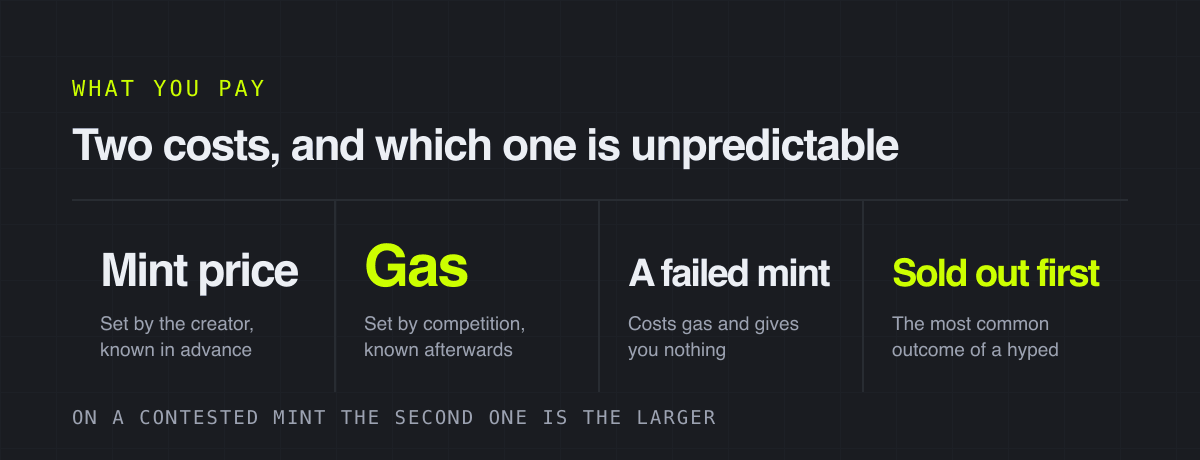
On Robinhood Chain this is less punishing than on a congested chain – gas is cheap and blocks come fast – but the structure is identical: contested supply is allocated by whoever pays to be earlier.
Failed mints
| What happened | Did you pay? | Why |
|---|---|---|
| Sold out before your transaction landed | Gas only | The counter hit the limit first |
| You were not on the allowlist | Gas only | The contract rejected the call |
| Your gas was too low | Gas only, if it reverted | You were outbid for inclusion |
| Mint succeeded | Price plus gas | The normal case |
Before you mint anything
- Read the supply and the limit per wallet. Those two numbers tell you whether this will be a gas auction.
- Verify the contract address from the project's own channel, not from a link in a reply. Fake mint pages are the most common NFT scam there is.
- Check what the mint function actually does on
 Blockscout Explorer if the contract is verified – it is usually short and readable.
- Decide what you will pay in total, gas included, before the mint opens.
- Expect to get nothing on a contested mint, and treat that as the base case rather than as bad luck.
Minting your own
Deploying a collection is cheap and the hard parts are the same as everywhere else: an audience that exists before the mint, and metadata hosted somewhere that will still be there in two years. OPENMINTZ covers the mint flow on this chain, and OpenSea lists the result.
The question worth answering first is where the images live. A collection whose metadata points at a server that stops paying its bill becomes a set of token ids pointing at nothing, and that has happened to a great many collections already.
Tools mentioned
FAQ
What does minting an NFT mean?
Calling a function on a contract that creates a new token and records your address as its owner. You pay whatever mint price the creator set, plus gas for the transaction.
How much does it cost to mint an NFT?
The mint price plus gas. On a contested mint gas can exceed the price, because everyone submits the same transaction at once and inclusion is decided by what people pay – and the gas is spent even by those who get nothing.
Why did my mint fail?
Usually because the supply sold out before your transaction landed, your address was not on the allowlist, or you were outbid for inclusion in the block. All three cost gas and deliver nothing.
What should I check before minting?
The total supply and per-wallet limit, which tell you whether this will be a gas auction, and the contract address verified from the project's own channel – fake mint pages are the most common NFT scam.
More from the blog
Prediction Markets: A Price That Looks Like a Probability
A contract paying one dollar if something happens trades at the market's estimate of it happening. The gap between that and a forecast is where the money is.
Staking, and Why There Is None on This Chain
Staking pays you for securing a network. An L2 that settles to Ethereum and charges gas in ETH has nothing for you to secure.
Multisig: Removing the Single Point of Failure
Two of three signatures to move anything. It solves theft and loss at once, and introduces a problem of its own.