The Seed Phrase: What Those Twelve Words Actually Are
Not a password. A number, written in a dictionary, from which every key you will ever have is derived.
The short answer
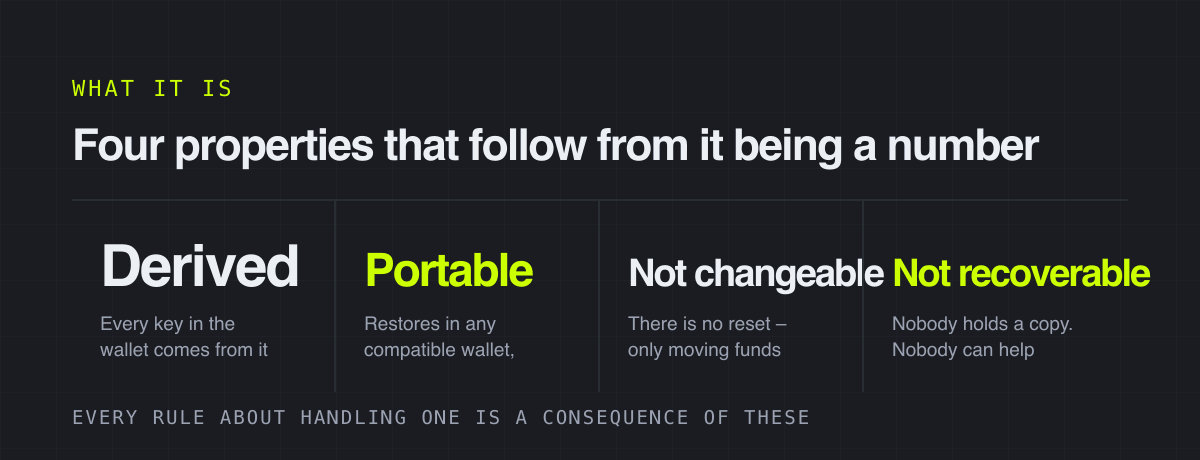
A seed phrase is a very large random number encoded as words from a fixed list. Every private key in the wallet is derived from it mathematically, which is why it restores a wallet anywhere and why anyone who reads it owns everything in it, permanently and without recourse.
People treat a seed phrase as a password with extra steps, and almost every bad decision about one comes from that. It is not a credential checked against a server. It is a number, and the keys to your funds are computed from it.
Why words
The underlying thing is random data, large enough that guessing it is not a strategy anyone can pursue. Writing that as hexadecimal invites transcription errors, so it is encoded as words drawn from a fixed list of two thousand and forty-eight, with a checksum built in – which is why an incorrectly copied phrase is usually rejected rather than silently opening an empty wallet.
The words carry no meaning and the order is part of the number. There is nothing clever hidden in which words you got.
What derivation means in practice
Every account in the wallet, on every chain it supports, comes from that one number through a defined path. That is why the same phrase restores the same addresses in a different wallet application, and why one phrase can hold funds across many chains at once.
Where phrases are actually lost
Not to sophisticated attacks. To photographs in a cloud backup, to a note in a password manager that was itself breached, to a screenshot, to typing it into a site that asked, and to a piece of paper nobody could find two years later.
| Storage | Survives | Fails to |
|---|---|---|
| Paper in one place | Most things | Fire, flood, moving house |
| Metal plate | Fire and water | Someone finding it |
| Photo on a phone | Nothing worth listing | Any cloud sync, ever |
| Password manager | Fire and loss | A breach of that manager |
| Split across locations | Most single failures | Your own memory of the scheme |
The rule that covers most cases
Written down physically, in at least two places you control, never photographed and never typed into anything except a wallet you deliberately opened to restore it. No legitimate service, support agent, airdrop claim or wallet connection ever needs it.
- Nothing legitimate asks for a seed phrase. A request for one is the attack, with no exceptions worth considering.
- Signing a transaction never requires it – that is what the wallet's own key is doing. If a site asks, close the tab.
- Keep holdings and trading funds in separate wallets with separate phrases, so one mistake is bounded.
- Test the restore once, with a small amount, before trusting a backup you have never verified.
A hardware wallet changes where the key is used, not what the phrase is – the same words still derive everything, and losing them is still final.  Rabby and
 MetaMask both show you what you are signing, which prevents a different class of mistake and none of these.
FAQ
What is a seed phrase?
A large random number encoded as words from a fixed 2,048-word list. Every private key in the wallet is derived from it, which is why entering it in any compatible wallet restores the same accounts.
Can I change my seed phrase?
No. There is no reset. If a phrase is exposed, the only remedy is creating a new wallet and moving everything to it before whoever saw the phrase does.
Is it safe to store a seed phrase in a password manager?
It survives fire and loss, and it fails if that manager is ever breached. Physical storage in two separate places you control is the version with no single online point of failure.
Will a wallet or site ever ask for my seed phrase?
No legitimate one, ever. Signing a transaction does not require it. Any prompt asking you to enter a seed phrase is the attack itself.
More from the blog
Prediction Markets: A Price That Looks Like a Probability
A contract paying one dollar if something happens trades at the market's estimate of it happening. The gap between that and a forecast is where the money is.
Staking, and Why There Is None on This Chain
Staking pays you for securing a network. An L2 that settles to Ethereum and charges gas in ETH has nothing for you to secure.
Multisig: Removing the Single Point of Failure
Two of three signatures to move anything. It solves theft and loss at once, and introduces a problem of its own.