Setting Price Alerts That You Will Still Read Next Week
An alert on every token you looked at is a notification stream. Three rules make the difference between a tool and wallpaper.
The short answer
DEX Screener supports price alerts on watchlisted pairs through its mobile app, and the free API lets you build your own into Telegram or anywhere else. The constraint is never the tooling – it is setting few enough alerts, at levels that mean something, with a decided response.
Alerts are the cheapest form of attention management available and the one most reliably wasted. The mechanism is easy – the mobile app does price alerts on watchlisted pairs, and the free API lets you build whatever you want into Telegram. The failure is never technical.
Rule one: alert on positions, not on interest
The instinct is to set an alert on everything that looked interesting. Two weeks later there are forty of them, most on tokens you decided against, and the notification you actually needed arrived between two you did not.
Alert on things you hold and things you have genuinely decided to buy at a price. Everything else is a watchlist entry, which is a different thing and does not need to interrupt you.
Rule two: pick levels that change a decision
A round number is not a level. The useful alert fires at a price where you would do something different: where you would take profit, where your thesis is wrong, where a position you wanted becomes affordable.
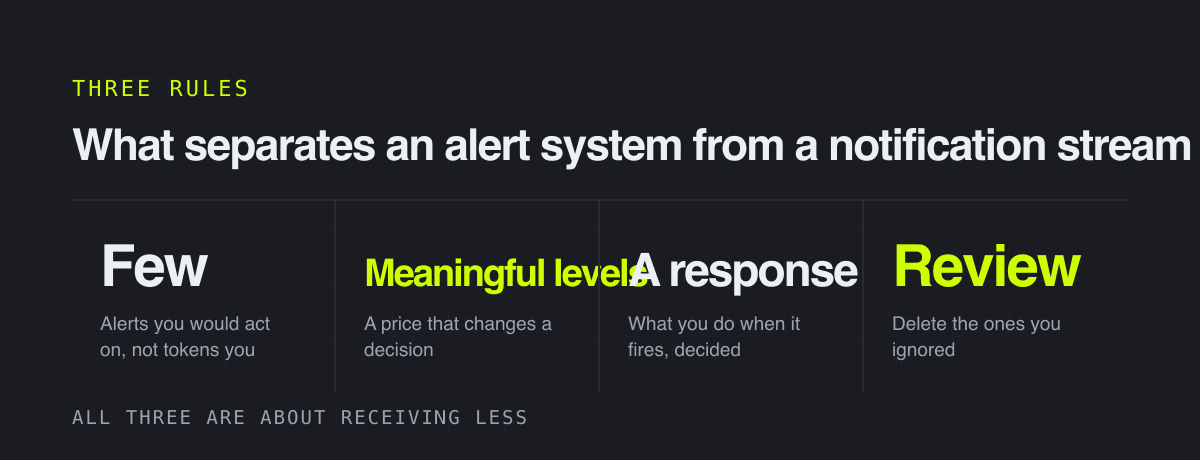
Rule three: the response is decided before
This is the whole difference. An alert that fires into an undecided mind is a prompt to improvise at the worst possible moment, because the price just moved and you are reacting to it. An alert with a written response is an instruction you issued when you were calm.
| Alert | The response that makes it useful |
|---|---|
| Take-profit level reached | Sell the decided portion. Not reconsider |
| Thesis-break level | Exit. The hardest one to honour |
| Entry level on a watched token | Buy the decided size, or skip and delete the alert |
| Large move with no level | Look. Explicitly not act |
What alerts cannot do onchain
They do not execute. There is no stop loss on a decentralised exchange, so an alert is a notification that you must act on yourself, and the gap between the alert firing and your hand reaching the keyboard is real – at night it is several hours.
That gap is the honest argument for sizing positions so that an unattended move is survivable, rather than for setting more alerts.
Building your own
- The free API plus a small script covers price thresholds into Telegram, with no key required.
- Use websockets rather than polling if you watch more than a few pairs, since rate limits are per endpoint.
- For wallet activity rather than price, this is the wrong tool –
 Cielo Finance and
 RayBot do that, and price alerts will not tell you a holder is distributing.
- Review monthly and delete every alert you ignored. They are spending attention and paying nothing.
Tools mentioned
FAQ
Does DEX Screener have price alerts?
Yes, through the mobile app on watchlisted pairs. The free API also makes it straightforward to build custom alerts into Telegram or anywhere else.
How many alerts should I set?
Only on positions you hold and prices where you would genuinely act. Alerts set on everything interesting become a notification stream that gets muted, which is worth the same as having none.
Can an alert sell for me?
No. There is no stop loss on a decentralised exchange, so an alert notifies and you execute. The gap between the two is real, and overnight it can be hours – which is an argument for smaller positions rather than more alerts.
Can I get alerts on wallet activity?
Not from a price screener. Wallet and holder alerts need a different kind of tool – a tracker that watches addresses rather than pairs.
More from the blog
Prediction Markets: A Price That Looks Like a Probability
A contract paying one dollar if something happens trades at the market's estimate of it happening. The gap between that and a forecast is where the money is.
Staking, and Why There Is None on This Chain
Staking pays you for securing a network. An L2 that settles to Ethereum and charges gas in ETH has nothing for you to secure.
Multisig: Removing the Single Point of Failure
Two of three signatures to move anything. It solves theft and loss at once, and introduces a problem of its own.