Community Takeovers: What a CTO Actually Transfers
The creator walked away and the holders kept trading. A CTO formalises that, and the thing it moves is the revenue.
The short answer
A community takeover is when holders continue a coin the original creator abandoned, and platforms formalise it by transferring the creator fee stream and the social profile to a new party. It transfers revenue and control of the listing – it does not transfer the contract, the supply, or anything the original creator still holds.
Coins outlive their creators routinely. Someone launches, loses interest within a week, and stops posting – while a group of holders keeps trading it, makes graphics, runs the chat and behaves like the project team. A community takeover is the formal version of that, and it moves a specific and limited set of things.
What it transfers
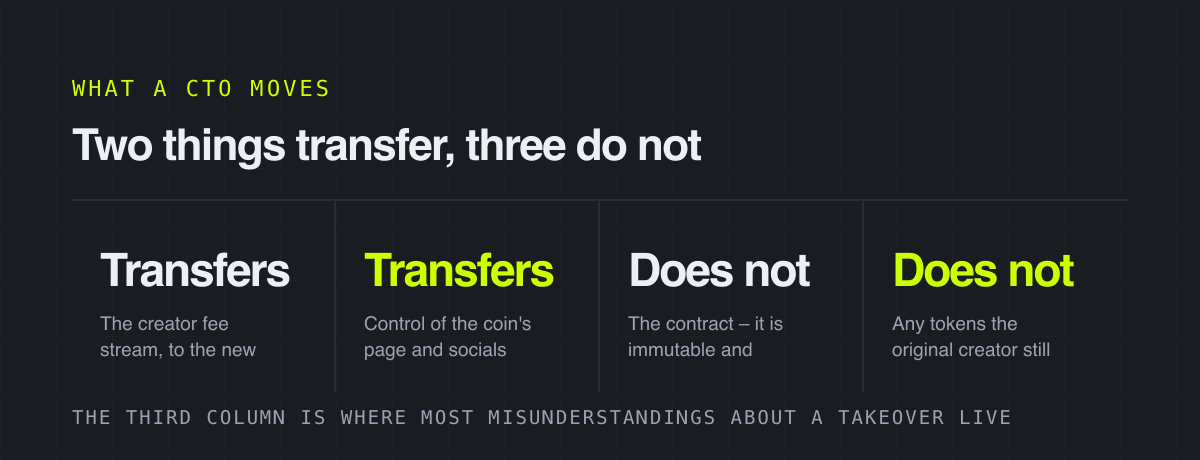
Two things. The creator fee stream – the share of trading volume that was routing to the original deployer – is reassigned. And control of the coin's page and its social links moves to whoever took over, which is what lets a takeover look official rather than like a fan account.
That first part is the substance. A takeover without the fee transfer is a group of people volunteering; with it, the people doing the work are the people being paid for the volume they generate.
What it does not transfer
The contract. A deployed token is immutable, and a takeover does not and cannot change its code, its supply, or its behaviour. Whatever the original creator wrote is what the token still is.
Why platforms formalise it
Because the alternative is worse. Without a process, a takeover is a claim anyone can make, and the coin's page keeps pointing at an abandoned account while three different groups say they are the real team. An application process with a transfer at the end produces one answer.
It also keeps the fee revenue attached to whoever is generating the volume, which is the same incentive logic that made creator fees worth having in the first place.
| Question | Answer after a CTO |
|---|---|
| Who receives creator fees | The new party |
| Who controls the coin's page | The new party |
| Has the contract changed | No – it cannot |
| Does the original creator still hold tokens | Whatever they held, they still hold |
| Is the coin now safe | Unrelated question |
How to read one as a buyer
- Check what the original creator's wallet still holds –
 Bubblemaps shows it and any wallets funded alongside it. That position did not move and it is the largest overhang.
- Read the contract yourself rather than assuming the takeover improved anything – it is the same code it always was.
- Look at whether the new party has done anything beyond the announcement. A takeover is a claim until there is work behind it.
- Treat the fee transfer as the real signal: someone thought the volume was worth applying for.
The honest assessment
A takeover is a genuine second life for a coin, and several of the larger memecoins in existence are running on one. It is also frequently a relaunch of marketing around an asset whose fundamental situation – supply concentration, an absent creator holding tokens – has not changed at all.
The distinction is visible in the wallets rather than in the announcement, which is where it always is.
Tools mentioned
FAQ
What is a CTO on Pump.fun?
A community takeover – a formal process by which holders who continued an abandoned coin receive the creator fee stream and control of the coin's page and social links.
Does a CTO change the token contract?
No. A deployed contract is immutable, so its code, supply and behaviour are exactly what the original creator wrote. A takeover changes who gets paid and who controls the listing, nothing more.
Do the original creator's tokens transfer in a CTO?
No. Whatever position they held when they walked away, they still hold afterwards – which makes that wallet the largest overhang on any coin that has been taken over.
Is a coin better after a community takeover?
Sometimes genuinely, when the new party does real work and the fee revenue funds it. Often it is new marketing around an unchanged situation. The difference shows in the wallets rather than in the announcement.
More from the blog
Prediction Markets: A Price That Looks Like a Probability
A contract paying one dollar if something happens trades at the market's estimate of it happening. The gap between that and a forecast is where the money is.
Staking, and Why There Is None on This Chain
Staking pays you for securing a network. An L2 that settles to Ethereum and charges gas in ETH has nothing for you to secure.
Multisig: Removing the Single Point of Failure
Two of three signatures to move anything. It solves theft and loss at once, and introduces a problem of its own.