Impermanent Loss: The Number That Decides LP Farming
Not a fee and not a hack – arithmetic. Providing liquidity pays you in trading fees and charges you for the price moving, and only one of those is visible while it happens.
The short answer
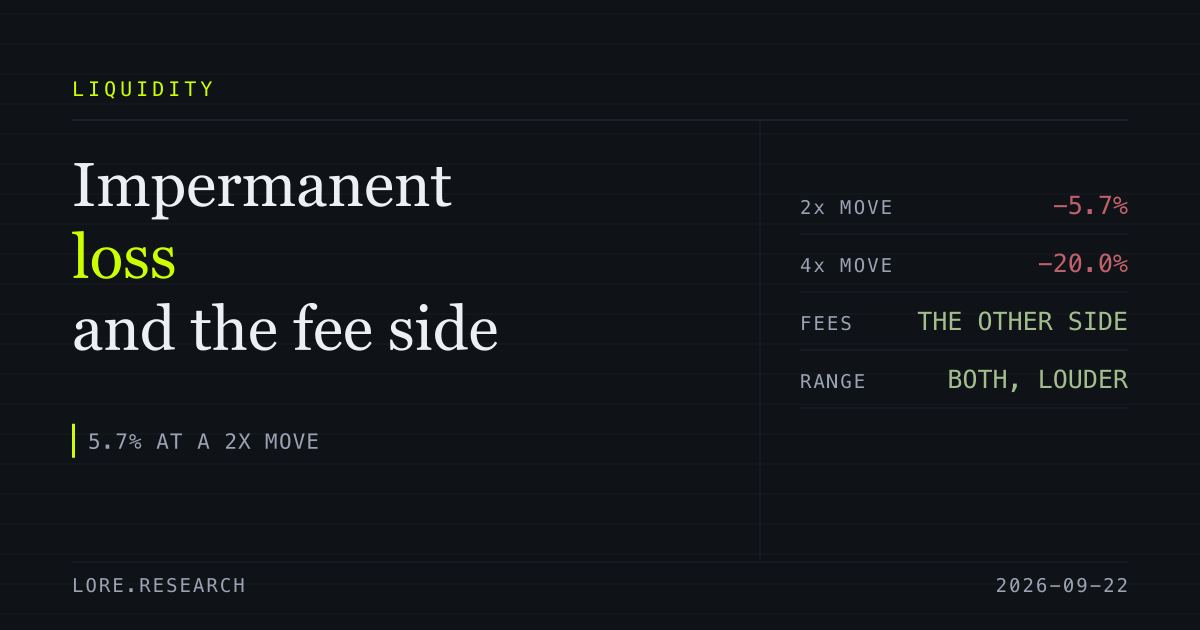
Impermanent loss is the gap between holding two tokens and putting them in a liquidity pool. As the price ratio moves, the pool automatically sells you out of the token that is rising and into the one that is falling, so you end up with less value than simply holding – 5.7% down at a 2x move, 20% at 4x, 42.5% at 10x. It is called impermanent because it reverses if the price returns, and it becomes permanent the moment you withdraw. Against it sits fee income: you earn a share of every swap through the pool. Providing liquidity is profitable when fees earned exceed divergence over the period you were in.
Impermanent loss is the most feared and least calculated number in liquidity provision. It is not a fee anyone charges and not a flaw in a contract – it is what falls out of the arithmetic when an automated market maker rebalances a position you own.
What actually happens to your position
You put two tokens into a pool in some ratio. Traders arrive and swap against it. Every buy of token A takes A out of the pool and puts B in, and the pool's price moves accordingly. You never chose to trade, but your share of the pool now holds a different mix.
The direction is always the same and always uncomfortable: the pool sells you out of whatever is rising and buys you into whatever is falling. That is not a bug, it is the entire mechanism – the pool is the counterparty to every trade, and traders buy the thing going up.
The numbers, for a standard 50/50 pool
| Price ratio moves | You end up below holding by |
|---|---|
| 1.25x | 0.62% |
| 1.5x | 2.02% |
| 2x | 5.72% |
| 3x | 13.40% |
| 4x | 20.00% |
| 5x | 25.46% |
| 10x | 42.50% |
Two things worth reading off that table. It is symmetrical – a halving costs the same as a doubling, because what matters is the ratio, not the direction. And it is gentle at first and brutal later: a 1.5x move costs two percent, which fees can cover easily, while a 10x move costs more than forty, which they mostly cannot.
The other side: fees on volume
Nobody provides liquidity for the losses. Every swap through the pool pays a fee, and that fee is distributed to whoever supplied the liquidity it traded against. On Uniswap that is 0.05%, 0.30% or 1% depending on the pool's tier, and on a memecoin pair it is usually the top of that range.
The rate at which that accrues depends on one ratio: how much volume the pool does relative to how much liquidity sits in it. A pool with half a million in liquidity doing fifty thousand a day at 0.3% pays about 11% a year. The same pool doing two hundred thousand a day pays about 44%. A thin, violently traded memecoin pool at the 1% tier can print numbers that look absurd – and the reason it can is the same reason the divergence side is about to be enormous.
Concentrated liquidity makes both sides louder
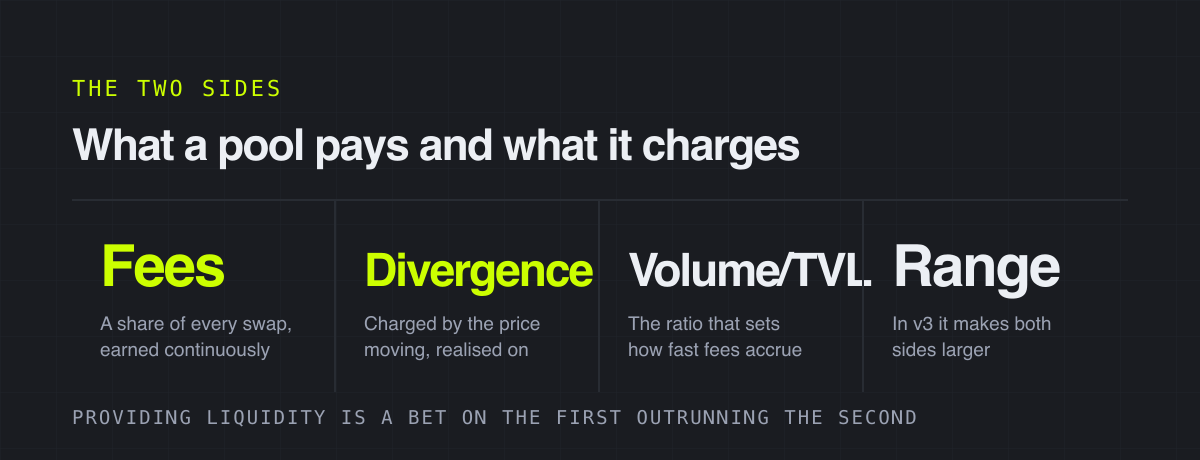
Uniswap v3 and v4 let you choose a price range instead of supplying across all prices. Inside your range, your capital does the work of a much larger v2 position, so fees per dollar go up sharply. Outside it, you earn nothing at all and hold entirely the wrong token.
This is the trade that defines modern LP farming. A narrow range multiplies fee income and multiplies divergence, and it stops paying the moment price leaves. A wide range earns less and survives more.
Which is why people build ladders
Rather than one range, several: a row of positions across a span of prices, so that some are always in range and the ones behind the move keep earning. It spreads the fee income, softens the cliff at the edge of a single range, and turns a single guess about where price will sit into a distribution.
Doing that by hand on Uniswap means opening and tracking each position separately, which is why the tooling exists. Liquidity Ladder builds and manages ladders of up to fifty positions from a browser or a phone, with PnL across the whole set rather than per position. Zenith LP does a lighter version of the same job from a Telegram chat, which suits a position you want to open and check on rather than actively manage.
When LPing is and is not worth it
- Correlated pairs – a stablecoin against another stablecoin, or an asset against its wrapped version – barely diverge, so almost any fee income is profit.
- A blue chip against ETH diverges moderately and trades heavily. This is where the maths usually works.
- A memecoin against ETH is the hard case: divergence is unbounded and fees have to be extraordinary to cover a move that can be 10x in a week.
- A pool nobody trades pays nothing while still charging you for every price move. Low volume with high volatility is the worst combination there is.
- Your own exit matters too. Withdrawing during the move locks the loss in at its widest point.
How to actually judge a pool before entering
- Read volume against liquidity, not volume alone. The ratio is what sets the fee rate.
- Read the fee tier. The same volume pays three times more at 1% than at 0.3%.
- Decide the range you believe in, then check the divergence cost at both of its edges on the table above.
- Compare that cost against the fee income the volume/TVL ratio implies over the period you intend to stay.
- Assume you will be out of range some of the time, and discount the fee estimate accordingly.
If the fee estimate does not comfortably beat the divergence at the edges of your range, the position is a bet on the price staying still. That is a legitimate bet, and it is worth making on purpose rather than discovering afterwards that it was the bet you made.
Tools mentioned
 Uniswap
 Liquidity Ladder
 Zenith LP
FAQ
What is impermanent loss in simple terms?
It is how much less you end up with by putting two tokens in a liquidity pool instead of just holding them. As the price ratio moves, the pool sells you out of the rising token and into the falling one – about 5.7% behind holding at a 2x move, 20% at 4x, and 42.5% at 10x.
Is impermanent loss permanent?
Only when you withdraw. While your liquidity is still in the pool the gap closes again if the price ratio returns to where you entered, which is why it is called impermanent. Exiting turns it into a realised loss at whatever the gap is that day.
How do you avoid impermanent loss?
You cannot remove it – it is arithmetic, not a fee. You can make it small by choosing pairs that barely diverge, and you can outrun it with fee income by choosing pools where trading volume is high relative to the liquidity in them. Everything else is a trade between those two.
Does concentrated liquidity increase impermanent loss?
Yes, and it increases fee income by the same mechanism. A narrow range on Uniswap v3 or v4 concentrates your capital so it earns far more per dollar while price sits inside it, diverges faster when price moves, and earns nothing at all once price leaves the range.
More from the blog
Is Crypto Arbitrage Profitable? Yes, and Not for You
The opportunity is real and it is measured in milliseconds. By the time a price difference is visible on a screen, it has been taken.
What a DEX Aggregator Does, and When It Costs You
It searches every pool for the best route and splits your trade across them. That is worth real money on a large order and worth nothing on a small one.

Token Approvals: The Permission You Forgot You Gave
Every swap asks for permission to move a token, and most of those permissions are unlimited and permanent. They stay live long after the trade is done.